The short answer
Architect fees in Miami run about $4,450 to $10,050 to design a 600 square foot ADU and $3,700 to $27,900 for a 2,500 square foot new home. Building a 600 square foot detached ADU here costs roughly $83,700 to $139,500. Before design starts, check whether your lot is in the High-Velocity Hurricane Zone and the floodplain. Both change the drawings and the permit.
What architects and ADUs cost in Miami
These figures start with national cost data and apply the Miami cost factor of 0.93 from the U.S. Army Corps of Engineers Area Cost Factors. Design fees and build costs are listed separately because you usually pay the architect months before a builder starts.
| Job | Miami (typical range) | US average |
|---|---|---|
| Architect fees, ADU (600 sq ft) | $4,450–$10,050 | $4,800–$10,800 |
| Architect fees, addition (500 sq ft) | $2,800–$7,000 | $3,000–$7,500 |
| Architect fees, new home (2,500 sq ft) | $3,700–$27,900 | $4,000–$30,000 |
| 3D rendering package | $745–$3,000 | $800–$3,200 |
| Prefab ADU, 600 sq ft, built | $44,650–$89,300 | $48,000–$96,000 |
| Garage conversion ADU, 600 sq ft | $27,900–$111,600 | $30,000–$120,000 |
| Attached ADU, 600 sq ft | $69,750–$125,550 | $75,000–$135,000 |
| Detached ADU, 600 sq ft | $83,700–$139,500 | $90,000–$150,000 |
| ADU above a garage, 600 sq ft | $111,600–$279,000 | $120,000–$300,000 |
| Land survey | $370–$1,650 | $400–$1,800 |
Estimates for 2026, including labor and standard parts. Miami prices use the metro's construction cost factor of 0.93 (US average = 1.00) from the U.S. Army Corps of Engineers Area Cost Factors. Your quote depends on access, materials and the condition of the home.
The cost estimator below shows design fees and weeks to permit for your project type and ZIP code. The architecture cost estimator page has a longer version.
How Miami architects charge
Residential architects commonly charge a percentage of construction cost, a price per square foot, or an hourly rate, and the fee is usually split by phase:
| Phase | Share of the fee | What you get |
|---|---|---|
| Schematic design | 20% | Layout options, massing, early cost check |
| Design development | 10% | Materials, windows, structure and systems |
| Construction documents | 40% | The permit set and the drawings builders price |
| Bidding | 5% | Help comparing builder bids |
| Construction administration | 25% | Site visits and answers during the build |
Floodplain lots, HVHZ product schedules and city design review push the fee toward the top of each range. The architecture pillar page compares fees across project types.
What the build costs
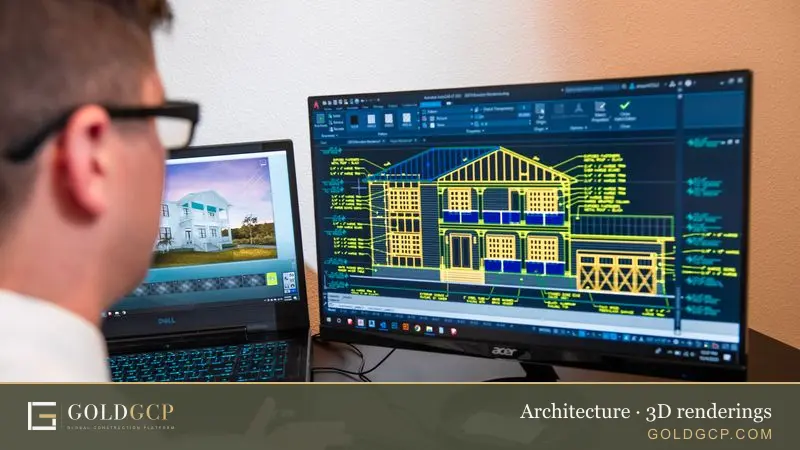
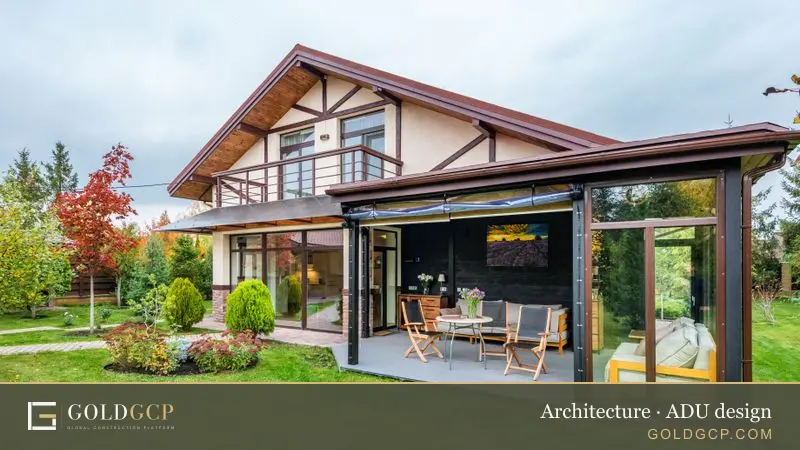
A 600 square foot detached ADU runs about $83,700 to $139,500 built. An attached ADU runs $69,750 to $125,550, a garage conversion $27,900 to $111,600, and a unit above a garage $111,600 to $279,000. A prefab unit runs $44,650 to $89,300. A land survey, which most ADU and addition permits need, runs $370 to $1,650. A 3D rendering package runs $745 to $3,000 if you want to see the unit before the layout is fixed. The 3D rendering guide covers what the packages include.
How ADU rules work in Miami-Dade
Miami-Dade County allows an ADU or guesthouse in a single-family zoned district, either newly detached or attached, including conversion of part of an existing single-family home. The county allows one ADU per property, and the use must be ancillary. You may rent an ADU for a fee without making the property an unlawful duplex, and the occupant does not have to be family of the main house's occupant.
The county adds conditions that shape the design:
- An ADU needs a renewable Certificate of Use, and only the property owner may obtain it. It needs a one-time interior inspection and exterior inspections at each renewal.
- An ADU is not a duplex and cannot be sold separately from the main building.
- An RV cannot be used as an ADU.
- The county now permits guesthouses in RU-1 zoning districts; before, it allowed them only in EU and AU districts. A guesthouse may not be rented, only used by gratuitous guests, and if it exceeds 800 square feet it cannot be used as an ADU.
The pre-approved ADU program
Miami-Dade runs a pre-approved ADU program that streamlines the building permit for adding a dwelling unit. Pre-approved plans may permit faster than starting from scratch because the building department has already approved them. You cannot change them, though you may rotate the orientation of the structure to fit the site. Any change needs re-approval and can extend permitting. If you submit your own plans, the standard process requires review by all building trades and may take longer.
The county says the pre-approved timeline can vary on lots with protected trees or Environmentally Critical Areas. Every ADU application needs a completed owner disclosure statement. Pre-approved applications also need a Hold Harmless form. Projects must meet minimum and maximum floor area, building code, location on the lot, appearance standards, parking and impact fees. Free permitting assistance is available at 786-315-2388 or CHAT@miamidade.gov.
Palm Beach County's rules
Palm Beach County's code allows one accessory dwelling as an accessory to a principal single-family home that is owner occupied. It may be attached or freestanding. Maximum floor area is 800 square feet on lots under one acre and 1,000 square feet on lots of one acre or more, counting only living area under a solid roof; porch, patio, carport or garage space under a solid roof may not exceed 500 square feet. The unit is limited to one bedroom and one bathroom and must match the main house in character and materials.
Two conditions catch owners. Both buildings must share one electric meter, and separate service is prohibited. You must sign an agreement to remove all kitchen equipment before the building permit issues, and the kitchen must come out if the main house stops being owner occupied. The ADU stays under the same ownership as the main house and cannot be sold as a condominium.
City rules
Miami, Miami Beach, Coral Gables, Fort Lauderdale, Hollywood, Boca Raton and West Palm Beach each run their own building department and zoning code. Size limits, setbacks, parking and owner-occupancy rules can differ from the county's, so the first design question is which rulebook applies to your address. The ADU design guide covers layouts and cost-saving choices once you know the limits.
What the High-Velocity Hurricane Zone changes
Miami-Dade and Broward are the High-Velocity Hurricane Zone. Every other Florida county, including Palm Beach, is a non-HVHZ area. The zone changes what your architect has to specify and what the inspector checks.
Miami-Dade's Product Control Section issues a Notice of Acceptance. It conveys approval of a product or system and gives the information needed for code compliance, permitting, installation and inspection. You can also use NOAs to get the optional State of Florida Product Approval for panel walls, exterior doors, roofing products, skylights, windows, shutters and structural components. In Miami-Dade and Broward, ask for the NOA number of every window, door, shutter and roofing product on the quote. The impact window guide explains how the glazing and frame are rated together.
Florida Product Approval is the manufacturer's option under Rule 61G20-3, in place since October 1, 2003. It covers the same product categories, and once the Florida Building Commission approves a product, local jurisdictions must accept it. Search approvals at floridabuilding.org.
The statewide code is the 2023 Florida Building Code, 8th Edition, in effect since December 31, 2023. The 9th Edition takes effect December 31, 2026. Broward County adds its own local amendments, which the Board of Rules and Appeals adopts and files with the state.
Flood zones and the 50% rule
FEMA's flood maps decide a lot's zone. Zone AE (flood depths over three feet), Zone AH (one to three feet) and Zone VE (coastal with wave hazard) carry mandatory flood insurance for federally backed mortgages. Look up an address at msc.fema.gov.
All new construction and substantial improvements need an elevation certificate, and Miami-Dade has collected them from builders since 1995. If your house was built before 1995 and was never substantially improved or damaged, you may need to hire a surveyor or ask the prior owner for the certificate. A tie beam inspection hold applies to all new construction and substantial additions. It requires an under-construction elevation certificate showing floor elevation, adjacent grade elevation and crown of road elevation.
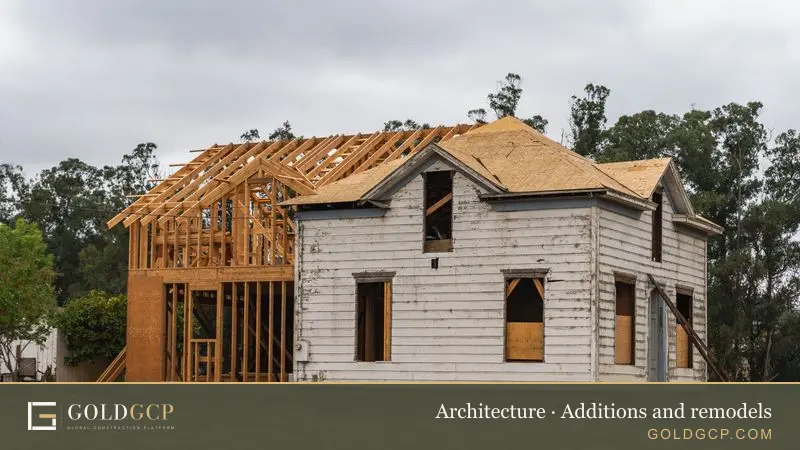
The 50% rule is the one that changes budgets. If a house in a flood zone is damaged or improved to an amount greater than 50% of its market value, it must be raised to meet the current elevation requirement. A renovation that creeps past that line turns into a lifting project, so the architect should price the improvement against the building's value before drawings go far. Miami-Dade's flood line is 786-315-2800.
Do you need a permit?
Yes, for any ADU, addition or new home. Miami-Dade's building division adopted a revised fee schedule effective October 1, 2025, the first increase in more than 17 years. Permit fees include amounts assessed by other agencies: DTPW, Development Services, DERM, Fire Rescue, WASD and the state for septic tanks. A non-refundable up-front processing fee of about 30 percent of the new permit cost is due when the county receives a building permit application, and it is credited toward the final fee. Work started before a permit requires paying a double permit fee.
Fire plans review for new building or addition work costs $3.92 per 100 square feet up to 20,000 square feet, with a minimum of $145.82. For renovation-type work it costs $12.72 per $1,000 of estimated cost up to $1,000, minimum $145.82, then $2.86 for each additional $1,000. A preliminary inspection costs $98.46 for buildings under 5,000 square feet. A temporary certificate of occupancy adds $98.46, and cancelling an inspection the day of the visit costs $194.44. You can pay fees online through the county's ePayment service.
A new state exemption from July 1, 2026 lets work valued under $7,500 on single-family homes, duplexes and townhouses qualify for a simplified no-building-permit process. It does not apply to units in multifamily buildings or to properties partly or fully in a flood hazard area, and electrical, plumbing, structural, mechanical and gas work still needs a permit. You may not split projects to avoid permits.
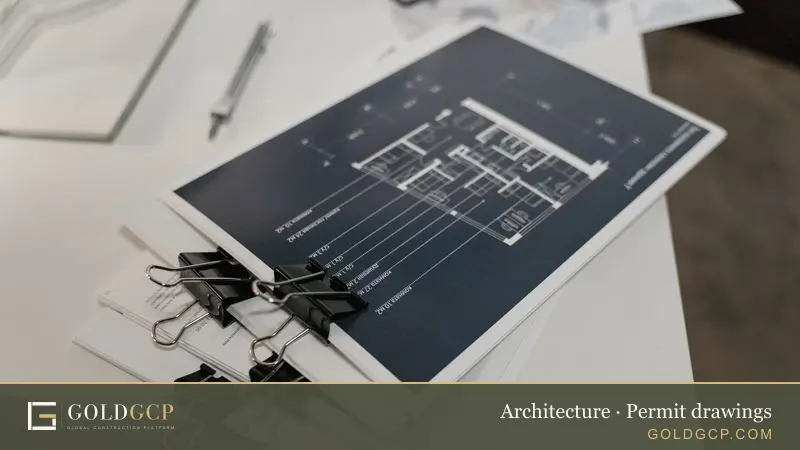
The cities run their own counters. The City of Miami's Easy Permit program lets qualified contractors get small permits without plan review through iBuild, and its permit counter is at 444 SW 2nd Avenue, 4th Floor. Miami Beach, Coral Gables, Fort Lauderdale, Hollywood, Boca Raton and West Palm Beach each publish their own fee schedules and review times. Ask your architect which office will review the set and how long that office is currently taking. The permit drawings guide lists what a complete set includes.
Structural and energy coordination
Wind load drives the structure in Miami-Dade and Broward. The architect coordinates with a structural engineer on the continuous load path, roof-to-wall connections and foundation, and the engineer stamps the structural sheets. The guide to structural coordination explains how those drawings fit into the architect's set.
The Florida Energy Code applies to new homes and to additions and alterations at the scope the code sets. The architect or an energy consultant runs the compliance report that goes in the permit set. The energy compliance guide covers what the report includes.
Condo owners have a separate layer. Under F.S. 553.899, condominium and cooperative buildings three habitable stories or more need a milestone inspection by December 31 of the year the building turns 30, and every 10 years after. Miami-Dade also recertifies buildings at 30 years and every 10 years after, with condo and co-op buildings three stories or taller within three miles of the coastline built in 1998 or later at 25 years. Single-family homes, duplexes, and buildings with an occupant load of 10 or less and 2,000 square feet or less are exempt. If you own a condo unit, check the association's inspection status before planning interior work.
How to check an architect before you hire
Florida licenses architects through the Department of Business and Professional Regulation, and the Board of Architecture and Interior Design governs the profession. A registered architect is a person licensed under Chapter 481 to practice architecture. The practice includes planning, preliminary study designs, drawings and specifications, job-site inspection, and administration of construction contracts.
- Look up the individual on the DBPR license search at myfloridalicense.com. The board licenses people, so find the architect in charge of your project.
- Ask whether the firm holds a certificate of authorization to provide architectural services.
- Ask who will stamp the structural sheets and prepare the energy compliance report.
- Ask for Miami-Dade or Broward projects similar to yours, especially floodplain or HVHZ work if that applies.
Not every project needs a licensed architect. Under Florida law, no architect license is required for a building costing less than $25,000, except a school, auditorium or other building intended for public use. A general contractor certified or registered under Chapter 489 does not need an architect license on a design-build contract as long as a licensed architect provides the architectural services. An engineer may perform architectural services purely incidental to engineering practice, but may not use the title architect.
Interior design is separate. A person performing interior design or decorator services for a residential application is exempt from the architecture practice part, and residential applications include single-family homes, multifamily homes, townhouses, apartments, condominiums and domestic outbuildings. Interior design excludes architectural and engineering work except specifying fixtures and their locations. For interior-only projects, see the Miami interior designer guide if it is published, or the residential design guide.
Areas we cover
GOLDGCP architects and vetted pros work across Miami-Dade, Broward and Palm Beach counties, including:
- Miami
- Miami Beach
- Coral Gables
- Fort Lauderdale
- Hollywood
- Boca Raton
- West Palm Beach
Each city runs its own building department and its own ADU and floodplain rules. Miami-Dade and Broward are in the High-Velocity Hurricane Zone. Palm Beach County is not. Enter your ZIP code to see local prices.
How GOLDGCP works
- Tell us about the lot and the project.
- Our in-house architects check zoning, ADU rules, flood zone and HVHZ status, then draw the permit set.
- We match you with up to 3 vetted, licensed builders and show prices by ZIP code.
- You approve each stage and release milestone payments, tracked in the client portal. The payment protection page explains how milestones work.
Builders pass six-step vetting first: state license verification, an insurance check, a background and business check, portfolio review, client reference calls, and onboarding with a quality score. GOLDGCP is free for homeowners and serves all 50 states.
Frequently asked questions
How much does an architect cost in Miami?
About $4,450 to $10,050 for a 600 square foot ADU design, $2,800 to $7,000 for a 500 square foot addition, and $3,700 to $27,900 for a 2,500 square foot new home, using national data at Miami's 0.93 cost factor.
How much does it cost to build an ADU in Miami?
A 600 square foot detached ADU runs about $83,700 to $139,500 built, an attached ADU $69,750 to $125,550, and a garage conversion $27,900 to $111,600. Design, survey and permit fees are extra.
How big can an ADU be in Miami-Dade?
The county allows one ADU per property in a single-family district, attached or detached, with size set by floor area limits, lot location, parking and impact fees. Palm Beach County caps an accessory dwelling at 800 square feet on lots under one acre.
What is the Miami-Dade pre-approved ADU program?
A catalog of ADU designs the county building department has already approved. You buy a plan and may rotate it to fit the site, but cannot change it without re-approval. Permitting is usually faster than a custom set.
What does the High-Velocity Hurricane Zone mean for my plans?
Miami-Dade and Broward are in the zone. Windows, doors, shutters and roofing products need a Miami-Dade Notice of Acceptance or an HVHZ-rated Florida Product Approval, and the structure is designed for the zone's wind loads. Palm Beach County is outside the zone.
What is the 50% rule in a flood zone?
If a house in a flood zone is damaged or improved to more than 50% of its market value, it must be raised to meet the current elevation requirement. New construction and substantial improvements need an elevation certificate.
Do I need a licensed architect in Florida?
Not always. No architect license is required for a building costing less than $25,000, except a school, auditorium or other building intended for public use. Anything larger, and any engineered structure, should carry a licensed architect's or engineer's stamp.
How we calculate these prices
GOLDGCP starts from national price ranges for each job, taken from published 2026 cost guides and checked against local price guides where they exist. To get a local price, we multiply the national range by the construction cost factor for the metro from the U.S. Army Corps of Engineers Area Cost Factors (US average = 1.00). Where that table has no entry for a metro, we use the nearest listed location or the state value. For ZIP codes outside the 50 largest metros, the cost estimator uses the state's price level from the Bureau of Economic Analysis Regional Price Parities. Ranges include labor and standard materials but not unusual site conditions, so a written quote after an inspection is always the final price.
Sources
- Miami-Dade County · Accessory Dwelling Unit (ADU)
- discover.pbc.gov
- Miami-Dade County · IO-04-123.pdf
- The Florida Legislature
- U.S. Army Corps of Engineers
- U.S. Bureau of Economic Analysis

About this guide
Written by the GOLDGCP editorial team. Prices come from national cost guides adjusted with official construction cost factors for Miami; rules and statistics come from the agencies and reports linked in the text. We update this page when prices or codes change.