
How much water heater replacement costs
Quick answer
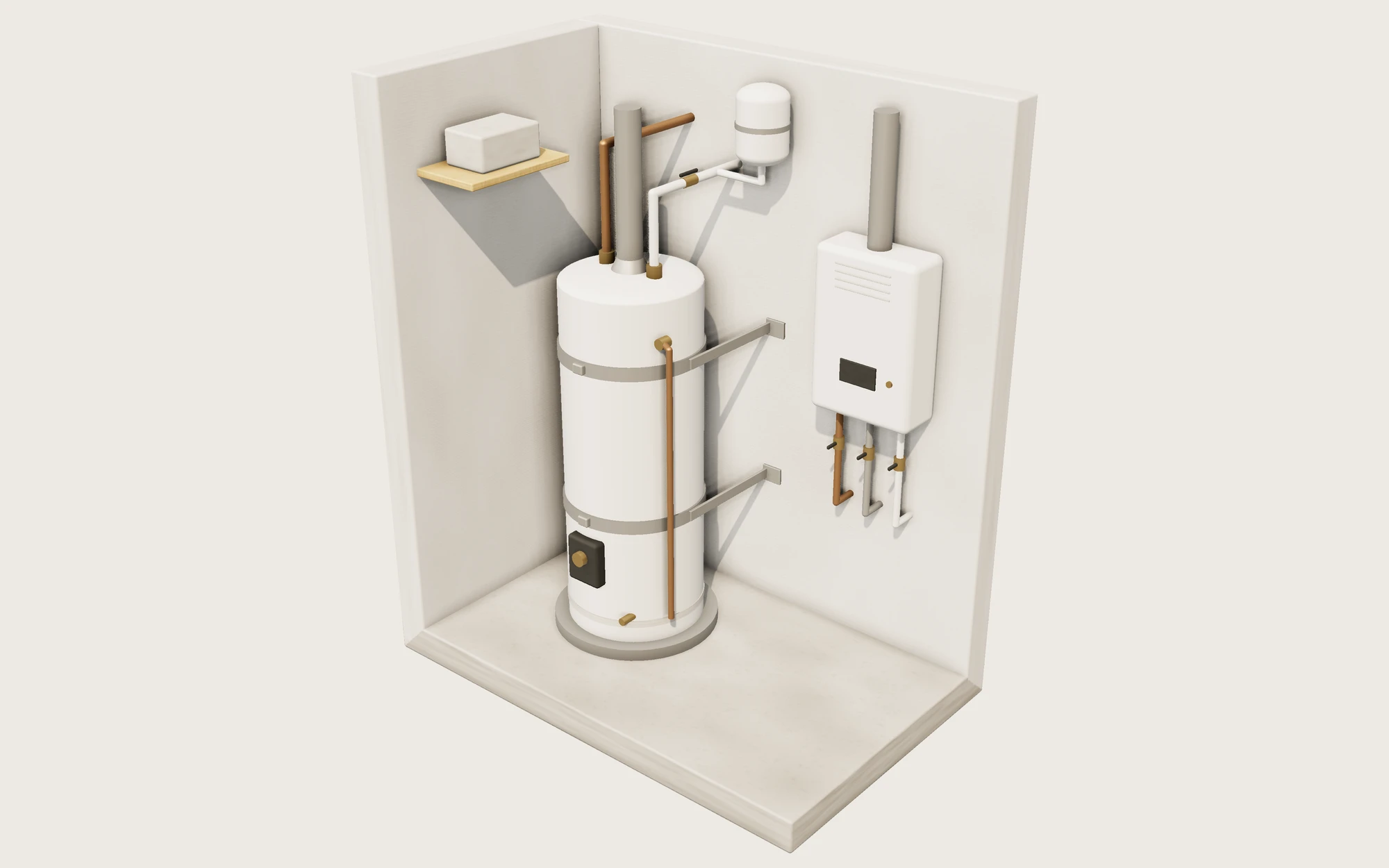
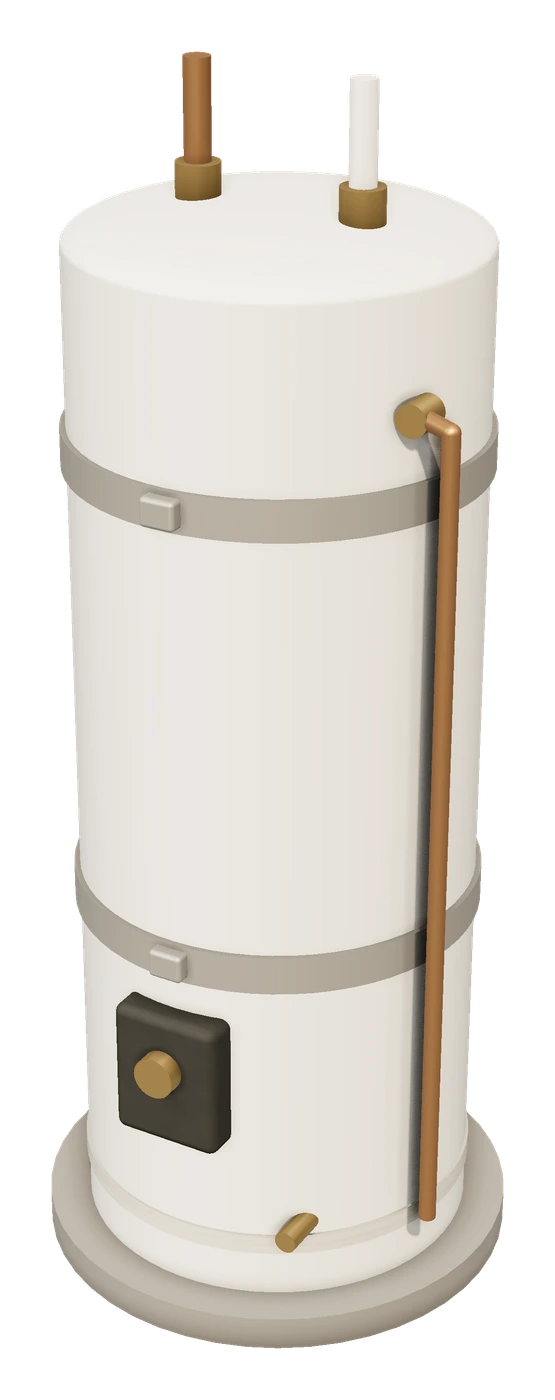
Replacing a water heater in the US usually costs $600 to $5,600 installed, depending on the type. A standard 40- or 50-gallon tank runs about $600 to $3,100. A tankless water heater costs $1,400 to $3,000 for an electric model and $2,100 to $5,600 for gas, because gas units often need new venting and a larger gas line. A heat pump (hybrid) water heater costs about $2,000 to $4,600 installed.
| Job | US average (typical range) | Typical |
|---|---|---|
| 40-gallon tank, installed | $600–$3,000 | $1,500 |
| 50-gallon tank, installed | $700–$3,100 | $1,600 |
| 80-gallon tank, installed | $1,200–$4,000 | $2,400 |
| Tankless, electric, installed | $1,400–$3,000 | $2,200 |
| Tankless, gas, installed | $2,100–$5,600 | $3,800 |
| Heat pump (hybrid), installed | $2,000–$4,600 | $3,300 |
| Water heater repair | $150–$750 | $400 |
| Old tank removal | $75–$500 | $200 |
| Gas vent replacement | $100–$600 | $350 |
| Gas line upgrade | $350–$2,000 | $900 |
| Expansion tank | $100–$400 | $250 |
| Permit | $50–$200 | $125 |
US national averages for 2026, labor and standard materials included, from published cost guides (sources at the end of this page). Local prices differ: see the city table below, or enter your ZIP code in the calculator.
Tank sizes and what they cost
HomeGuide's national prices for tank water heaters:
| Tank size | Unit only | Installed | Usually right for |
|---|---|---|---|
| 30 gallons | $300 to $900 | $500 to $1,900 | 1 person or a small apartment |
| 40 gallons | $400 to $2,000 | $600 to $3,000 | 1 to 2 people |
| 50 gallons | $500 to $2,100 | $700 to $3,100 | 3 to 4 people |
| 65 gallons | $700 to $2,400 | $900 to $3,400 | 4 to 5 people |
| 80 gallons | $1,000 to $3,000 | $1,200 to $4,000 | 5 or more people |
Find a water heater installer near you
Enter your ZIP code to see local prices and get matched with a vetted, licensed plumber who installs water heaters in your area. GOLDGCP works in every US ZIP code.
Water heater costs in 50 US metros
This table prices a 50-gallon tank water heater, installed, in each of the 50 largest US metros, using each metro's construction cost factor.
| Metro | Cost factor | 50-gallon tank, installed |
|---|---|---|
| New York | 1.31 | $915–$4,050 |
| San Francisco Bay Area | 1.28 | $895–$3,950 |
| San Jose | 1.28 | $895–$3,950 |
| Boston | 1.23 | $860–$3,800 |
| Chicago | 1.20 | $840–$3,700 |
| San Diego | 1.19 | $835–$3,700 |
| Sacramento | 1.17 | $820–$3,650 |
| Philadelphia | 1.15 | $805–$3,550 |
| Seattle | 1.15 | $805–$3,550 |
| Providence | 1.15 | $805–$3,550 |
| Los Angeles | 1.14 | $800–$3,550 |
| Detroit | 1.13 | $790–$3,500 |
| Riverside–San Bernardino | 1.11 | $775–$3,450 |
| Portland | 1.10 | $770–$3,400 |
| Las Vegas | 1.10 | $770–$3,400 |
| Milwaukee | 1.10 | $770–$3,400 |
| Hartford | 1.10 | $770–$3,400 |
| Minneapolis–St. Paul | 1.06 | $740–$3,300 |
| Pittsburgh | 1.06 | $740–$3,300 |
| Denver | 1.05 | $735–$3,250 |
| Washington DC | 1.04 | $730–$3,200 |
| St. Louis | 1.04 | $730–$3,200 |
| Cincinnati | 1.02 | $715–$3,150 |
| Salt Lake City | 0.99 | $695–$3,050 |
| Orlando | 0.98 | $685–$3,050 |
| Columbus | 0.98 | $685–$3,050 |
| Cleveland | 0.98 | $685–$3,050 |
| Baltimore | 0.96 | $670–$3,000 |
| Kansas City | 0.96 | $670–$3,000 |
| Jacksonville | 0.96 | $670–$3,000 |
| Virginia Beach–Norfolk | 0.94 | $660–$2,900 |
| Miami | 0.93 | $650–$2,900 |
| Tampa | 0.93 | $650–$2,900 |
| Indianapolis | 0.93 | $650–$2,900 |
| Phoenix | 0.90 | $630–$2,800 |
| Rochester | 0.90 | $630–$2,800 |
| Oklahoma City | 0.89 | $625–$2,750 |
| Buffalo | 0.89 | $625–$2,750 |
| Nashville | 0.87 | $610–$2,700 |
| Memphis | 0.87 | $610–$2,700 |
| Richmond | 0.87 | $610–$2,700 |
| Louisville | 0.86 | $600–$2,650 |
| Birmingham | 0.86 | $600–$2,650 |
| Atlanta | 0.85 | $595–$2,650 |
| Charlotte | 0.85 | $595–$2,650 |
| Raleigh–Durham | 0.85 | $595–$2,650 |
| Dallas–Fort Worth | 0.84 | $590–$2,600 |
| Houston | 0.82 | $575–$2,550 |
| Austin | 0.82 | $575–$2,550 |
| San Antonio | 0.80 | $560–$2,500 |
Cost factors from the U.S. Army Corps of Engineers Area Cost Factors (US average = 1.00). Outside these metros, the calculator uses your state's price level from the Bureau of Economic Analysis. Linked metros have a full local guide.
Tank, tankless or heat pump?
| Tank | Tankless | Heat pump (hybrid) | |
|---|---|---|---|
| Installed cost | $600 to $3,100 | $1,400 to $5,600 | $2,000 to $4,600 |
| Hot water supply | Limited to the tank, then a wait to reheat | Continuous, limited by flow rate | Tank-based, recovers more slowly |
| Typical lifespan | 8 to 12 years | Often longer than a tank | Similar to or longer than a tank |
| Space | Needs floor space | Mounts on a wall | Needs space and airflow around it |
| Best for | Lowest upfront cost, simple swaps | Steady demand, small spaces, long-term owners | Electric homes wanting lower energy use |
HomeGuide puts the annual energy cost of a gas tankless unit at about $220 to $480, against about $250 to $420 for a gas tank, and $340 to $540 for an electric tankless unit against $530 to $600 for an electric tank. Tankless units save the most when a household uses a lot of hot water at steady rates, and the least when the main goal is a low upfront price.
Why tankless jobs cost more
The unit itself is only about 40% to 45% of a tankless installation. The rest is labor and changes to the house:
- Upgrading the gas line to carry more fuel, $350 to $2,000
- New venting, since old tank vents usually can't be reused, $100 to $600
- A dedicated electrical circuit for electric models, $250 to $900, and sometimes a panel upgrade
- Permits, usually $50 to $200
Repair or replace?
A repair makes sense for a newer heater with one failed part, such as a thermostat, heating element, igniter, thermocouple or valve. Most repairs cost $150 to $750. Replacement is usually the better choice when:
- The heater is near or past 8 to 12 years old
- There is rust in the hot water or corrosion around the fittings
- Water is leaking from the tank itself, not a fitting
- The tank rumbles loudly from sediment that flushing no longer clears
- Repairs would cost more than about half the price of a new heater
A leaking tank cannot be fixed. If water is coming from the bottom of the tank, shut off the cold water supply on top of the heater and turn off the gas or power to it.
Making a water heater last
- Flush the tank once a year to clear sediment, more often with hard water.
- Check the anode rod every two to three years and replace it when it's worn.
- Test the temperature and pressure relief valve once a year.
- Keep the thermostat around 120°F, which saves energy and lowers scald risk.
- In earthquake areas, make sure the tank is strapped as local code requires.
Hard water shortens a heater's life a lot. In very hard-water cities such as Phoenix, many tanks fail in 6 to 8 years without a softener; see our Phoenix plumbing guide.
Permits and code requirements
Most cities require a permit to replace a water heater, even with the same type in the same place. The inspection checks the venting, gas connection, relief valve and its drain line, and any local rules such as earthquake straps in California or drain pans for attic installs in Texas. A licensed plumber normally pulls the permit as part of the job.
Gas or electric?
The choice usually follows what the house already has. Switching from electric to gas means running a gas line and adding venting, and switching from gas to electric may need a new 240-volt circuit or a panel upgrade. Gas tank heaters recover faster after heavy use, while electric heaters are simpler to install and don't need venting. Heat pump water heaters are electric but use far less energy than standard electric tanks, which makes them the main efficient option for homes without gas.
What a water heater installation includes
A standard replacement usually takes three to five hours and includes:
- Shutting off the water, gas or power and draining the old tank
- Disconnecting and removing the old heater
- Setting the new heater, on a stand or pan where code requires
- Connecting water lines with new shutoff valves and connectors
- Connecting gas and venting, or the electrical supply
- Installing the temperature and pressure relief valve and its discharge line
- Adding an expansion tank and earthquake straps where required
- Filling the tank, checking for leaks, lighting or powering it, and testing the temperature
- Hauling away the old unit and scheduling the permit inspection
Water heater safety
Two parts keep a water heater safe. The temperature and pressure relief valve opens if the tank overheats or builds too much pressure, and its discharge pipe must run to a safe location close to the floor or outside, never be capped. In gas heaters, proper venting carries combustion gases, including carbon monoxide, out of the house; a vent that is disconnected, rusted or blocked is dangerous. Every home with gas appliances should have working carbon monoxide alarms, and a gas water heater should be checked by a professional if you notice soot, a yellow flame or a smell of gas.
How to hire a water heater installer
- Check the plumber's license with your state or city licensing board.
- Ask what the price includes: removal and disposal of the old tank, new valves and connectors, an expansion tank if required, and the permit.
- For tankless, ask whether your gas line, venting and electrical service can support the unit, and get those costs in writing.
- Ask about the manufacturer's warranty and the installer's labor warranty.
- Pay on completion for simple swaps, and in stages for larger conversions.
Every plumber in the GOLDGCP network passes a license check, insurance verification, a background check and reference calls before getting a job, and you pay in milestones as the work gets done.
Frequently asked questions
How much does it cost to replace a water heater?
Usually $600 to $3,100 for a standard tank water heater installed, $1,400 to $3,000 for an electric tankless unit, and $2,100 to $5,600 for a gas tankless unit.
How much does a tankless water heater cost installed?
About $1,400 to $3,000 for electric and $2,100 to $5,600 for gas, according to HomeGuide. Gas line, venting and electrical upgrades account for much of the difference.
How long does a water heater last?
A tank water heater typically lasts 8 to 12 years. Very hard water can shorten that to 6 to 8 years without a softener and annual flushing.
What size water heater do I need?
As a rough guide, 40 gallons for 1 to 2 people, 50 gallons for 3 to 4, and 65 to 80 gallons for larger households. A plumber can size a tankless unit by your peak flow rate.
Is a tankless water heater worth it?
It can be if you plan to stay in the home and use a lot of hot water. It costs more upfront, but provides continuous hot water, saves floor space and can lower energy costs.
Do I need a permit to replace a water heater?
In most US cities, yes, even for a like-for-like replacement. The licensed plumber usually pulls it and arranges the inspection.
Why is my water heater leaking?
Leaks from a fitting or valve can often be repaired. A leak from the tank itself means the tank has corroded through and must be replaced. Shut off the water and power or gas to the heater right away.
How often should I flush my water heater?
Once a year for most homes, and every six months in areas with very hard water. Flushing drains the sediment that settles on the bottom of the tank, which makes the heater work harder, causes rumbling noises and shortens its life. Tankless units need descaling on a similar schedule.
How we calculate these prices
GOLDGCP starts from national price ranges for each job, taken from published 2026 cost guides and checked against local price guides where they exist. To get a local price, we multiply the national range by the construction cost factor for the metro from the U.S. Army Corps of Engineers Area Cost Factors (US average = 1.00). For ZIP codes outside the 50 largest metros, the calculator uses the state's price level from the Bureau of Economic Analysis Regional Price Parities. Ranges include labor and standard materials but not unusual site conditions, so a written quote after an inspection is always the final price.
Sources
- Water heater installation or replacement cost · HomeGuide
- Tankless water heater cost · HomeGuide
- Area Cost Factors, PAX Newsletter 3.2.1 (2024) · U.S. Army Corps of Engineers
- Regional Price Parities by State · U.S. Bureau of Economic Analysis

About this guide
Written by the GOLDGCP editorial team. Prices come from national cost guides; rules and statistics come from the agencies and reports linked in the text. We update this page when prices or codes change.