
The short answer
Water heater repair in Miami runs $140 to $700. A 50-gallon tank installed costs $650 to $2,900, a gas tankless unit $1,950 to $5,200 and a heat pump $1,850 to $4,300. The permit is the local factor that matters most. Miami-Dade and Broward both require one for a replacement, and the inspector checks the pan, the relief line and the anchoring.
What water heater work costs in Miami
The table shows installed prices for a single-family home, adjusted with the Miami construction cost factor of 0.93 from the U.S. Army Corps of Engineers. That puts Miami about 7% below the national average, and labor here is cheaper than in big northern metros.
| Job | Miami (typical range) | US average |
|---|---|---|
| 40-gallon tank, installed | $560–$2,800 | $600–$3,000 |
| 50-gallon tank, installed | $650–$2,900 | $700–$3,100 |
| 80-gallon tank, installed | $1,100–$3,700 | $1,200–$4,000 |
| Tankless, electric, installed | $1,300–$2,800 | $1,400–$3,000 |
| Tankless, gas, installed | $1,950–$5,200 | $2,100–$5,600 |
| Heat pump (hybrid), installed | $1,850–$4,300 | $2,000–$4,600 |
| Water heater repair | $140–$700 | $150–$750 |
| Old tank removal | $70–$465 | $75–$500 |
| Gas vent replacement | $93–$560 | $100–$600 |
| Gas line upgrade | $325–$1,850 | $350–$2,000 |
| Expansion tank | $93–$370 | $100–$400 |
| Permit | $47–$185 | $50–$200 |
Estimates for 2026, including labor and standard parts. Miami prices use the metro's construction cost factor of 0.93 (US average = 1.00) from the U.S. Army Corps of Engineers Area Cost Factors. Your quote depends on access, materials and the condition of the home.
Repairs are priced by the part. These are the common jobs and what they cover:
| Repair | Typical cost in Miami | What it fixes |
|---|---|---|
| Thermocouple or igniter | $140 to $350 | Gas pilot or burner that will not stay lit |
| Heating element | $140 to $400 | Lukewarm water or hot water that runs out fast on an electric tank |
| Anode rod | $150 to $370 | Corrosion inside the tank |
| Pressure relief valve | $140 to $700 | A relief valve that drips or will not seal |
| Expansion tank | $93 to $370 | Pressure creep on a closed system |
| Tankless flush and descale | $140 to $400 | Scale in the heat exchanger |
| Gas control valve | $200 to $700 | Pilot and burner control, thermostat on gas units |
If you smell gas, leave the house and call your gas utility's emergency line before you call anyone else. A faulty gas control valve can leak, so do not wait on that repair.
Use the cost estimator for a number based on your ZIP code, tank size and fuel.
Repair or replace?
A tank heater usually lasts 8 to 15 years and a tankless unit 10 to 20. Replace the heater when it is past 10 years old, when the tank body itself leaks, or when the repair costs more than half of a new unit. A rusted tank cannot be patched from the inside, so replacement is the only fix. Water around the base, rust in the hot water and rumbling from sediment on the bottom all point to a tank near the end.
Younger tanks are usually worth fixing: a bad thermocouple, heating element, relief valve or anode rod is a parts job.
Salt air and humidity along the coast speed up corrosion around the fittings and connections. A tank near an open carport or a beachside utility closet can fail sooner than its age suggests. Flushing the tank once a year through the drain valve helps in an area with hard water.
Tank, tankless or heat pump in a South Florida home
| Gas tank | Gas tankless | Heat pump | |
|---|---|---|---|
| Installed cost in Miami | $650 to $2,900 (50 gal) | $1,950 to $5,200 | $1,850 to $4,300 |
| Extra work often needed | Pan, expansion tank, anchoring | Larger gas line ($325 to $1,850), new venting ($93 to $560) | Dedicated circuit, condensate drain, air space |
| Where it usually goes | Garage, utility closet, attic | Interior wall or exterior wall with vent | Garage or utility room with air flow |
Gas tank
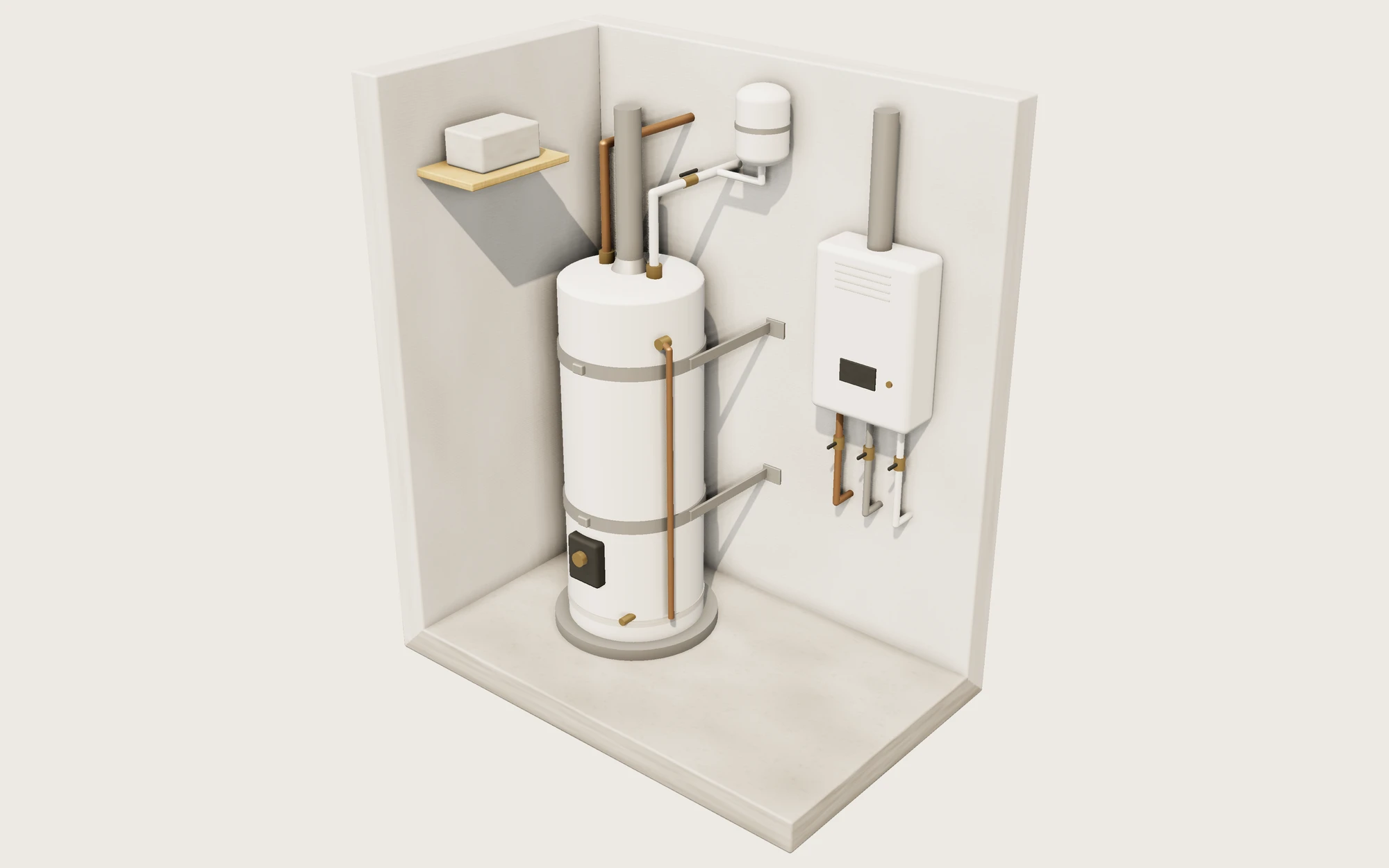
A like-for-like gas tank is the lowest-cost option and still allowed everywhere in the metro. On an older install, the replacement may need to be brought up to current code: a drain pan with an indirect drain, an expansion tank on a closed system, a relief valve line that discharges through an air gap, and, in a garage, the ignition source raised 18 inches above the floor unless the unit is listed as flammable-vapor-ignition-resistant. Our Miami plumbing guide covers the pipe and drain side of the same house.
Gas tankless
A tankless unit heats water only when a tap is open, so there is no standing tank, and most of the cost is in the install. A tankless burner often needs a larger gas line ($325 to $1,850 in Miami) and new venting ($93 to $560). In Broward, a tankless permit needs a separate plumbing application and an electrical application, plus installation plans signed by the license holder. Tankless units also need a flush and descale at least once a year, which matters with South Florida's water.
Heat pump
A heat pump water heater pulls heat from the air around it, so it needs space and air flow. It needs a dedicated electrical circuit, a drain for condensate, and sometimes more capacity at the electrical panel. In a Miami garage the unit also cools the room it sits in. If your panel needs work first, our Miami electrician guide covers panel upgrades and permits.
Attic and closet installs
Many South Florida homes put the heater in the attic or a closet. The Florida Building Code requires a level service space at least 30 inches by 30 inches at the front or service side of an attic unit, and a working space of the same size in front of the control side. A leaking attic tank is the worst case, so the pan and drain matter more here than in a garage.
Do you need a permit?
A water heater replacement is plumbing work, and Florida plumbing work always requires a permit. Miami-Dade County's page on the 2026 state exemption (House Bill 803, which lets some projects under $7,500 skip a building permit) says plumbing, electrical, gas and mechanical work still need permits even under that threshold. A property partly or fully in a flood hazard area is not eligible for the exemption at all.
The permit office depends on where you live:
- City of Miami: City of Miami Building Department, which runs an Easy Permit program for qualified contractors on small jobs.
- Miami Beach and Coral Gables: their own building departments.
- Unincorporated Miami-Dade (Kendall and others): Miami-Dade County. The Permitting and Inspection Center is at 11805 SW 26 Street, Miami, FL 33175, open 7:30 a.m. to 4:00 p.m. Qualified contractors can apply, pay and print permit cards online.
- Fort Lauderdale and Hollywood: the city building departments in Broward County.
- Boca Raton and West Palm Beach: the city building departments in Palm Beach County.
In Broward County, a like-for-like replacement may have a simpler application than a relocation, fuel conversion or tankless upgrade. It still needs a plumbing permit, though plans are not required when the fixture stays in the same location. Some Broward cities use a water heater replacement data form, and the county's uniform form lets a contractor use the same paperwork in each jurisdiction. A tankless install usually needs both a plumbing and an electrical permit.
Fees vary by city. The City of Coral Springs, in Broward, charges $154 for a domestic water heater permit and has a plumbing minimum fee of $152. Miami-Dade requires a Plumbing Fee Sheet with the application. Expect a permit fee of $47 to $185, and more if plan review is triggered.
The inspector checks the items the Florida Building Code and the Florida Residential Code require:
- Drain pan: at least 1 1/2 inches deep, drained by an indirect waste pipe at least 3/4 inch in diameter, where a leak would cause damage. When replacing a heater where no pan drain existed before, a new pan drain is not required.
- Relief valve: temperature setting no more than 210°F, pressure setting no more than the tank rating or 150 psi, whichever is less. The discharge line runs through an air gap in the same room and ends not more than 6 inches above the floor or receptor.
- Expansion control: Florida requires an approved method of thermal expansion control, usually an expansion tank.
- Garage elevation: the ignition source at least 18 inches above the floor unless the unit is flammable-vapor-ignition-resistant.
- Cold water shutoff: a valve on the cold line near the heater, serving only that heater.
- Tankless limit: tankless units must not deliver water hotter than 140°F for domestic use.
Unpermitted work becomes a problem at resale: Broward County warns that work done without a permit may need a professional engineer's approval or may have to be redone, and buyers, inspectors and insurers ask about recent work.
How to check a water heater installer before you hire
Water heater work in Florida is plumbing work, so the installer needs a Florida plumbing contractor license from the Department of Business and Professional Regulation. On a license record that shows as a CFC (certified plumbing contractor) or RF (registered plumbing contractor). A certified contractor can work anywhere in Florida, while a registered contractor can work only in the jurisdiction where they registered.
Miami-Dade County also licenses contractors through its Contractor Licensing Section and the Construction Trades Qualifying Board. A plumbing contractor in the county must have a master plumber as qualifying agent. County certificate holders must register with the state DBPR when the county code and Florida Statute 489 require it, and failing to register restricts their permitting privileges.
A heat pump or tankless unit that needs a new dedicated circuit also needs a licensed electrical contractor (an EC or ER in the state system).
- Look up the license number at the DBPR license verification portal and confirm it is active and in the company's name.
- Ask who pulls the permit and books the inspection. It should be the installer.
- Get the price in writing with the pan, expansion tank, anchoring, haul-away and permit listed separately.
- Ask for the manufacturer's data or an AHRI certificate that shows the unit's efficiency, which some Broward permits require.
- Check workers' compensation coverage through the Florida Department of Financial Services database.
A contract with an unlicensed contractor is unenforceable by that contractor under Florida law, and unlicensed contracting during a declared state of emergency is a third-degree felony. Every installer in the GOLDGCP network passes a license check, insurance verification, a background check and reference calls before getting a job.
Anchoring and hurricane prep
Florida is not a seismic state, so the California strap rule does not apply here. Wind and water are the risks. A full residential tank weighs about 450 to 500 pounds, and in a hurricane a garage or carport unit can be knocked over or flooded. Keep the pan drain clear and the relief line unobstructed, and check the unit after a storm. Before a storm, know where the cold water shutoff and the gas shutoff are.
Hard water and how long your heater lasts
Miami-Dade's water comes mainly from the Biscayne Aquifer, and the county's 2025 Water Quality Report says the Alexander Orr plant gets lime treatment to reduce hardness while the Hialeah and Preston plants serve the area north of SW 8 Street. The report does not publish a single hardness number, and hardness varies by plant, so treat Miami water as moderately hard to hard.
Hard water lowers a heater's efficiency. In a tank, minerals settle as sediment, which causes the rumbling sound and wears the lower element on electric units. In a tankless unit, scale builds in the heat exchanger. Three habits help:
- Flush a tank once a year.
- Check the anode rod and replace it when it is mostly gone.
- Descale a tankless unit at least once a year.
WASD uses chloramine as its secondary disinfectant, which matters if you have a softener or filter serviced at the same time.
Areas we cover
GOLDGCP water heater pros work across the Miami metro:
- Miami and Miami Beach
- Coral Gables
- Fort Lauderdale and Hollywood
- Boca Raton and West Palm Beach
Enter your ZIP code to find a vetted installer near you.
How GOLDGCP works
- Tell us what is happening through the form, a call or WhatsApp. Include the tank's age, size and fuel if you know them.
- We match you with up to 3 vetted, licensed pros and show prices for your ZIP code before anyone visits.
- The installer pulls the permit, does the work and books the inspection.
- You pay in milestones, each one after you approve that stage.
If you have no hot water and a leak on the floor, call the 24/7 emergency line at the top of the page.
Frequently asked questions
How much does water heater repair cost in Miami?
Most repairs run $140 to $700. A thermocouple or igniter is about $140 to $350, a heating element $140 to $400 and an anode rod $150 to $370. A tankless flush and descale is $140 to $400. A tank that leaks from the body needs replacing, not repair.
Should I repair or replace my water heater in Miami?
Replace it if it is more than 10 years old, if the tank itself leaks, or if the repair costs more than half the price of a new heater. Younger tanks with a bad element, valve, thermocouple or anode rod are usually worth fixing.
Do I need a permit to replace a water heater in Miami?
Yes. Florida plumbing work always needs a permit, and Miami-Dade says the 2026 exemption for projects under $7,500 does not cover plumbing. The permit comes from your city or, in unincorporated areas, Miami-Dade County. Expect $47 to $185 in fees, more if plan review is triggered.
What does a tankless water heater cost installed in Miami?
A gas tankless unit runs $1,950 to $5,200 installed and an electric one $1,300 to $2,800. The install often needs a larger gas line ($325 to $1,850) and new venting ($93 to $560). In Broward, a tankless permit needs both a plumbing and an electrical application.
Is a heat pump water heater worth it in Miami?
A heat pump runs $1,850 to $4,300 installed, more than a gas tank, but it uses less energy. It needs a dedicated circuit, a condensate drain and air space. In a Miami garage it also cools the room it sits in, which helps in summer.
Does hard water shorten water heater life in Miami?
Miami-Dade water is moderately hard to hard and varies by treatment plant, which adds wear. Flushing a tank once a year, replacing the anode rod when it wears down, and descaling a tankless unit yearly help a heater reach its expected lifespan.
Do water heaters need earthquake straps in Miami?
Florida is not a seismic zone, so the California strap rule does not apply. What matters here is the drain pan, the relief line, the expansion tank and, in a garage, raising the ignition source 18 inches above the floor unless the unit is flammable-vapor-ignition-resistant.
How we calculate these prices
GOLDGCP starts from national price ranges for each job, taken from published 2026 cost guides and checked against local price guides where they exist. To get a local price, we multiply the national range by the construction cost factor for the metro from the U.S. Army Corps of Engineers Area Cost Factors (US average = 1.00). Where that table has no entry for a metro, we use the nearest listed location or the state value. For ZIP codes outside the 50 largest metros, the cost estimator uses the state's price level from the Bureau of Economic Analysis Regional Price Parities. Ranges include labor and standard materials but not unusual site conditions, so a written quote after an inspection is always the final price.
Sources

About this guide
Written by the GOLDGCP editorial team. Prices come from national cost guides adjusted with official construction cost factors for Miami; rules and statistics come from the agencies and reports linked in the text. We update this page when prices or codes change.