
The short answer
A new asphalt shingle roof on a typical Miami house runs about $6,500 to $13,000 for 2,000 square feet, and tile runs $13,000 to $46,500. Most leak repairs land between $140 and $930. The High-Velocity Hurricane Zone matters most here. Every roofing product needs Miami-Dade approval, and the deck and secondary water barrier get inspected.
What roofers charge in Miami
The table starts from national cost data adjusted for Miami. The U.S. Army Corps of Engineers puts construction costs in the Miami area at 0.93 times the national average, so a roof that costs $10,000 elsewhere tends to cost around $9,300 here.
| Job | Miami (typical range) | US average |
|---|---|---|
| Asphalt shingle roof, 2,000 sq ft | $6,500–$13,000 | $7,000–$14,000 |
| Metal roof, 2,000 sq ft | $9,300–$29,750 | $10,000–$32,000 |
| Tile roof, 2,000 sq ft | $13,000–$46,500 | $14,000–$50,000 |
| Flat roof, 1,000 sq ft | $2,800–$10,250 | $3,000–$11,000 |
| Tear-off of one old layer, 2,000 sq ft | $1,850–$3,700 | $2,000–$4,000 |
| Vent boot repair | $70–$140 | $75–$150 |
| Replace up to 25 shingles | $93–$280 | $100–$300 |
| Flashing repair | $185–$465 | $200–$500 |
| Minor leak repair | $140–$930 | $150–$1,000 |
| Leak with water damage | $930–$5,600 | $1,000–$6,000 |
| Roof deck repair, per 100 sq ft | $185–$465 | $200–$500 |
Estimates for 2026, including labor and standard parts. Miami prices use the metro's construction cost factor of 0.93 (US average = 1.00) from the U.S. Army Corps of Engineers Area Cost Factors. Your quote depends on access, materials and the condition of the home.
What pushes a quote up in South Florida:
- Tile. Clay and concrete tile is heavy and slow to install, and resetting old tile on new underlayment is priced as its own job.
- The hurricane package. A secondary water barrier, upgraded deck attachment and approved fasteners are required on a reroof in Miami-Dade and Broward, and they add labor.
- Product approval paperwork. The roofer has to match every product to a Miami-Dade Notice of Acceptance or a Florida Product Approval before the permit is issued.
- Old layers. Each layer of roofing that has to come off adds about $1,850 to $3,700 on a 2,000-square-foot roof.
- Deck repairs found after tear-off. Roof deck repair runs $185 to $465 per 100 square feet.
Run your own numbers with the cost estimator below or the full roofing cost estimator. Both use the rate for your ZIP code. For national prices and how roofers measure a roof, see our roofing cost guide.
Roofing materials that suit South Florida
Common choices at Miami prices for 2,000 square feet of roof:
| Material | Miami installed cost, 2,000 sq ft | Notes for this metro |
|---|---|---|
| Asphalt (composition) shingles | $6,500 to $13,000 | Cheapest option; needs a Miami-Dade approved shingle and underlayment system |
| Metal | $9,300 to $29,750 | Light and good in wind; standing seam panels need HVHZ approval |
| Concrete or clay tile | $13,000 to $46,500 | Common on Coral Gables and Miami Beach homes; the underlayment wears out first |
| Low-slope (flat) roof, 1,000 sq ft | $2,800 to $10,250 | TPO and PVC membranes can be permitted remotely in unincorporated Miami-Dade |
The Florida PACE Funding Agency notes that slate, tile, concrete shingles and metal offer strong protection in a storm but cost the most to replace (Florida PACE). It also says hip roofs tend to perform better in windstorms, and that a properly secured roof deck and adequate overhangs protect against wind and water intrusion.
Tile roofs: the underlayment is the weak spot
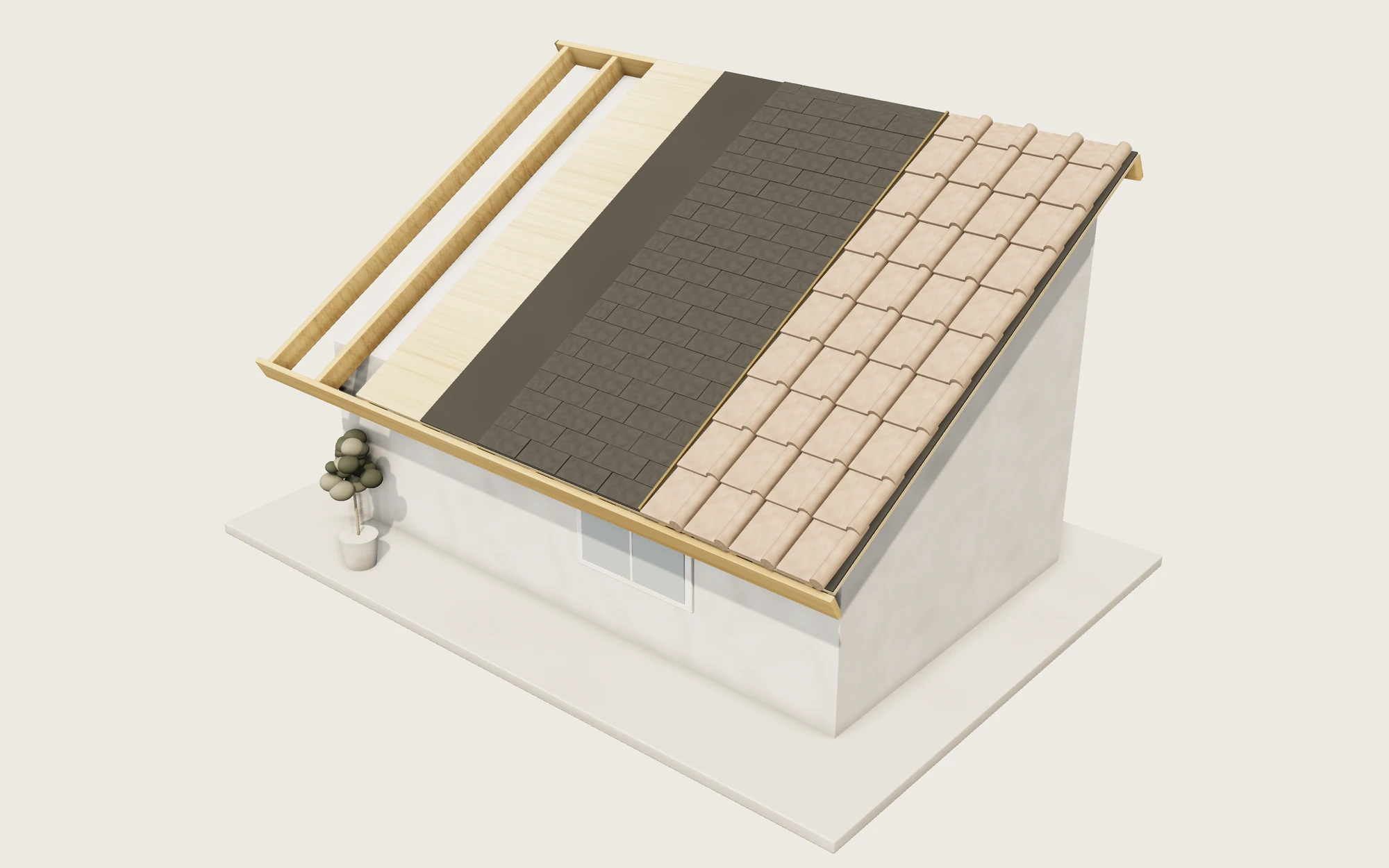
Tile can last decades. The layer under it does not. Once that underlayment dries out and cracks, water that slips between the tiles reaches the deck. The fix is often a lift and relay: the crew removes the tiles, installs new underlayment and flashing, then resets the same tiles and replaces the broken ones. In Miami-Dade, that job still needs a roofing permit and the same hurricane mitigation paperwork as a full reroof.
Flat roofs on mid-century and commercial buildings
Low-slope roofs are common on older Miami-Dade and Broward buildings. Miami-Dade lets roofing contractors pull permits remotely for selected TPO and PVC membrane roof assemblies, but only for addresses in the unincorporated parts of the county (Miami-Dade). Inside Miami, Miami Beach or Coral Gables, the city building department handles the permit.
Why Miami roofs fail
Miami International Airport averages 67.41 inches of rain a year, with June at 10.51 inches, September at 10.22 and August at 9.58, based on the NOAA normals for 1991 to 2020 (NOAA NCEI). That rain is driven sideways by storm winds. A cracked vent boot or a lifted shingle tab can let water in for months before anyone sees a ceiling stain.
Heat and humidity do the rest. The August normal high at MIA is 90.7°F, and the average August dew point is 74.4°F. Roof surfaces get far hotter than the air. Daily expansion and contraction ages sealant, flashing and underlayment faster than in a dry climate.
The normal number of nights at or below 32°F is 0.0 at Miami International and Fort Lauderdale-Hollywood International, and 0.1 at Palm Beach International. Ice dams and freeze-thaw damage are rare in South Florida.
Termites are a factor. Florida has 20 established termite species, the most in the mainland United States, and six of them are invasive (UF/IFAS). The Formosan and Asian subterranean termites both occur in South Florida. When a roofer opens a roof, damaged framing and sheathing sometimes turn up, and that is a separate repair.
Hurricanes and tropical storms
Hurricane Andrew hit south Miami-Dade before dawn on August 24, 1992, as a Category 5 with 165 mph sustained winds. It destroyed about 49,000 homes and damaged 108,000 in southern Dade County, with about $26 billion in U.S. damage (NWS Miami). The hurricane provisions in the Florida Building Code for this region trace back to that storm.
Hurricane Irma in September 2017 was weaker here but still caused damage. Most of Miami-Dade saw sustained tropical-storm-force winds, storm surge put 3 to 5 feet of water along Biscayne Bay from Homestead to Brickell, and more than three-quarters of South Florida electric customers lost power (NWS Miami).
Schedule inspections and repairs in the drier months, before the June to November season. A roofer can reseal flashing, replace cracked tiles, clear valleys and check the underlayment at the eaves while the schedule is open. If a storm is already here and the roof is leaking, see our Miami plumbing guide for water damage and shutoff help.
The High-Velocity Hurricane Zone
Miami-Dade and Broward are the only two Florida counties in the High-Velocity Hurricane Zone, or HVHZ. Every other county, including Palm Beach, is a non-HVHZ area under the Florida Building Code (Miami-Dade Product Control). The HVHZ has stricter wind design and product rules.
What it changes for homeowners:
- Every roofing product needs approval. Miami-Dade's Product Control Section issues a Notice of Acceptance, or NOA, for products and systems used on the building envelope, including roofing (Miami-Dade). Ask for the NOA number of the shingle, tile, underlayment and fasteners on your quote.
- You can look the product up yourself. Miami-Dade runs a public Product Control search where you enter a file number and see whether the product is approved (Miami-Dade).
- The deck gets strengthened. Miami-Dade requires an Affidavit of Compliance with Roof Decking Attachment and Secondary Water Barrier, certifying that the deck attachment and fasteners were corrected and a second water barrier was installed (Miami-Dade).
- Ventilation is checked. Under-eave or soffit ventilation must equal or exceed ridge ventilation, and a Ridge Ventilation Calculations Form is required at plan review.
Palm Beach County is outside the HVHZ but inside the wind-borne debris region of the code, so products there still need Florida Product Approval. Florida Product Approval is a state option under Rule 61G20-3, and once the Florida Building Commission approves a product, local jurisdictions must accept it (Palm Beach County).
The 25% rule and your insurance
Florida law governs how partial roof work is treated. Under F.S. 553.844(5), if an existing roof was built, repaired or replaced under the 2007 Florida Building Code or later, and 25% or more of it is repaired, replaced or recovered, only the portion worked on must meet the current code (Florida Statutes). The Florida PACE Funding Agency explains that the older 25% rule was eliminated for homes built after March 2009 that comply with the 2007 or later code, so only the damaged portion needs repair or replacement (Florida PACE).
Insurance rules also apply:
- An insurer may not refuse to issue or renew a policy solely because a roof is less than 15 years old.
- For a roof 15 years or older, the insurer must let you get an inspection by an authorized inspector before requiring replacement, and may not refuse solely for age if the inspection shows five years or more of useful life left (Florida Statutes).
- Citizens Property Insurance requires a four-point inspection for homes more than 20 years old. Roofs older than 25 years (shingle) or 50 years (tile, slate, clay, concrete, metal) need documentation of at least five years of remaining useful life, or proof of a full replacement (Citizens).
Watch out for storm chasers. Florida law bars a contractor from soliciting you with an ad that urges an insurance claim for roof damage unless it states that you pay the deductible and that waiving or rebating a deductible is insurance fraud. Contractors may not offer rebates, gift cards or deductible waivers to induce a claim (Florida Statutes).
The state's My Safe Florida Home program offers free wind mitigation inspections and grants of up to $10,000 for approved upgrades such as roof-to-deck attachment, roof-to-wall connections, secondary water resistance and opening protection. The program tells homeowners to use a state-licensed contractor and get at least three bids (My Safe Florida Home).
Do you need a permit?
A reroof or a structural roof repair needs a building permit in every city in this metro. The Florida Building Code, 8th Edition, applies until December 30, 2026, when the 9th Edition takes effect.
The permit office depends on where you live:
| Area | Permit office |
|---|---|
| Miami | City of Miami Building Department |
| Miami Beach | City of Miami Beach Building Department |
| Coral Gables | City of Coral Gables Development Services |
| Unincorporated Miami-Dade | Miami-Dade County |
| Fort Lauderdale | City of Fort Lauderdale Building Services |
| Hollywood | City of Hollywood Building Division |
| Boca Raton | City of Boca Raton Building Permits and Inspections |
| West Palm Beach | City of West Palm Beach Building Division |
Miami-Dade revised its building fee schedule on October 1, 2025, the first increase in more than 17 years (Miami-Dade). Permit fees include charges from other agencies such as the Department of Transportation and Public Works, DERM, Fire Rescue and Water and Sewer. Fees can be paid online through the county's ePayment service (Miami-Dade).
In Palm Beach County you can estimate the fee with the county's online Building Fee Estimator, and impact fee questions go to Impact Fee staff at 561-233-5019 (Palm Beach County). A permit issued after about 1992 with no superseding permit must be reactivated to close it. Reactivation costs $75 within 180 days of inactive status, or 30% of the original permit fee (minimum $75) after that.
A permit brings an inspector to check the deck attachment, the secondary water barrier, the underlayment, the flashing and the product approval labels. It also creates the record your insurer and a future buyer will want.
Repair or replace?
Repair makes sense when the damage is local: a cracked vent boot, a few broken shingles, a flashing repair, or a small leak. At Miami prices those run from about $70 to $465. A minor leak runs $140 to $930. If water has already damaged the deck, insulation or a ceiling, plan on $930 to $5,600.
Replacement makes sense when:
- Leaks show up in more than one place after the same storm
- Shingles are bald, curled or brittle over large areas
- The tile is fine but the underlayment is failing across the roof (a lift and relay may be the middle option)
- The roof is near the end of its material's lifespan and your insurer is asking questions
- The deck attachment and secondary water barrier were never brought up to the current code
How to check a roofer before you hire
Florida licenses roofers through the Department of Business and Professional Regulation and its Construction Industry Licensing Board. A roofing contractor license is unlimited in the roofing trade, including waterproofing and coating (Florida Statutes 489.105).
Florida issues two kinds of state license:
- A certified contractor holds a state certificate of competency and may contract anywhere in Florida. Certified license codes begin with C.
- A registered contractor has met a local jurisdiction's requirements and may contract only in that jurisdiction. Registered codes begin with R.
- Look up the license number on the DBPR license verification portal at myfloridalicense.com. The status should be active and the business name should match.
- Confirm workers' compensation coverage through the Florida Department of Financial Services (DFS).
- In Miami-Dade, ask whether the roofer also holds a county certificate of competency for roofing. The county's Construction Trades Qualifying Board issues local certificates for specialty trades (Miami-Dade).
- Get a written contract that names the product line, the NOA or Florida Product Approval number, the underlayment, the secondary water barrier, the flashing and who pulls the permit.
- Know your rights. A contract with an unlicensed contractor is unenforceable by that contractor in law or in equity (Florida Statutes 489.128). Unlicensed contracting during a state of emergency declared by the Governor is a third-degree felony (Florida Statutes 489.127).
The minor work exemption rarely helps with roofs. It covers work of a casual, minor or inconsequential nature under $2,500 in total, and not when it is part of a larger job or split into small contracts to evade the law (Florida Statutes 489.103).
GOLDGCP checks every roofer before they join: state license verification, insurance, a background and business check, a portfolio review, client reference calls, and onboarding with a quality score. You pay your pro directly, stage by stage, after you approve each milestone. Read more about how milestone payments work.
Areas we cover
Roofers in the GOLDGCP network work across Miami-Dade, Broward and Palm Beach counties:
- Miami
- Miami Beach
- Coral Gables
- Fort Lauderdale
- Hollywood
- Boca Raton
- West Palm Beach
Enter your ZIP code to see roofing prices for your street and get matched with a local roofer.
How GOLDGCP works
- Tell us about the roof: material, rough size, the leak or the plan. Use the form, call or send a WhatsApp message.
- You see prices for your ZIP code, then we match you with up to 3 vetted, licensed roofers.
- Your roofer inspects, gives a written estimate, pulls the city or county permit and orders products with the right Miami-Dade NOA or Florida Product Approval.
- You pay your pro directly, stage by stage, for example after tear-off and deck inspection, and after the final inspection. Track it all in the client portal.
For an active leak during a storm, call our 24/7 emergency line.
Frequently asked questions
How much does a new roof cost in Miami?
For about 2,000 square feet of roof, expect $6,500 to $13,000 in asphalt shingles, $9,300 to $29,750 in metal and $13,000 to $46,500 in tile. A flat roof on 1,000 square feet runs $2,800 to $10,250. Tear-off of an old layer, deck repairs and the hurricane package push the price up.
How much does roof repair cost in Miami?
Small fixes such as a vent boot, a few shingles or a flashing repair cost about $70 to $465. A minor leak runs $140 to $930. If water has already damaged the deck, insulation or a ceiling, plan on $930 to $5,600.
Do I need a permit to replace my roof in Miami?
Yes. A reroof needs a building permit from your city or, in unincorporated areas, Miami-Dade County. Miami-Dade raised its building fees on October 1, 2025, the first increase in more than 17 years. The permit triggers inspections of the deck attachment, secondary water barrier and product approvals.
What is the High-Velocity Hurricane Zone?
The stricter wind region of the Florida Building Code, covering only Miami-Dade and Broward counties. Roofing products there need a Miami-Dade Notice of Acceptance or a Florida Product Approval, and a reroof requires a secondary water barrier and corrected deck attachment. Palm Beach County is outside the HVHZ.
Does a new roof in Miami need a Miami-Dade approval?
In Miami-Dade and Broward, yes. Every roofing product on the quote should have a Miami-Dade NOA or an HVHZ-rated Florida Product Approval number, and the inspector checks it. You can look up a product yourself in the county's Product Control search.
Will my insurer make me replace my roof?
No, not solely because of age if it is under 15 years old. For a roof 15 years or older, the insurer must let you get an inspection, and may not refuse solely for age if it shows five years or more of useful life left. Citizens has its own rules for roofs past 25 or 50 years.
What license does a roofer need in Florida?
A roofing contractor license from the DBPR Construction Industry Licensing Board. A certified license (code starting with C) works anywhere in Florida. A registered license (R) works only in the jurisdiction that issued it. Check it at myfloridalicense.com and confirm workers' compensation coverage.
How we calculate these prices
GOLDGCP starts from national price ranges for each job, taken from published 2026 cost guides and checked against local price guides where they exist. To get a local price, we multiply the national range by the construction cost factor for the metro from the U.S. Army Corps of Engineers Area Cost Factors (US average = 1.00). Where that table has no entry for a metro, we use the nearest listed location or the state value. For ZIP codes outside the 50 largest metros, the cost estimator uses the state's price level from the Bureau of Economic Analysis Regional Price Parities. Ranges include labor and standard materials but not unusual site conditions, so a written quote after an inspection is always the final price.
Sources
- Florida PACE Funding Agency
- Miami-Dade County · Roofing Permits
- NOAA
- ask.ifas.ufl.edu
- National Weather Service · National Weather Service
- National Weather Service · National Weather Service
- wwwx.miamidade.gov
- Miami-Dade County · Product Approval
- Miami-Dade County · Product Control Search - Miami-Dade County
- Palm Beach County Planning, Zoning & Building · Palm Beach County Planning, Zoning &…
- leg.state.fl.us · leg.state.fl.us
- leg.state.fl.us · leg.state.fl.us
- citizensfla.com
- leg.state.fl.us · leg.state.fl.us
- mysafeflhome.com
- Miami-Dade County · Building Fee Schedules, Refunds &…
- Miami-Dade Department of Regulatory and Economic Resources · ePayment Home Page
- Palm Beach County Planning, Zoning & Building · Planning, Zoning & Building
- leg.state.fl.us · leg.state.fl.us
- myfloridalicense.com
- myfloridacfo.com
- Miami-Dade Department of Regulatory and Economic Resources · Miami-Dade Department of Regulatory and…
- leg.state.fl.us · leg.state.fl.us
- leg.state.fl.us · leg.state.fl.us
- leg.state.fl.us · leg.state.fl.us
- U.S. Army Corps of Engineers
- U.S. Bureau of Economic Analysis

About this guide
Written by the GOLDGCP editorial team. Prices come from national cost guides adjusted with official construction cost factors for Miami; rules and statistics come from the agencies and reports linked in the text. We update this page when prices or codes change.