
The short answer
A new asphalt shingle roof on a typical Phoenix house runs about $6,300 to $12,600, tile runs $12,600 to $45,000, and a flat roof over 1,000 square feet costs $2,700 to $9,900. Most repairs land between $68 and $900. In Phoenix, heat and monsoon storms cause most roof failures, and the tile underlayment usually fails first.
What roofers charge in Phoenix
These prices come from national cost data adjusted for Phoenix. The U.S. Army Corps of Engineers puts construction costs in the Phoenix area at 0.90 times the national average, so a roof that costs $10,000 elsewhere tends to cost around $9,000 here.
| Job | Phoenix (typical range) | US average |
|---|---|---|
| Asphalt shingle roof, 2,000 sq ft | $6,300–$12,600 | $7,000–$14,000 |
| Metal roof, 2,000 sq ft | $9,000–$28,800 | $10,000–$32,000 |
| Tile roof, 2,000 sq ft | $12,600–$45,000 | $14,000–$50,000 |
| Flat roof, 1,000 sq ft | $2,700–$9,900 | $3,000–$11,000 |
| Tear-off of one old layer, 2,000 sq ft | $1,800–$3,600 | $2,000–$4,000 |
| Vent boot repair | $68–$135 | $75–$150 |
| Replace up to 25 shingles | $90–$270 | $100–$300 |
| Flashing repair | $180–$450 | $200–$500 |
| Minor leak repair | $135–$900 | $150–$1,000 |
| Leak with water damage | $900–$5,400 | $1,000–$6,000 |
| Roof deck repair, per 100 sq ft | $180–$450 | $200–$500 |
Estimates for 2026, including labor and standard parts. Phoenix prices use the metro's construction cost factor of 0.90 (US average = 1.00) from the U.S. Army Corps of Engineers Area Cost Factors. Your quote depends on access, materials and the condition of the home.
What raises a quote in Phoenix:
- Tile. Clay and concrete tile is heavy, and the crew handles every piece. Lifting and resetting old tile on new underlayment is priced as its own job.
- Two-story and steep-pitch work. A lift-and-relay on a two-story or steep-pitch roof costs more than the same job on a single-story ranch house.
- Deck repairs. Once the tile or shingles come off, damaged sheathing is replaced and the deck is re-nailed to current Arizona code before anything new goes down.
- Old layers. Each layer of roofing that has to come off adds about $1,800 to $3,600 on a 2,000-square-foot roof.
Get your own numbers from the roofing cost estimator, which uses the rate for your ZIP code. For national prices and how roofers measure a roof, see our roofing cost guide.
Roofing materials that suit Phoenix
Common roofing choices at Phoenix prices for 2,000 square feet:
| Material | Phoenix installed cost, 2,000 sq ft | Phoenix notes |
|---|---|---|
| Asphalt (composition) shingles | $6,300 to $12,600 | Cool-rated shingles are worth it as part of a planned replacement |
| Metal | $9,000 to $28,800 | Light and long-lived, but costs more up front |
| Concrete or clay tile | $12,600 to $45,000 | Heavy, and the underlayment under the tile wears out first |
| Low-slope (flat) roof, 1,000 sq ft | $2,700 to $9,900 | Foam and reflective coatings are common on Arizona low-slope roofs |
Spray polyurethane foam, usually called SPF or foam roofing, is common on Arizona low-slope roofs, with light-colored coatings that reflect the sun (TraVek). A coating can protect a compatible roof and keep it cooler. Do not use it to hide defects like active leaks, saturated material, damaged decking, poor drainage or failed flashing.
Tile roofs: the underlayment is the weak spot
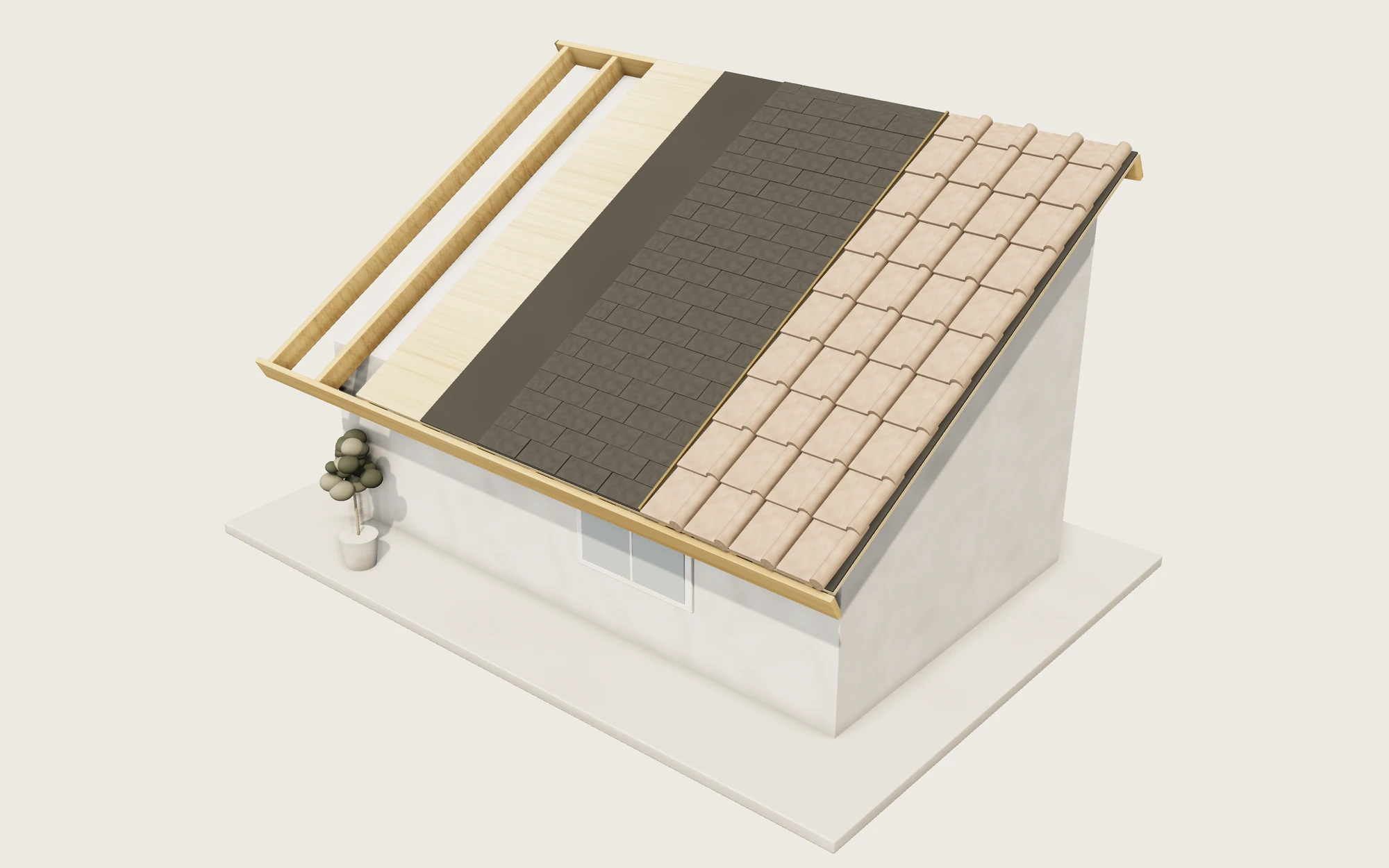
On most Arizona tile roofs, the tile outlives the underlayment by 25 years or more. The original organic felt under the tile typically starts failing around year 18 to 22 from heat and UV exposure, even though the tile on top still looks fine from the street (Power Peak Roofing).
The fix is a lift and relay. The crew removes the tiles, installs a high-temperature underlayment rated for Phoenix roof deck temperatures, adds valley metal, edge metal and flashing at every penetration, then resets the same tiles with new fasteners to current Arizona wind code. Typical Phoenix-area tile underlayment replacement projects start around $11,000 to $22,000. Two-story or steep-pitch jobs run $18,000 to $30,000, and a partial section where only one slope or valley is failing runs $3,800 to $8,500. Lift and relay typically costs 30 to 40 percent less than a full tile replacement.
Cool roofs and the heat
Standard black asphalt roofing can reach summer midday temperatures of roughly 165°F to 185°F. Highly reflective, high-emittance cool roofs reach peak temperatures of about 110°F to 115°F, according to EPA figures cited by TraVek. The U.S. Department of Energy reports that, under favorable hot-climate conditions, replacing a conventional roof with a cool roof can cut a single-story building's annual air-conditioning energy use by up to 15%.
Phoenix cool roof requirements apply to new construction and roof replacements where more than 50% of the roof area is being replaced, with exemptions for historic buildings, rooftop equipment areas and vegetated roofing sections. For steep-sloped roofs (greater than 2:12 pitch), the minimum is initial solar reflectance of 0.25 and thermal emittance of 0.75, or an SRI of at least 29 (East Valley Foam & Coating). Mesa and Tempe adopted the International Energy Conservation Code with local amendments that include cool roof provisions similar to Phoenix's.
The Cool Roof Rating Council tests and publishes performance ratings for roofing products. The Solar Reflectance Index combines reflectance and emittance to compare how hot different surfaces get in sunlight. Ask your roofer for the CRRC rating of the exact product in the bid. Cool-rated shingles are worth it as part of a planned replacement. They are not a reason to remove a serviceable roof.
Why Phoenix roofs fail when they do
Phoenix gets little rain, and it usually arrives fast. The 1991-2020 normals put Phoenix's average annual rainfall at 7.22 inches, down 0.81 inches from the prior normal (NWS Phoenix). Scottsdale averages 8.73 inches and Phoenix/Deer Valley Airport 8.90 inches. The Southwest is drier under the new normals. The largest percentage reductions in Southwest precipitation came in the spring and autumn transition months.
The rain arrives with the monsoon, which typically spans the latter half of June through September. Downburst wind speeds can reach 50, 60 and 70 mph, and in rare cases exceed 100 mph (NWS Albuquerque). Downburst winds have toppled trees, fences, utility poles and lines. Powerful haboobs can strip granules and expose underlayment. Phoenix codes address wind uplift and moisture protection for exactly this climate (OneClick Code).
Heat does the rest. Arizona has seen half a century of increasing annual temperatures, with the last year to fall below the middle third of its normals being 1982. Scottsdale's 1991-2020 average annual temperature is 73.3°F, up 0.8°F from the prior normal. A roof can sit dry for months with a cracked vent boot or a lifted tile. Nobody notices until the first storm.
Plan inspections and repairs in late spring, before the monsoon. A roofer can reseal flashing, replace cracked tiles, check the underlayment at the eaves and clear the valleys while the schedule is open. If a storm is already overhead and the roof is leaking, see our Phoenix plumbing guide for water damage and shutoff help.
Repair or replace?
Repair makes sense when the damage is local: a cracked vent boot, a few broken tiles, a lifted shingle tab, or failed flashing at a chimney or skylight. At Phoenix prices those run from about $68 to $450. A minor leak runs $135 to $900. A leak that has already soaked the deck or a ceiling costs $900 to $5,400.
Replacement starts to make sense when:
- Leaks show up in more than one place after the same storm
- Shingles are bald, curled or brittle over large areas
- The tile is fine but the underlayment is failing across the roof (a lift and relay may be the middle option)
- The roof is near the end of its material's lifespan
- You are replacing more than half the roof and the current surface is not a cool roof
Keep the 50% line in mind. Replacing more than half the roof triggers Phoenix's cool roof requirement.
Storm insurance claims
Before calling a roofer about storm damage, photograph the damage inside and out and call your insurer to open a claim. Get the adjuster's scope in writing and compare it line by line with the roofer's estimate. Be careful with anyone who knocks on doors after a storm. Arizona licenses contractors through the Registrar of Contractors, and you can check any license before you sign.
Do you need a permit?
Most municipalities in the Phoenix metro require permits for full or partial roof replacements and most structural repairs. Permit rules and fee thresholds vary by city (OneClick Code). Construction permits are issued at your local building department, and fees are based on the size and complexity of the project, with fee and valuation tables available at each department (AZBO).
Where you apply depends on where the house sits:
- City of Phoenix. The city uses the 2018 Phoenix Building Construction Code, which includes amendments to the 2018 IBC and the 2017 National Electrical Code, and the 2018 IRC with local amendments (BCAP).
- Unincorporated Maricopa County. The county's Planning and Development Department handles building permit review and inspection for unincorporated areas. All new permit and plan applications go through the county's Permit Center, the online system launched in June 2024 (Maricopa County). If your project is in unincorporated Maricopa County you need a county permit; otherwise you start with your city or town. The county's phone number is 602-506-3301.
- Tempe. All building permit applications go through the Tempe Citizen Access Portal, and a registered account is required (City of Tempe). Tempe publishes a fee schedule covering plan review and building permits.
- Chandler. Chandler adopted the 2024 International Codes with the 2023 National Electrical Code, and plans submitted on or after July 1, 2025 must comply with those editions (City of Chandler). Inspections can be scheduled through the automated system at 480-782-3100.
- Peoria. Peoria encourages submitting permit applications through its Development Services online portal, and for most projects plans must be reviewed before a building permit is issued (City of Peoria). Development Services can be reached at (623) 773-7225.
- Scottsdale and Mesa. Both apply their own additional requirements on top of the base code, including unique fastening patterns or inspection protocols, so an address-level check matters.
Arizona law requires homeowners selling a home to fully disclose all remodeling work and whether permits were obtained (AZBO). A permit is issued in the name of the party performing the work. A certified inspector can examine the work to make sure it is done safely and according to code. That record is what a buyer's inspector or your insurer will look for later.
If your community has an HOA, review the CC&Rs before any modification. It is the property owner's responsibility, not the county's, and a building permit does not prevent an HOA from enforcing its rules (Maricopa County). Scottsdale HOAs may regulate roofing materials, colors, visible finishes and exterior changes through CC&Rs or an architectural review process, and Scottsdale also has design standards in certain zoning contexts that address glare and highly reflective exterior materials (TraVek).
How to check a roofer before you hire
Arizona licenses contractors through the Registrar of Contractors, which regulates over 60,000 residential and commercial contractors (AZ ROC). Any business that contracts or offers to contract to build, alter, repair, add to or improve a building must be a licensed contractor. Contractors must be properly licensed before submitting bids (AZ ROC).
- Look up the license number on the AZ ROC search. The status should be active and the business name should match the bid.
- Confirm the license bond. Applicants must obtain and submit proof of a license bond before the license is issued.
- Check that an LLC or corporation is registered with the Arizona Corporation Commission and in good standing, which the ROC requires to get and renew a license.
- Read the complaint history. ROC staff investigate and work to resolve complaints against licensed pros and unlicensed entities.
- Get a written contract that names the product line, the CRRC rating, the underlayment, the flashing and who pulls the permit.
- Ask who handles the city permit and HOA paperwork, and get it in writing.
Arizona has no direct reciprocity with any state for contractor licensing, so a roofer licensed elsewhere is not licensed here. The ROC office is in Phoenix at 1700 W. Washington St. Suite 105, and customer service runs Monday through Friday, 8:30 am to 4:30 pm.
GOLDGCP checks every roofer before they join: state license verification, insurance, a background and business check, a portfolio review, client reference calls, and onboarding with a quality score. You pay your pro directly, stage by stage, each milestone after you approve that stage. Read more about how milestone payments work.
Areas we cover
Roofers in the GOLDGCP network work across the Valley of the Sun:
- Phoenix
- Scottsdale
- Mesa
- Tempe
- Chandler
- Gilbert
- Glendale
- Peoria
Enter your ZIP code to see roofing prices for your street and get matched with a local roofer.
How GOLDGCP works
- Tell us about the roof: material, rough size, the leak or the plan. Use the form, call or send a WhatsApp message.
- You see prices for your ZIP code, then we match you with up to 3 vetted, licensed roofers.
- Your roofer inspects, gives a written estimate, pulls the city or county permit and orders the right cool roof product.
- You pay your pro directly, stage by stage: for example after tear-off and deck inspection, and after the final inspection. Track it all in the client portal.
For an active leak during a monsoon storm, call our 24/7 emergency line.
Frequently asked questions
How much does a new roof cost in Phoenix?
For about 2,000 square feet of roof, expect $6,300 to $12,600 in asphalt shingles, $9,000 to $28,800 in metal and $12,600 to $45,000 in tile. A flat roof over 1,000 square feet runs $2,700 to $9,900. Two-story access, tear-off of old layers and deck repairs push the price up.
How much does roof repair cost in Phoenix?
Small fixes such as a vent boot, up to 25 shingles or a flashing repair cost about $68 to $450. A minor leak runs $135 to $900. If water has already damaged the deck, insulation or a ceiling, plan on $900 to $5,400.
Do I need a permit to replace my roof in Phoenix?
Most municipalities in the Phoenix metro require permits for full or partial roof replacements and most structural repairs. Where you apply depends on the address: the City of Phoenix, the city or town for incorporated areas, or Maricopa County for unincorporated areas. Rules and fee thresholds vary by city.
What is a tile lift and relay, and what does it cost in Phoenix?
The crew removes the tiles, installs new high-temperature underlayment and flashing, then resets the same tiles with new fasteners. Typical Phoenix-area projects start around $11,000 to $22,000. Two-story or steep-pitch jobs run $18,000 to $30,000, and a partial section runs $3,800 to $8,500.
Does a new roof in Phoenix have to be a cool roof?
Phoenix cool roof requirements apply to new construction and replacements where more than 50% of the roof area is being replaced. Steep-sloped roofs need initial solar reflectance of at least 0.25 and thermal emittance of 0.75, or an SRI of at least 29. Mesa and Tempe have similar provisions.
When should I fix my roof in Phoenix?
Late spring, before the monsoon. The monsoon typically runs from the latter half of June through September, with downburst winds that can reach 50 to 70 mph. Booking an inspection in April or May avoids the post-storm rush and gives the roofer time to reseal flashing and check the underlayment.
What license does a roofer need in Arizona?
An active license from the Arizona Registrar of Contractors. Any business that contracts to repair or improve a building must be licensed, and contractors must be licensed before submitting bids. Check the license, the bond and the complaint history at roc.az.gov before you sign anything.
How we calculate these prices
GOLDGCP starts from national price ranges for each job, taken from published 2026 cost guides and checked against local price guides where they exist. To get a local price, we multiply the national range by the construction cost factor for the metro from the U.S. Army Corps of Engineers Area Cost Factors (US average = 1.00). Where that table has no entry for a metro, we use the nearest listed location or the state value. For ZIP codes outside the 50 largest metros, the cost estimator uses the state's price level from the Bureau of Economic Analysis Regional Price Parities. Ranges include labor and standard materials but not unusual site conditions, so a written quote after an inspection is always the final price.
Sources
- TraVek Remodeling & Roofing
- Power Peak Roofing
- East Valley Foam & Coating
- National Weather Service · National Weather Service
- National Weather Service · National Weather Service
- OneClick Code
- azbo.us
- bcapcodes.org
- Maricopa County, AZ
- tempe.gov
- chandleraz.gov
- peoriaaz.gov
- Maricopa County Planning and Development Department
- Arizona Registrar of Contractors · Search
- Arizona Registrar of Contractors · Applying for a License
- U.S. Army Corps of Engineers
- U.S. Bureau of Economic Analysis

About this guide
Written by the GOLDGCP editorial team. Prices come from national cost guides adjusted with official construction cost factors for Phoenix; rules and statistics come from the agencies and reports linked in the text. We update this page when prices or codes change.