
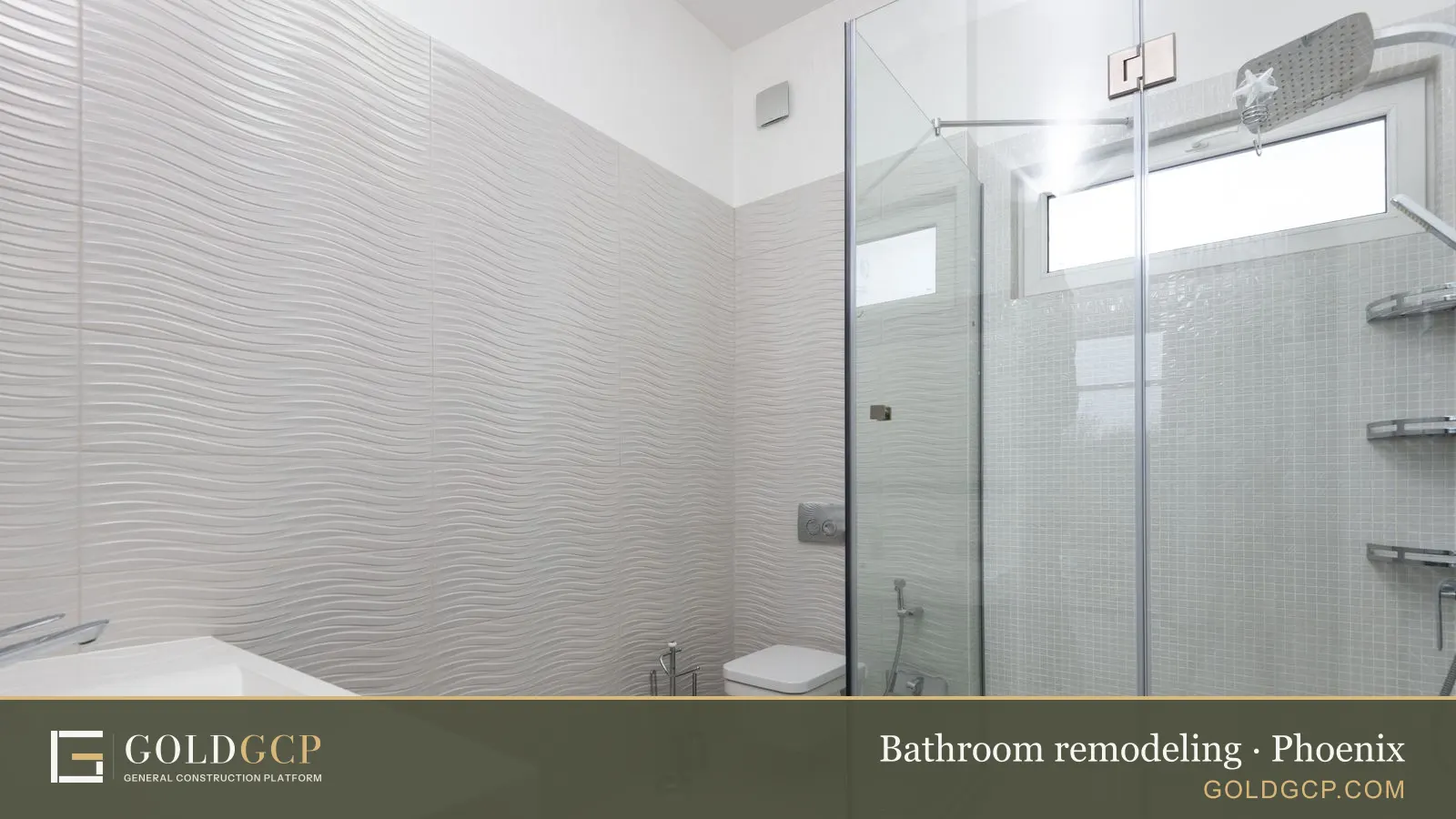
The short answer
A mid-range full bathroom remodel in Phoenix runs about $8,100 to $25,200 by our cost-adjusted figures, and a primary bath $18,000 to $54,000. Keeping the toilet and shower where they are avoids saw-cutting the concrete slab and keeps the permit simple.
What a bathroom remodel costs in Phoenix
Our numbers start with national remodeling cost data and apply the Phoenix construction cost factor of 0.90, published by the U.S. Army Corps of Engineers. The same bathroom costs about 10% less here than the national average.
| Job | Phoenix (typical range) | US average |
|---|---|---|
| Half bath (powder room) remodel | $3,600–$12,600 | $4,000–$14,000 |
| Full bathroom, cosmetic refresh | $4,850–$15,100 | $5,400–$16,800 |
| Full bathroom remodel, mid-range | $8,100–$25,200 | $9,000–$28,000 |
| Full bathroom, high-end | $12,150–$37,800 | $13,500–$42,000 |
| Primary bathroom remodel | $18,000–$54,000 | $20,000–$60,000 |
| Tub-to-shower conversion | $1,800–$10,800 | $2,000–$12,000 |
| Tile, installed | $9–$36/sq ft | $10–$40/sq ft |
| New toilet, installed | $315–$720 | $350–$800 |
| New faucet, installed | $110–$270 | $120–$300 |
Estimates for 2026, including labor and standard parts. Phoenix prices use the metro's construction cost factor of 0.90 (US average = 1.00) from the U.S. Army Corps of Engineers Area Cost Factors. Your quote depends on access, materials and the condition of the home.
Small rooms cost more per square foot, because the valve, toilet and vanity cost the same whether the room is 40 or 80 square feet. Tile swings the most: $9 to $36 per square foot installed here, depending on whether you choose ceramic or large-format porcelain.
For your own room size, finish level and ZIP code, use the cost estimator below.
The slab is the hidden line item
Most Valley houses sit on a concrete slab, so moving a drain means saw-cutting a trench through the floor, breaking concrete, relocating the drain and vent, then patching. A house with a crawl space is a different job, because a plumber can reach the line from below. A toilet also needs a 3-inch drain with a vent close enough to satisfy the plumbing code, so a small move can turn into a big one.
Every fixture that stays in place saves money. A tub-to-shower conversion in the same footprint runs $1,800 to $10,800 here. Move the drain to the other wall and the plumbing line grows well beyond that.
What drives a Phoenix bathroom budget
| Choice | Lower cost | Higher cost |
|---|---|---|
| Shower | Tub with tile surround, same spot | Walk-in shower with glass, tub removed |
| Tile | Ceramic on the walls, about $9 per sq ft installed | Large-format porcelain or stone, up to about $36 per sq ft |
| Toilet | Standard model swapped in place, $315 to $720 installed | Wall-hung toilet with a new carrier in the wall |
| Faucet | Standard set, $110 to $270 installed | Widespread or thermostatic set |
| Layout | Everything stays | Toilet or shower moved, wall shifted |
Building a shower that survives Phoenix
A leaking shower soaks the framing and subfloor long before anyone sees a stain. In a slab house the water goes sideways into the walls and the room next door.
What the inspector checks
Phoenix uses the 2018 Phoenix Building Construction Code, which includes the 2018 International Residential Code with local amendments, according to the Building Codes Assistance Project. The shower items that matter:
- Pan: a continuous waterproof pan tied into the drain and flood-tested before any tile goes down.
- Valve: an auto-compensating mixing valve, thermostatic or pressure balancing, sized for the showerhead's flow rate. The U.S. Department of Energy notes this valve reduces the risk of thermal shock and scalding when someone else opens a tap. An old two-handle valve cannot stay once the wall is open.
- Glass: tempered or laminated safety glass in doors and tub enclosures.
- Fan: an exhaust fan ducted outside, never into the attic.
Heat, dust and monsoon moisture
Phoenix averages 7.22 inches of rain a year, according to NWS Phoenix, and most of it arrives in a short monsoon season that typically runs from the latter half of June through September (NWS Albuquerque). A bathroom with a window or a vent that leaks lets in blowing dust during monsoon downbursts, which can reach 50 to 70 mph. The dry months also pull moisture out of the air fast, so a shower that leaks slowly may not show a stain for a long time. The flood test before tile is the reliable check.
Hard water and what it does to a bathroom
Valley water carries dissolved minerals that leave scale on glass, faucets and tile grout. Scale etches shower glass over time and shortens the life of a cartridge valve. A water softener or a whole-house filtration system is a common addition during a remodel, and it is cheapest to rough in the loop while the walls are open. If you are already planning plumbing work, ask the remodeler whether the softener loop can go in the same permit.
Water-saving fixture rules in Arizona
Federal standards set the floor for what can be sold. Lavatory faucets and aerators made and sold in the U.S. after January 1, 1994 must use no more than 2.2 gallons per minute, and showerheads no more than 2.5 gpm, per the U.S. Department of Energy. WaterSense-labeled bathroom faucets go further, at 1.5 gpm or less, and WaterSense showerheads at 2 gpm or less.
| Fixture | Federal limit | WaterSense |
|---|---|---|
| Bathroom faucet | 2.2 gpm | 1.5 gpm or less |
| Showerhead | 2.5 gpm | 2 gpm or less |
Test system pressure during the remodel. The DOE says pressure should sit between 20 and 80 psi: too low and high-efficiency fixtures won't work properly, too high and they use more water than rated. Skip touchless faucets in a home bathroom. The DOE notes that automatic sensors are not conservation devices and can waste water by triggering when not needed.
Planning for aging in place
A bathroom remodel is the cheapest time to make the room work for someone with a walker, a bad knee or a wheelchair, because the walls and floor are already open.
| Feature | What it involves | Notes |
|---|---|---|
| Wood blocking for grab bars | Added in the wall framing before backer board goes up | Small cost if done during framing |
| Grab bar | Installed into blocking or studs | Cheap once blocking exists |
| Curbless (zero-threshold) shower | Recessed floor, linear drain, wider waterproofing | Structural work in a slab house |
| Wider clearances | Room in front of and beside the toilet | Planning only, unless walls move |
The curbless shower changes the permit. In a slab-on-grade Phoenix house, recessing the floor for a zero-threshold entry means cutting and re-pouring concrete, which is structural work and moves the project into plan review. The code also sets minimum clearances around a toilet, including space to each side and clear floor area in front. In a narrow hall bath, those numbers often decide whether a wider shower fits at all. Ask the designer to draw the turning space before you choose tile.
Do you need a permit?
In every Valley city, a real bathroom remodel needs a permit. Paint, a mirror, towel bars and floor tile alone do not.
| Bathroom work | Permit | Path |
|---|---|---|
| Paint, mirror, towel bars, floor tile only | No | None |
| Toilet, tub, valve or sink replaced in the same spot | Yes, plumbing | Often over the counter |
| Tub-to-shower conversion with nothing structural | Yes, combined permit | Over the counter or e-plan |
| New circuit, GFCI outlet or exhaust fan | Yes, electrical or mechanical | Over the counter |
| Moving a drain to a new spot | Yes, plumbing | Plan review in most cities |
| Recessed floor for a curbless shower, moved wall, larger window | Yes, building | Plan review |
Each city runs its own counter, and the process differs enough to plan around.
- Phoenix enforces the 2018 Phoenix Building Construction Code, which includes the 2018 IRC with local amendments (BCAP).
- Chandler offers walk-in plan review Monday through Friday, 8 a.m. to 4:30 p.m., for residential and small commercial projects, and most residential renovations qualify. Plans submitted on or after July 1, 2025 must meet the 2024 International Codes and the 2023 National Electrical Code. Inspections are scheduled at 480-782-3100 (Chandler Building Safety).
- Tempe requires plan approval before a permit is issued for remodels, and all applications go through the Tempe Citizen Access Portal. Inspection requests received before midnight are inspected the following business day between 6:30 a.m. and 3:30 p.m. (Tempe).
- Peoria requires plans submitted for review before a building permit for most projects, and encourages submittals through its Development Services online portal (Peoria).
- Scottsdale, Mesa, Gilbert and Glendale run their own counters under the same state code family. Ask your remodeler which counter handles your address before the bid is signed.
- Unincorporated Maricopa County is handled by Maricopa County Planning and Development, which regulates development outside city limits. All new permit applications go through the county's Permit Center, launched in June 2024. The county warns it will never request payment by wire transfer, and all payments go through Permit Center (Maricopa County).
Fees follow the value of the work, and Maricopa County says fees vary widely by project type, valuation and site (Maricopa County fee schedule). For a bathroom, expect a few hundred dollars, not thousands. The county publishes fee estimators and answers fee questions at 602-506-3301.
A building permit does not override your HOA's CC&Rs. The county puts the responsibility on the property owner to check HOA rules before any modification (Maricopa County).
How long a bathroom remodel takes in Phoenix
| Scope | Permit time | Build sequence |
|---|---|---|
| Fixtures swapped in place | Days to 2 weeks | Demo, rough-in, final |
| Fixtures moved or shower enlarged | About 3 to 8 weeks | Adds a rough plumbing test before walls close |
| Gut remodel with structural change | Several weeks to a few months | Adds plan review corrections and framing inspection |
On site, the work follows a fixed order. Crews demolish to the studs, repair framing and add grab bar blocking, run rough plumbing, electrical and the fan, pass one rough inspection on a combined permit, install backer board and waterproofing with the pan flood test, then set tile and fixtures, measure and hang glass, and pass the final inspection. Glass is measured after the tile is done.
Summer changes the schedule. In a house with no air conditioning, thinset can skin over before you set the tile, and workers lose hours to heat. Most Valley remodelers start early and schedule interior work around the worst of July and August. If this is the only bathroom in the house, agree with the remodeler on how you will have a working toilet each night.
How to check a bathroom remodeler before you hire
Arizona licenses contractors through the Arizona Registrar of Contractors, which regulates more than 60,000 residential and commercial contractors.
If the entire project cost, including labor and materials, is over $1,000, or the work requires a permit from the local city, the person or business doing the work must be licensed (AZ ROC). That rules out any unlicensed handyman for a bathroom remodel.
| What to check | How |
|---|---|
| License active and in the right name | Search at roc.az.gov |
| The person you are talking to is authorized | Call the phone number listed on the license |
| Bond on file | The license requires a license bond (AZ ROC) |
| Complaint history | AZ ROC investigates complaints against licensed pros |
Arizona licenses belong to the business, not to the individual qualifier, so confirm the company name on the bid matches the license. Licensed pros must list their ROC license number on advertisements and correspondence. If something goes wrong, you can file a complaint against the license within two years of occupancy or the last work, and under certain conditions apply to the Registrar's Residential Contractors' Recovery Fund for up to $30,000 to have work corrected or completed (AZ ROC).
Ask these questions before signing:
- How do you build the shower pan, which waterproofing system do you use, and do you flood-test before tile?
- Who pulls the permit, and is the permit fee in the bid?
- If the drain moves, is the concrete cutting and patching included?
Our guide to paying a contractor covers milestones and lien releases. For plumbing problems outside a remodel, see our Phoenix plumbing guide. If your project grows into a layout change or an addition, our residential design and permit drawings guides explain what an architect or designer adds.
Areas we cover
GOLDGCP bathroom remodelers work across the Valley, including:
- Phoenix
- Scottsdale
- Mesa
- Tempe
- Chandler
- Gilbert
- Glendale
- Peoria
Enter your ZIP code to see bathroom prices and the remodelers who cover it.
How GOLDGCP works
- Describe the bathroom through the form, a call or WhatsApp: its size, what you want to change and whether the toilet or shower moves.
- We match you with up to 3 vetted, licensed remodelers in your area, and you see prices by ZIP code before anyone visits.
- Each remodeler has passed six-step vetting: state license verification, an insurance check, a background and business check, a portfolio review, client reference calls, and onboarding with a quality score.
- Your remodeler pulls the permit and books the inspections.
- You pay in milestones, each one after you approve that stage, and follow the job in the client portal.
Frequently asked questions
How much does a bathroom remodel cost in Phoenix?
By our cost-adjusted figures, a mid-range full bathroom costs about $8,100 to $25,200, a powder room $3,600 to $12,600 and a primary bath $18,000 to $54,000. A cosmetic refresh runs $4,850 to $15,100. Moving drains in a slab house pushes costs higher.
Do I need a permit to remodel a bathroom in Phoenix?
Yes, if you replace or move a toilet, tub, shower valve or sink, add a circuit or install a fan. Paint, accessories and floor tile alone need no permit. Moving a drain or recessing the floor for a curbless shower requires plan review in most Valley cities.
What does a Phoenix inspector check in a new shower?
A waterproof pan flood-tested before tile, an anti-scald mixing valve sized for the showerhead, safety glass in doors and enclosures, and an exhaust fan ducted outside rather than into the attic. The city enforces the 2018 Phoenix Building Construction Code, which includes the 2018 IRC.
How much does it cost to move a toilet in a Phoenix bathroom?
More than in a house with a crawl space, because most Valley homes sit on a concrete slab. Moving the drain means saw-cutting the floor, relocating the drain and vent, and patching the concrete. Keeping the toilet in place avoids that cost entirely.
Can I get a curbless shower in a slab-on-grade Phoenix house?
Usually, but recessing the floor for a zero-threshold entry means cutting and re-pouring concrete, which is structural work and needs plan review. Add grab bar blocking while the walls are open. It is the cheapest time to make the room work for someone with limited mobility.
How do I check a bathroom remodeler in Arizona?
Search the license at roc.az.gov and call the phone number listed on the license to confirm the person you are negotiating with is authorized. Any project over $1,000 or requiring a permit needs a licensed contractor. You can file a complaint within two years of occupancy.
Is a bathroom remodel worth it in Phoenix?
It is the room guests notice and the one that wears out fastest. Keeping the layout and drains in place is the easiest way to stay near the mid-range budget, and the slab makes that choice pay off more here than in most metros.
How we calculate these prices
GOLDGCP starts from national price ranges for each job, taken from published 2026 cost guides and checked against local price guides where they exist. To get a local price, we multiply the national range by the construction cost factor for the metro from the U.S. Army Corps of Engineers Area Cost Factors (US average = 1.00). Where that table has no entry for a metro, we use the nearest listed location or the state value. For ZIP codes outside the 50 largest metros, the cost estimator uses the state's price level from the Bureau of Economic Analysis Regional Price Parities. Ranges include labor and standard materials but not unusual site conditions, so a written quote after an inspection is always the final price.
Sources
- bcapcodes.org
- energy.gov
- National Weather Service · National Weather Service
- National Weather Service · National Weather Service
- City of Chandler
- City of Tempe
- City of Peoria
- Maricopa County Planning & Development Department · Maricopa County Planning & Development…
- Maricopa County Planning & Development Department · Fee Schedule and Estimators
- Maricopa County Planning & Development Department · Maricopa County Planning & Development…
- Arizona Registrar of Contractors · Arizona Registrar of Contractors
- Arizona Registrar of Contractors · Arizona Registrar of Contractors
- Arizona Registrar of Contractors · Applying for a License
- U.S. Army Corps of Engineers
- U.S. Bureau of Economic Analysis

About this guide
Written by the GOLDGCP editorial team. Prices come from national cost guides adjusted with official construction cost factors for Phoenix; rules and statistics come from the agencies and reports linked in the text. We update this page when prices or codes change.