
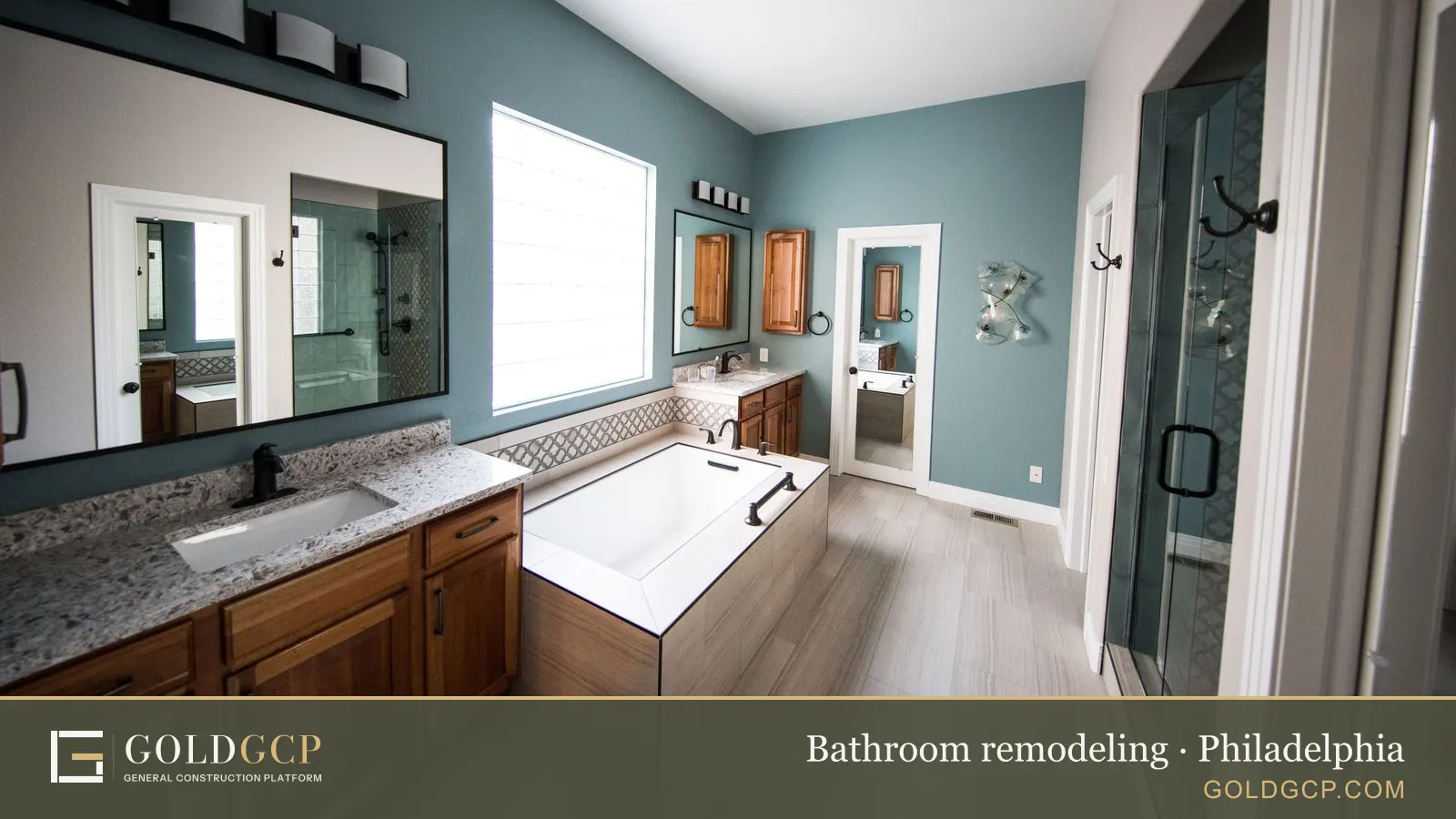
The short answer
A mid-range full bathroom remodel in Philadelphia costs about $10,350 to $32,200 by our cost-adjusted figures. The shower is where problems usually start. In an older rowhouse it sits over old framing, and how it is waterproofed decides whether the ceiling below stays dry.
What a bathroom remodel costs in Philadelphia
Our numbers start with national remodeling cost data and apply the Philadelphia cost factor of 1.15, published by the U.S. Army Corps of Engineers. The same bathroom costs about 15% more here than the national average.
| Job | Philadelphia (typical range) | US average |
|---|---|---|
| Half bath (powder room) remodel | $4,600–$16,100 | $4,000–$14,000 |
| Full bathroom, cosmetic refresh | $6,200–$19,300 | $5,400–$16,800 |
| Full bathroom remodel, mid-range | $10,350–$32,200 | $9,000–$28,000 |
| Full bathroom, high-end | $15,500–$48,300 | $13,500–$42,000 |
| Primary bathroom remodel | $23,000–$69,000 | $20,000–$60,000 |
| Tub-to-shower conversion | $2,300–$13,800 | $2,000–$12,000 |
| Tile, installed | $11.5–$46/sq ft | $10–$40/sq ft |
| New toilet, installed | $400–$920 | $350–$800 |
| New faucet, installed | $140–$345 | $120–$300 |
Estimates for 2026, including labor and standard parts. Philadelphia prices use the metro's construction cost factor of 1.15 (US average = 1.00) from the U.S. Army Corps of Engineers Area Cost Factors. Your quote depends on access, materials and the condition of the home.
For your own room size, finish level and ZIP code, use the cost estimator below or open the full bathroom cost estimator.
What drives a Philadelphia bathroom budget
| Choice | Lower cost | Higher cost |
|---|---|---|
| Shower | Tub with tile surround, same spot | Walk-in shower with glass, tub removed ($2,300 to $13,800 for the conversion here) |
| Tile | Ceramic on the walls, about $11.50 per sq ft installed | Large-format porcelain or stone, up to about $46 per sq ft |
| Toilet | Standard model swapped in place, $400 to $920 installed | Wall-hung toilet with a new carrier in the wall |
| Layout | Everything stays | Toilet or shower moved, wall shifted |
| Fixtures | New faucet at $140 to $345 installed | Branded thermostatic valve and rain head |
Small bathrooms cost more per square foot, because the valve, toilet and vanity cost the same whether the room is 40 or 80 square feet. A powder room is the cheapest project, and a primary bath with two sinks and a large shower is the most expensive.
Moving a drain in a rowhouse
Most Philadelphia bathrooms sit on wood joists over a basement, not on a concrete slab. That changes the plumbing. A plumber can often reach a new drain line from the basement ceiling, so moving a toilet a few feet is a framing and pipe job rather than a concrete-cutting job. In newer suburban housing in Bucks County and South Jersey, more bathrooms sit over slabs or finished basements, and a moved drain costs more.
The drain is only part of the plumbing work. A toilet needs a 3-inch drain with a vent close enough to satisfy the plumbing code, and a shower drain needs its own trap and vent. In a narrow rowhouse bath, the vent stack often sits in the wall behind the toilet, so a small move can turn into a bigger one once the wall is open.
Waterproofing and shower rules in Philadelphia
A leaking shower soaks the framing and the ceiling below long before anyone sees a stain. In a rowhouse, that ceiling belongs to your neighbor or your own first floor. Waterproofing has to keep water inside the shower.
What the inspector checks in the shower
Philadelphia enforces the 2021 International Codes, including the 2021 International Plumbing Code, for applications received on or after July 1, 2026 (L&I Code Bulletin B-2501). These shower items most often hold up a final inspection, so a remodeler should plan for them from day one:
- A waterproof pan tied into the drain and flood-tested before any tile goes down.
- A pressure-balance or thermostatic valve that keeps the water temperature steady when someone opens a tap elsewhere.
- Smooth, hard, nonabsorbent wall surfaces to the height the code requires, with moisture-resistant material behind them.
- Safety glass in shower doors and enclosures, and in any window close to the shower floor.
- An exhaust fan ducted outside, never into the attic or a party wall.
Ask your remodeler how they build the pan, which waterproofing system they use, and whether they flood-test before tile. If a remodeler cannot answer those questions in plain words, keep looking.
Ventilation in a small rowhouse bath
Philadelphia summers are humid, with about 30 days a year at 90°F or above at the airport, and the city gets about 44 inches of rain a year (NOAA normals). A small bathroom with a weak fan grows mold on the ceiling and around the tub. The fan must move enough air for the room size and vent outside through a duct with a backdraft damper. A fan that vents into the attic fails inspection and traps moisture in the roof framing.
Why old Philadelphia showers usually need more than new tile
Philadelphia has one of the oldest housing stocks of any big city in the country. About 40% of homes were built before 1940, more than 80% before 1980, and the median home dates from 1949 (ACS 2024). Tile set over sound backer board, with the fixtures left alone, needs no permit. In practice, once old tile comes off a shower more than 20 years old, the backer behind it is often soft. Replacing the backer and swapping the valve while the wall is open turns the job into a permitted remodel, so plan for that before demolition starts.
Water-saving fixture rules in Philadelphia
New fixtures sold in the United States meet federal flow limits, so fixtures from a Philadelphia showroom already comply. The local concerns are water quality and the pipes that carry it.
The Philadelphia Water Department owns the water main and the sewer, but the property owner is responsible for the water service pipe, the curb stop and all interior plumbing, including the main house drain and the sewer lateral (PWD). Thousands of properties in the city have a lead service line, and PWD publishes a service line map so you can check your address (PWD lead page). If the bathroom remodel includes new supply lines, ask the plumber what the incoming service is made of.
PWD also offers a free backwater valve through its Basement Backup Protection Program for homeowners whose water bill is current. That matters if your basement bathroom or laundry drain has ever backed up during a storm (PWD).
Planning for aging in place
A bathroom remodel is the cheapest time to make the room work for someone with a walker, a bad knee or a wheelchair, since the walls and floor are already open.
| Feature | What it involves | When to decide |
|---|---|---|
| Wood blocking for grab bars | Added in the wall framing before backer board goes up | During framing |
| Grab bar | Installed into blocking or studs | After tile |
| Curbless (zero-threshold) shower | Recessed or sloped floor, linear drain, wider waterproofing | Before demolition |
| Wider clearances | Room in front of and beside the toilet | Before the layout is drawn |
A curbless shower in a rowhouse usually means recessing the floor framing. That is structural work and moves the project into plan review. The code also requires a toilet at least 15 inches from its centerline to any side wall or fixture, with a 30-inch-wide space and 24 inches clear in front. In a narrow hall bath, those clearances often decide whether a wider shower fits. If someone in the house uses a wheelchair, have the designer draw the turning space before you pick tile. Our guide to 3D renderings shows how to see the finished room before anything is demolished.
Do you need a permit?
In most of the Philadelphia metro, a full bathroom remodel needs a permit, and the issuing office depends on which side of the city line you live on.
| Bathroom work | Permit |
|---|---|
| Paint, mirror, towel bars, floor tile only | No |
| Toilet, faucet or sink replaced in the same spot, pipes unchanged | Usually no |
| Tub-to-shower conversion with nothing structural | Yes, plumbing and often building |
| New circuit, GFCI outlet or exhaust fan | Yes, electrical or mechanical |
| Moving a drain to a new spot | Yes, plumbing |
| Recessed floor for a curbless shower, moved wall, larger window | Yes, building, with plan review |
Philadelphia: L&I and eCLIPSE
In the City of Philadelphia, the Department of Licenses and Inspections (L&I) issues permits through eCLIPSE. A plumbing permit is needed to install, alter, replace or repair plumbing, and a licensed master plumber must oversee the work (L&I plumbing permit). An electrical permit is needed for anything beyond routine maintenance, and a licensed electrical contractor must do the work. Electrical inspections in Philadelphia are done by a licensed private inspection agency hired by the owner, not by L&I staff (L&I electrical permit).
A typical Philadelphia bathroom permit set costs about $210 to $235 as of March 2026 (VM Power Construction). If the house is on the Philadelphia Register of Historic Places, the Historical Commission must approve any work that requires a building permit, and L&I will not issue one without that approval (Historical Commission).
Suburban Pennsylvania: the UCC and your township
In Bucks, Chester, Delaware and Montgomery counties, the Pennsylvania Uniform Construction Code applies, and each township or borough enforces it. A permit is required before altering or repairing a home or installing, altering or replacing a plumbing, electrical or mechanical system (34 Pa. Code 403.62). Ordinary repairs need no permit, but adding or relocating water, drain or vent piping or electric wiring does.
Bucks County township bathroom permit fees range about $200 to $600, with Newtown and Solebury trending higher (VM Power Construction). Pennsylvania has no statewide plumber license, but many municipalities require a licensed master plumber to pull plumbing permits. Ask your township before you hire.
South Jersey: the municipal construction office
In Cherry Hill and the rest of South Jersey, the New Jersey Uniform Construction Code applies, enforced by the municipal construction official. Cherry Hill directs applicants to the state Department of Community Affairs for construction permit applications (Cherry Hill Township). The local enforcing agency must act on a complete application within 20 business days (NJ DCA).
New Jersey's plumbing subcode is the National Standard Plumbing Code, not the IPC, and plumbing and electrical work may only be done by people licensed for it, except a single-family homeowner on their own dwelling (N.J.A.C. 5:23-2.15). The township will not issue a construction permit to an unregistered contractor.
Wilmington and New Castle County, Delaware
In northern Delaware, the New Castle County Department of Land Use issues permits for unincorporated county addresses, and the City of Wilmington Department of Licenses and Inspections issues them for city addresses. County rules exempt some work, such as window and door replacement of the same size in the same location, but interior alterations generally need a permit. Delaware licenses master plumbers, who may install water supply and drainage piping, fixtures and gas piping (Delaware Board of Plumbing). Ask the county or city office what your project needs before work starts.
How long a bathroom remodel takes
| Scope | Permit time | Build sequence |
|---|---|---|
| Fixtures swapped in place | Same day to 1 or 2 weeks | Demo, rough-in, final |
| Fixtures moved or shower enlarged | About 3 to 8 weeks | Adds a rough plumbing test before walls close |
| Gut remodel with structural change | About 6 to 14 weeks | Adds framing inspection and plan review corrections |
On site, the work follows a fixed order: demolition to the studs, framing repairs and grab bar blocking, rough plumbing, electrical and fan, one rough inspection, backer board and waterproofing with the pan flood test, then tile, fixtures, glass and the final inspection. Glass is measured after the tile is done. If this is the only bathroom in the house, agree with the remodeler on how you will keep a working toilet each night.
How to check a bathroom remodeler before you hire
The rules differ by state, so check the one that applies to your address.
| Where you live | What to check | Where to look it up |
|---|---|---|
| Philadelphia and suburban PA | PA Home Improvement Contractor (HICPA) registration | PA Attorney General HIC search |
| Philadelphia, plumbing or electrical | Philadelphia master plumber or electrical contractor license | L&I contractor search |
| South Jersey | NJ Home Improvement Contractor registration | NJ license verification |
| Wilmington and New Castle County | Delaware business license and state trade licenses | Delaware contractor registry |
Pennsylvania requires contractors who perform at least $5,000 of home improvements a year to register with the Attorney General's Office, and the registration number must appear on all ads, contracts, estimates and proposals (PA AG). Registration does not vouch for quality, so check references and get more than one bid.
New Jersey home improvement contractor businesses must be registered with the state, and bathroom remodeling is explicitly listed as covered work (NJ Division of Consumer Affairs). Current registrations expire on March 31, 2026, so confirm yours is active before you sign.
- Look up the registration or license, and confirm the name matches the contract.
- Ask how they build the shower pan and whether they flood-test before tile.
- Ask who pulls the permit and which office issues it.
- Ask for the insurance certificate and check the amounts.
- Read the contract for the start and completion dates, the payment schedule and the change-order rule.
In Pennsylvania, a home improvement contract over $5,000 may not take a deposit of more than one-third of the price, and no payment may be demanded before the contract is signed (HICPA). New Jersey advises consumers not to pay more than one third up front. Our guide to paying a contractor covers milestones and lien releases. For plumbing problems outside a remodel, see our bathroom remodeling guide.
Areas we cover
GOLDGCP bathroom remodelers work across the Philadelphia metro, in Pennsylvania, New Jersey and Delaware, including:
- Philadelphia
- The Main Line
- Bucks County
- Delaware County
- Cherry Hill and South Jersey
- Wilmington
Enter your ZIP code to see bathroom prices for your area and the remodelers who cover it.
How GOLDGCP works
- Describe the bathroom through the form, a call or WhatsApp: its size, what you want to change and whether the toilet or shower moves.
- We match you with up to 3 vetted, licensed remodelers in your area, and you see prices by ZIP code before anyone visits.
- Each remodeler has passed six-step vetting: state license verification, insurance check, background and business check, portfolio review, client reference calls, and onboarding and quality score.
- Your remodeler pulls the permit and books the inspections.
- You pay your pro directly, stage by stage, each milestone after you approve that stage, and follow the job in the client portal.
Frequently asked questions
How much does a bathroom remodel cost in Philadelphia?
By our cost-adjusted figures, a mid-range full bathroom costs about $10,350 to $32,200, a powder room $4,600 to $16,100 and a primary bath $23,000 to $69,000. Moving drains and replacing old backer board raise costs.
Do I need a permit to remodel a bathroom in Philadelphia?
Yes, if you replace or move a toilet, tub, shower valve or sink, add a circuit or install a fan. L&I issues permits through eCLIPSE, and a licensed master plumber must oversee plumbing work. Paint, accessories and floor tile alone need no permit. A house on the Philadelphia Register also needs Historical Commission approval.
What does a Philadelphia inspector check in a new shower?
A waterproof pan flood-tested before tile, an anti-scald valve, smooth nonabsorbent walls, safety glass in doors and nearby windows, and an exhaust fan ducted outside. The city enforces the 2021 International Codes for applications received on or after July 1, 2026.
Do I need a different permit in South Jersey or Wilmington?
Yes. In Cherry Hill and the rest of South Jersey, the municipal construction official enforces the New Jersey Uniform Construction Code, and the plumbing subcode is the National Standard Plumbing Code. In Wilmington and New Castle County, Delaware, the city or county building office issues the permit and state-licensed master plumbers do the plumbing.
How much does it cost to move a toilet in a Philadelphia rowhouse?
Often less than in a slab house, because a plumber can reach a new drain line from the basement ceiling. The cost depends on how far the drain moves and whether the vent stack has to be relocated. A toilet replaced in place costs about $400 to $920 here.
Can I get a curbless shower in an older Philadelphia rowhouse?
Usually, but recessing the floor framing for a zero-threshold entry is structural work, so it needs plan review, not a quick permit. Add grab bar blocking while the walls are open. In a narrow hall bath, the toilet clearances often decide whether a wider shower fits.
How do I check a bathroom remodeler in Philadelphia?
Look up the contractor's PA Home Improvement Contractor registration on the Attorney General's search, and confirm any plumber or electrician holds a Philadelphia license. In South Jersey, check the NJ Home Improvement Contractor registration. In Delaware, check the business license and state trade licenses.
How we calculate these prices
GOLDGCP starts from national price ranges for each job, taken from published 2026 cost guides and checked against local price guides where they exist. To get a local price, we multiply the national range by the construction cost factor for the metro from the U.S. Army Corps of Engineers Area Cost Factors (US average = 1.00). Where that table has no entry for a metro, we use the nearest listed location or the state value. For ZIP codes outside the 50 largest metros, the cost estimator uses the state's price level from the Bureau of Economic Analysis Regional Price Parities. Ranges include labor and standard materials but not unusual site conditions, so a written quote after an inspection is always the final price.
Sources
- phila.gov · phila.gov
- NOAA
- Census Reporter
- water.phila.gov · water.phila.gov
- water.phila.gov · water.phila.gov
- phila.gov · phila.gov
- phila.gov · phila.gov
- phila.gov · phila.gov
- VM Power Construction
- phila.gov · phila.gov
- pacodeandbulletin.gov
- Cherry Hill Township, NJ
- nj.gov
- Cornell Law School
- dpr.delaware.gov
- Pennsylvania Office of Attorney General · Home Improvement Contractor Search
- phila.gov · phila.gov
- newjersey.mylicense.com
- contractorregistry.delaware.gov
- Pennsylvania Office of Attorney General · Home Improvement Contractor Registration
- New Jersey Division of Consumer Affairs
- Pennsylvania Office of Attorney General · Pennsylvania Office of Attorney General
- usace.contentdm.oclc.org
- HomeGuide
- U.S. Army Corps of Engineers
- U.S. Bureau of Economic Analysis

About this guide
Written by the GOLDGCP editorial team. Prices come from national cost guides adjusted with official construction cost factors for Philadelphia; rules and statistics come from the agencies and reports linked in the text. We update this page when prices or codes change.