
The short answer
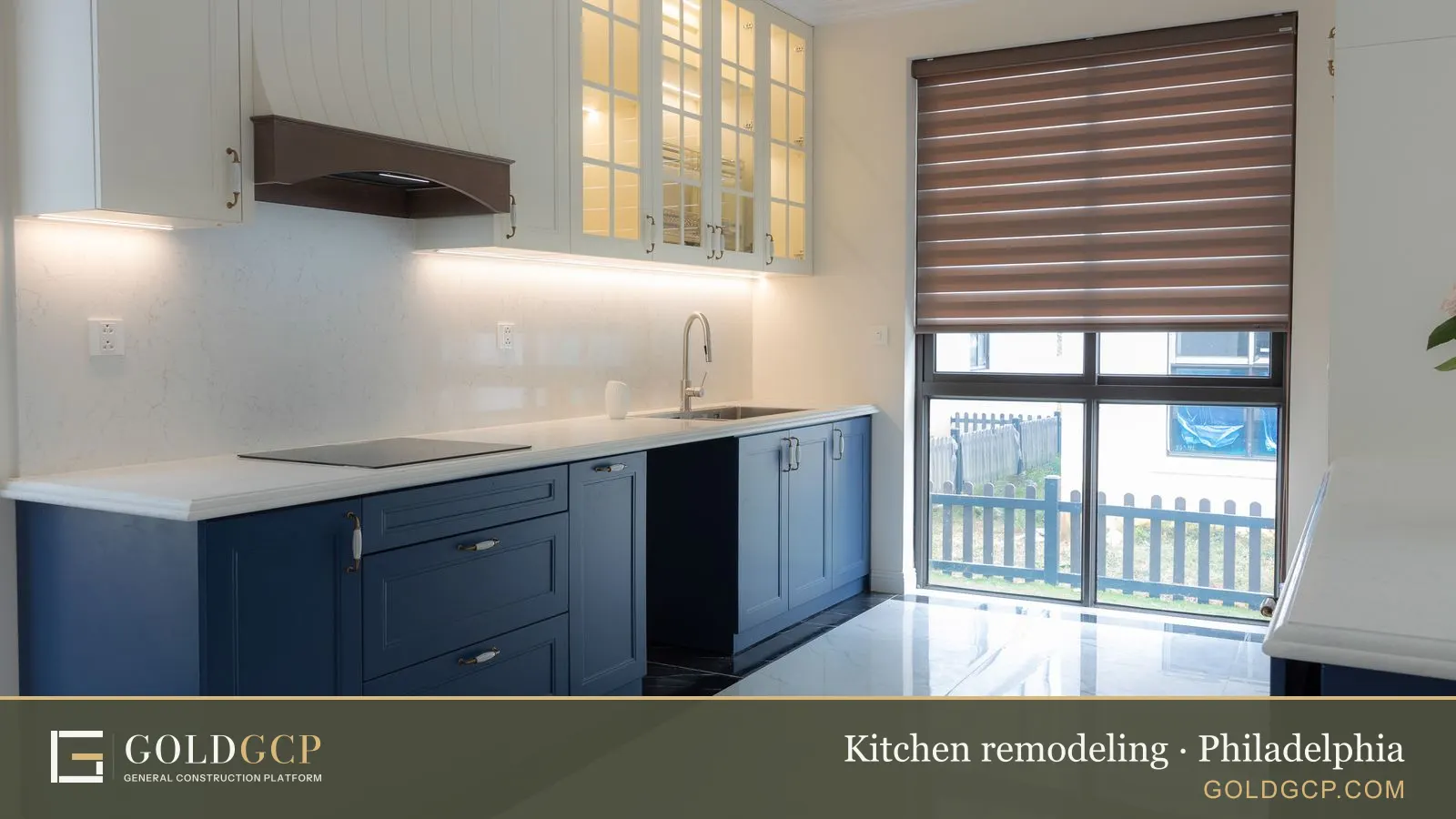
A mid-range remodel of a 150-square-foot kitchen in Philadelphia runs about $25,850 to $43,150 by our cost-adjusted figures. Your address is the biggest variable. Philadelphia, the PA suburbs, South Jersey and Wilmington each have their own permit office, license rule and inspection sequence, and your kitchen has to be built to the one that covers your block.
What a kitchen remodel costs in Philadelphia
The table starts from national remodeling cost data and applies the Philadelphia construction cost factor of 1.15 from the U.S. Army Corps of Engineers. That puts the metro about 15% above the US average for the same work.
| Job | Philadelphia (typical range) | US average |
|---|---|---|
| Cosmetic refresh, 150 sq ft kitchen | $12,950–$25,850 | $11,250–$22,500 |
| Mid-range remodel, 150 sq ft kitchen | $25,850–$43,150 | $22,500–$37,500 |
| High-end remodel, 150 sq ft kitchen | $43,150–$77,650 | $37,500–$67,500 |
| Small kitchen (10×10 ft), mid-range | $17,250–$28,750 | $15,000–$25,000 |
| Large kitchen (15×15 ft), mid-range | $38,800–$64,700 | $33,750–$56,250 |
| Stock cabinets, installed | $115–$460/lin ft | $100–$400/lin ft |
| Semi-custom cabinets, installed | $175–$805/lin ft | $150–$700/lin ft |
| Custom cabinets, installed | $575–$1,400/lin ft | $500–$1,200/lin ft |
| Appliance package | $2,900–$23,000 | $2,500–$20,000 |
| Moving plumbing or walls (add-on) | $5,750–$28,750 | $5,000–$25,000 |
| Permits | $575–$1,700 | $500–$1,500 |
Estimates for 2026, including labor and standard parts. Philadelphia prices use the metro's construction cost factor of 1.15 (US average = 1.00) from the U.S. Army Corps of Engineers Area Cost Factors. Your quote depends on access, materials and the condition of the home.
To price your own kitchen by size, finish and ZIP code, use the cost estimator. You can also open the full kitchen cost estimator.
Where the money goes
Cabinets are the largest single purchase. Installed, stock boxes cost about $115 to $460 per linear foot here, semi-custom $175 to $805, and custom $575 to $1,400. A narrow rowhouse galley and a Main Line kitchen with a long run of cabinets cost very different amounts at the same finish level.
Three other cost lines often surprise Philadelphia homeowners:
| Cost line | Why it shows up here | Typical effect |
|---|---|---|
| Moving plumbing, gas or walls | Opening a rowhouse kitchen usually means taking out a wall | About $5,750 to $28,750 on top of the remodel |
| Hidden conditions | The median Philadelphia home dates from 1949 | Hold 15% to 20% in reserve on pre-1980 houses |
| Code upgrades | A permit brings in detectors, and lead-safe work applies in pre-1978 homes | Depends on what the house already has |
The reserve figure comes from the housing stock. Census figures put 40% of Philadelphia homes built before 1940 and more than 80% before 1980, and 54.2% of city homes are attached single-family houses such as rowhouses. Opening a kitchen wall in an older rowhouse can reveal old wiring, galvanized supply lines or a party wall that was never framed for a beam, and none of that can be priced from a photo.
Homes built before 1978 add one more rule. Under the EPA's Renovation, Repair and Painting program, a contractor who is paid to disturb painted surfaces in an older home must be a certified firm and follow lead-safe work practices. Tearing out old cabinets and plaster counts as disturbing painted surfaces. If you rent out the unit, Philadelphia's lead law adds dust-wipe testing after the work.
Layout changes and what triggers a permit
Four permit authorities cover this metro, and the one that handles your address decides your schedule.
| Address | Permit office | What a kitchen remodel needs |
|---|---|---|
| City of Philadelphia | L&I, filed in eCLIPSE | Zoning permit in most cases, then a building permit; trade permits for plumbing and electrical |
| Suburban PA (Bucks, Delaware, Montgomery, Chester) | Your township or borough, or a certified third-party agency in opt-out towns | A UCC permit for structural, plumbing, mechanical or electrical work |
| South Jersey (Camden, Burlington, Gloucester) | The municipal construction official | A UCC construction permit with building, electrical, plumbing and mechanical subcodes |
| Wilmington and New Castle County, DE | City of Wilmington L&I, or New Castle County Land Use | A building permit, plus utility permits for plumbing and HVAC |
Philadelphia
In the city, paint, papering, floor coverings, cabinets and countertops do not need a building permit, according to the L&I building permit page. Non-structural interior alterations in a single-family home and removal of a non-load-bearing wall also skip the building permit and can go through an EZ permit. Most EZ permits are approved within 5 business days.
Anything else needs a full building permit. The filing fee is $25 for a one- or two-family home, plus a $3 city surcharge and a $4.50 state surcharge. Standard review takes 15 business days for one- and two-family alterations. An accelerated review within 5 business days costs $2,000. In most cases a zoning permit comes first.
Plumbing work needs a plumbing permit overseen by a licensed master plumber. Electrical work needs an electrical permit done by a licensed electrical contractor, at $25 per $1,000 of estimated electrical cost with a $63 minimum. Electrical inspections in Philadelphia are done by a private licensed inspection agency that you or your contractor hires. L&I staff do not inspect electrical work.
If the house is on the Philadelphia Register of Historic Places, the Historical Commission must approve changes that need a permit. Interior alterations are exempt unless the interior itself is designated. Project review is free, and staff approve over 90% of building permit applications without referral to the commission.
Suburban Pennsylvania
The suburbs enforce the PA Uniform Construction Code, and the 2021 I-codes have applied since January 1, 2026. A permit is required before altering a home or installing, altering or replacing an electrical, gas, mechanical or plumbing system. Ordinary repairs need no permit, but cutting a load-bearing wall, changing the means of egress, or adding or relocating wiring or piping is not an ordinary repair.
Pennsylvania's code exempts many like-for-like repairs, but townships and boroughs can require permits, so check before work starts. Most PA municipal permits are valid for 12 months, and a 6-month extension is usually available. Pennsylvania law also lets a homeowner pull a permit for work on their own primary residence.
South Jersey
New Jersey requires a UCC construction permit for structural, plumbing, mechanical and electrical work. The application uses Form F100, with subcode sections for building (F110), electrical (F120), plumbing (F130) and mechanical (F145). Submit one original plus three photocopies of each form, and have the electrical, plumbing and mechanical sections sealed by the corresponding licensee.
Cabinets, flooring and painting count as ordinary maintenance and need no permit. Cutting a load-bearing wall, moving water, sewer, gas or vent piping, and most new wiring do need a permit. The local enforcing agency must act on a complete application within 20 business days.
Wilmington and New Castle County
New Castle County requires a permit for all construction activity, including interior improvements and alterations, unless the work is specifically exempt. Residential renovations go through the county's eServices system, and plumbing and HVAC permits are handled as utility permits. The county does not permit or inspect electrical work. A state-licensed electrician must have the work inspected by a licensed inspection agency. An owner-occupant can get an electrical permit from the State of Delaware.
For city addresses, Wilmington L&I handles the permit. Projects over $10,000 need a City of Wilmington licensed general contractor, and projects over $25,000 need sealed plans.
What a Philadelphia permit costs
Across our price data, kitchen permits in the metro cost roughly $575 to $1,700. In the city, the fee depends on the valuation of the work, and trade permits are added per item. In the suburbs, fees vary by township. New Jersey fees are set locally and charged per permit, so an electrical permit and a plumbing permit are separate lines.
Electrical, gas and ventilation rules
Inspectors check kitchens against the code edition in force where you live, and these items most often change a design.
Counter circuits and outlets
A modern kitchen needs dedicated small-appliance circuits, GFCI protection at the counter, and receptacles spaced so no point along the counter is far from an outlet. Many older Philadelphia rowhouses fed the whole kitchen from one circuit, sometimes with knob-and-tube wiring behind the plaster. Bringing that up to code often means new wire runs back to the panel, and sometimes a larger panel. In Philadelphia, the electrical contractor pulls the permit and the private inspection agency signs off.
Gas lines to the range
Extending or adding a gas line to a range or cooktop is plumbing work under the permit. In Philadelphia a licensed master plumber oversees it. In South Jersey the plumbing subcode section must be sealed by a licensed master plumber. In Delaware, master plumbers may install gas piping. The gas utility depends on your address: PGW inside Philadelphia, PECO in the PA suburbs, South Jersey Gas or another utility in South Jersey, and Delmarva Power in northern Delaware.
Range hoods and ventilation
A ducted range hood has to vent outside. The duct route matters in a rowhouse where the range sits on an interior wall, and in a historic district a new exterior vent through historic siding can trigger review. Plan the duct path before cabinets are ordered.
What else the permit brings in
A kitchen permit pulls in work outside the kitchen. New Jersey requires smoke alarm and carbon monoxide alarm compliance as part of the permit. Philadelphia's lead law applies to rental units built before March 1978: the owner needs a lead-safe or lead-free certificate, and lead-safe certificates completed after February 1, 2020 are valid for four years. If you rent out the house, budget for dust-wipe testing after the remodel.
Philadelphia also requires water-saving fixtures under its plumbing code, and the city's 2021 code adoption means current energy provisions apply to new work. Ask your remodeler which of these your permit will trigger before you sign.
How long a Philadelphia kitchen remodel takes
| Phase | Same layout | Wall removed or layout changed |
|---|---|---|
| Permit | EZ permit in about 5 business days in Philadelphia; longer in the suburbs and New Jersey | Full review, 15 business days in Philadelphia plus zoning |
| Inspections | Rough and final for trades | Framing, rough and final |
| Total, start to finish | About 2 to 3 months | About 4 to 6 months |
Semi-custom and custom cabinets usually set the pace, so the order goes in as soon as measurements are final. In New Jersey, inspections run on the construction office's schedule, and the final building inspection comes after final plumbing, electric and fire inspections are approved.
Will a kitchen remodel pay off?
Resale value depends on the scope. A same-layout refresh that keeps cabinets in place and replaces fronts, counters and appliances costs the least and is the easiest to recover at sale. A full gut with a moved sink and an opened wall costs several times more, and buyers rarely pay the difference in full. If you plan to sell within a few years, spend on the layout you have. If you plan to stay, weigh the open plan by how you cook and live. Our remodel return estimator runs the numbers for your own budget.
How to check a kitchen remodeler before you hire
A kitchen remodel touches several trades, and the license you check depends on the state.
In Pennsylvania, any contractor doing more than $500 of residential work must register with the PA Office of Attorney General under the Home Improvement Consumer Protection Act. Look the registration up at hic.attorneygeneral.gov or call 1-888-520-6680. The registration number must appear on ads, contracts and estimates. Contractors must carry at least $50,000 of liability insurance for personal injury and $50,000 for property damage. In Philadelphia, a PA-registered home improvement contractor does not need a city Contractor License for work on existing one- and two-family homes, but electrical and plumbing work must be done by Philadelphia-licensed trades.
In New Jersey, home improvement contractors must be registered with the NJ Division of Consumer Affairs, and kitchen remodeling is explicitly covered. Verify the registration at the Division's lookup. Unregistered contractors will not be issued municipal construction permits. Electricians and master plumbers hold separate state licenses.
In Delaware, contractors need a Delaware business license from the Division of Revenue. Electricians and master plumbers are licensed by the Division of Professional Regulation. A contractor registry is at contractorregistry.delaware.gov.
Then read the contract. In Pennsylvania, a home improvement contract over $5,000 may not take a deposit of more than one-third of the price, or one-third plus designated special-order materials. No payment may be demanded before the contract is signed, and you have three business days to rescind. New Jersey requires a written contract over $500 with a three-day right to cancel, and the Division warns against paying more than one third up front. Delaware's 2023 home improvement regulation requires a written contract with all material terms and an approximate completion date. More on safe payments is in our guide to paying a contractor.
Areas we cover
GOLDGCP kitchen remodelers work across the Philadelphia metro, including:
- Philadelphia, from Center City and South Philly to the Northeast and Northwest
- The Main Line
- Bucks County and Delaware County
- Cherry Hill and South Jersey
- Wilmington
Each area runs under its own permit office and license rule, so the first question for any remodeler is which office handles your address. To see prices for your exact ZIP code, start with the search below.
How GOLDGCP works
- Tell us about your kitchen through the form, a call or WhatsApp: its size, what you want to change and your budget.
- We match you with up to 3 vetted, licensed remodelers who work in your area, and you see ZIP-based prices before anyone visits.
- If you are removing a wall, our in-house architects can prepare the drawings for plan review.
- Your remodeler pulls the permits and books the inspections with the right office for your address.
- You pay in milestones, each one after you approve that stage, and track progress in the client portal.
If you are sourcing cabinets or stone from overseas, our GCP Source and Ship service handles sourcing, factory inspection, shipping, customs and delivery to the jobsite.
Frequently asked questions
How much does a kitchen remodel cost in Philadelphia?
By our cost-adjusted figures, a 150-square-foot kitchen costs about $12,950 to $25,850 for a cosmetic refresh, $25,850 to $43,150 for a mid-range remodel and $43,150 to $77,650 for high-end work. A small 10 by 10 kitchen at mid-range runs $17,250 to $28,750, and a large 15 by 15 kitchen runs $38,800 to $64,700.
Do I need a permit to remodel a kitchen in Philadelphia?
No permit is needed for paint, cabinets, countertops or floor coverings. You do need a permit for new circuits, a moved sink, a gas line or a structural change. Non-structural interior alterations in a single-family home can go through an EZ permit, usually approved within 5 business days. A full building permit takes about 15 business days for review.
Who issues the permit in South Jersey?
The municipal construction official in your town, under the New Jersey Uniform Construction Code. You file Form F100 with subcode sections for building, electrical, plumbing and mechanical, one original plus three photocopies, and the office must act on a complete application within 20 business days.
What license should a kitchen remodeler have in Pennsylvania?
Registration with the PA Office of Attorney General under the Home Improvement Consumer Protection Act, verifiable at hic.attorneygeneral.gov. In Philadelphia, electrical work must be done by a Philadelphia-licensed electrical contractor and plumbing by a licensed master plumber. The suburbs set their own trade licensing, so ask the township.
Can I remove a kitchen wall in a Philadelphia rowhouse?
Only with a permit and, for a load-bearing wall, drawings. Removing a non-load-bearing interior wall in a single-family home can go through an EZ permit. A load-bearing wall needs a full building permit, and in a historic district the Historical Commission may need to review the change.
How long does a kitchen remodel take in Philadelphia?
About 2 to 3 months for a same-layout remodel and 4 to 6 months when a wall comes out or the layout changes. Permit review, cabinet lead times and inspection scheduling set the pace, and in Philadelphia standard review takes 15 business days for one- and two-family alterations.
Is a kitchen remodel worth it in the Philadelphia area?
A same-layout refresh that keeps cabinets in place is the easiest to recover at resale. A full gut with a moved sink and an opened wall costs several times more, and buyers rarely pay the difference in full. If you plan to sell soon, spend on the layout you have.
How we calculate these prices
GOLDGCP starts from national price ranges for each job, taken from published 2026 cost guides and checked against local price guides where they exist. To get a local price, we multiply the national range by the construction cost factor for the metro from the U.S. Army Corps of Engineers Area Cost Factors (US average = 1.00). Where that table has no entry for a metro, we use the nearest listed location or the state value. For ZIP codes outside the 50 largest metros, the cost estimator uses the state's price level from the Bureau of Economic Analysis Regional Price Parities. Ranges include labor and standard materials but not unusual site conditions, so a written quote after an inspection is always the final price.
Sources

About this guide
Written by the GOLDGCP editorial team. Prices come from national cost guides adjusted with official construction cost factors for Philadelphia; rules and statistics come from the agencies and reports linked in the text. We update this page when prices or codes change.