
The short answer
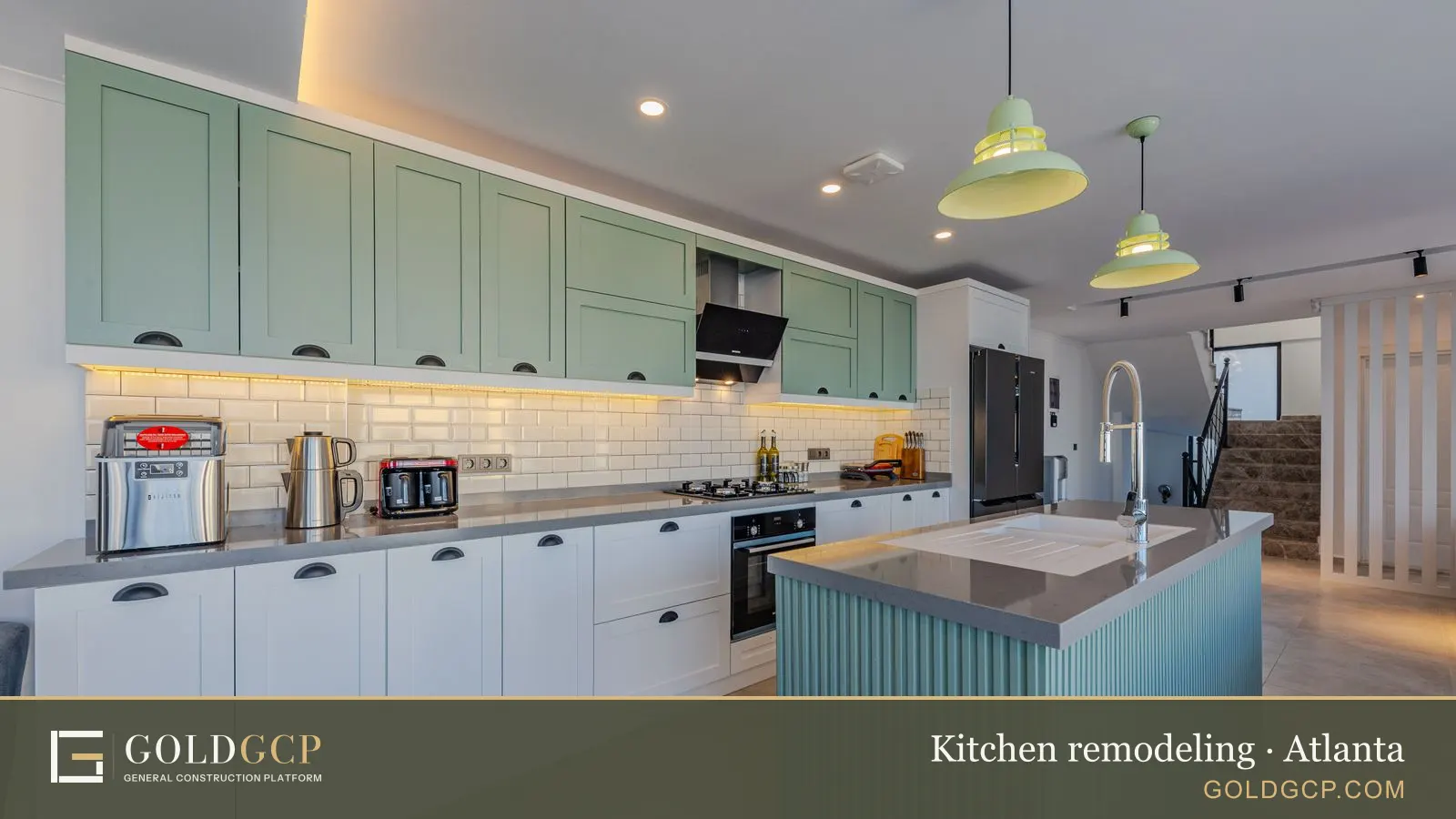
A mid-range remodel of a 150-square-foot kitchen in Atlanta runs about $19,150 to $31,900 by our cost-adjusted figures. The permit path is the biggest variable. Five different offices issue kitchen permits across this metro, and each one charges and reviews differently. Keeping the layout keeps the job simpler.
What a kitchen remodel costs in Atlanta
The table starts from national remodeling cost data and applies the Atlanta construction cost factor of 0.85 from the U.S. Army Corps of Engineers. That puts Atlanta about 15% below the US average for the same work.
| Job | Atlanta (typical range) | US average |
|---|---|---|
| Cosmetic refresh, 150 sq ft kitchen | $9,550–$19,150 | $11,250–$22,500 |
| Mid-range remodel, 150 sq ft kitchen | $19,150–$31,900 | $22,500–$37,500 |
| High-end remodel, 150 sq ft kitchen | $31,900–$57,400 | $37,500–$67,500 |
| Small kitchen (10×10 ft), mid-range | $12,750–$21,250 | $15,000–$25,000 |
| Large kitchen (15×15 ft), mid-range | $28,700–$47,800 | $33,750–$56,250 |
| Stock cabinets, installed | $85–$340/lin ft | $100–$400/lin ft |
| Semi-custom cabinets, installed | $130–$595/lin ft | $150–$700/lin ft |
| Custom cabinets, installed | $425–$1,000/lin ft | $500–$1,200/lin ft |
| Appliance package | $2,150–$17,000 | $2,500–$20,000 |
| Moving plumbing or walls (add-on) | $4,250–$21,250 | $5,000–$25,000 |
| Permits | $425–$1,300 | $500–$1,500 |
Estimates for 2026, including labor and standard parts. Atlanta prices use the metro's construction cost factor of 0.85 (US average = 1.00) from the U.S. Army Corps of Engineers Area Cost Factors. Your quote depends on access, materials and the condition of the home.
To price your own kitchen by size, finish and ZIP code, use the cost estimator. You can also open the full kitchen cost estimator.
Where the money goes in an Atlanta kitchen
Cabinets are the largest single purchase. Installed, stock boxes cost about $85 to $340 per linear foot here, semi-custom $130 to $595, and custom $425 to $1,000. A galley with 20 feet of cabinets and a U-shaped kitchen with 35 feet are very different budgets at the same finish level.
Three other cost lines often surprise Atlanta homeowners.
| Cost line | Why it shows up here | Typical effect |
|---|---|---|
| Moving plumbing, gas or walls | An open plan usually means taking out a wall | About $4,250 to $21,250 on top of the remodel |
| Hidden conditions | Much of the metro's housing is older than the kitchen | Local remodelers hold a contingency on pre-1980 houses |
| Termite and moisture damage | Georgia sits in what UGA Extension calls the termite belt | Repairs can appear once cabinets come out |
The age of the housing stock explains the last two lines. DeKalb County is the oldest county in the metro, with 44.1% of its homes built before 1980, and Decatur's median home dates to 1975, with 22.7% built before 1940. The City of Atlanta has about one home in eight built before 1940. Opening a 50-year-old kitchen wall can reveal undersized wiring, old drain lines or termite damage that no one priced beforehand.
Termites add real cost in Atlanta. UGA Extension says the yard of most Georgia homes holds one or more subterranean termite colonies, and swarmers fly most often from February to April. If your remodeler finds mud tubes when the cabinets come off, call a pest control company before any carpentry work starts. The Georgia Department of Agriculture's Structural Pest Division (404-656-3641) handles complaints about pest companies and termite letters.
Homes built before 1978 follow one more rule. Georgia runs its own lead-safe program through the Georgia Environmental Protection Division, not the EPA directly. Under the EPD's RRP program, a company that disturbs lead-based paint in a pre-1978 home must be certified, use certified renovators and follow lead-safe work practices. Demolishing old cabinets and plaster counts as disturbing paint. The EPD lead paint duty officer is at 404-363-7026.
Layout changes and what triggers a permit
Georgia has no single kitchen permit. The office that issues yours depends on the address, and the metro has five main paths.
| Where you live | Who issues the permit | What to know |
|---|---|---|
| City of Atlanta | Office of Buildings | Online through the Accela portal; residential counter at 55 Trinity Ave. SW, 404-330-6906 |
| Sandy Springs | City Community Development | Build Sandy Springs portal; 770-730-5600 |
| Marietta | City Permits and Inspections | Online through SagesGov; $5 per $1,000 of cost, $50 base |
| Unincorporated Cobb | Cobb Community Development | Fees by square footage and flat fees since July 1, 2024 |
| Unincorporated DeKalb | DeKalb Planning and Sustainability | Plans through ProjectDox; 404-371-2155 |
| Unincorporated Gwinnett | Gwinnett Planning and Development | ZIP Portal; 770-822-7700 |
| Lawrenceville | City Planning and Development | LPP Portal |
Check the parcel's jurisdiction first. DeKalb and Marietta both warn that a city address may belong to the city rather than the county. Cobb publishes an "Am I Located in a City?" map tool for the same reason.
What needs a permit and what does not
The City of Atlanta's work exempt from a permit list is the clearest guide in the metro. For an existing one- or two-family home, no permit is needed for replacing kitchen cabinets, bath cabinets or countertops without moving outlets, appliances or plumbing fixtures. Floor and wall coverings, interior painting and drywall up to three sheets are also exempt. Any repair work under $10,000 total valuation needs no permit if it is otherwise lawful.
Sandy Springs draws the same line. A permit is generally not required for cosmetic improvements such as painting or carpeting, and flooring installations do not need one. A building permit is required for projects involving multiple licensed trades or structural work. A project with only one licensed trade may qualify for a single trade permit, typically issued within one business day.
Gwinnett is similar: no permit for cosmetic repairs or remodels such as painting, new flooring, cabinets and vinyl siding.
A same-layout refresh that keeps the sink, range and outlets in place often needs no building permit. New circuits, a moved sink, a new gas line or a removed wall change that.
What a kitchen permit costs
Fees vary widely across the metro.
- City of Atlanta: the code sets a nonrefundable minimum application fee of $175, of which $25 funds technology, and building permit fees of $7.00 per $1,000 of valuation. Interior alterations without engineered structural work are valued at 20% of new-construction value. Permits needing plan review pay 50% of the total fee up front.
- Marietta: $5 per $1,000 of total construction cost, labor plus materials, with a $50 base fee and no plan review fee.
- Sandy Springs: $5.00 per $1,000 of building valuation data, plus a $25 administrative fee on every new application.
- Cobb County: residential building permit fees of $150 for construction cost of $15,001 to $25,000, $300 for $25,001 to $50,000, and $450 for $50,001 to $75,000. Trade permits cost $80 each.
- DeKalb County: minimum fees total $245, made up of a $195 minimum permit fee and a $50 certificate of occupancy fee.
Across our price data, Atlanta kitchen permits cost roughly $425 to $1,300.
Plan review and drawings
Georgia does not require stamped plans for residential structures, but Marietta's permit page notes that adding or removing loads on an existing structure, or any engineered design, requires a design professional. That rule applies to a wall removal. If you open a kitchen to the living room and add a beam, expect an engineer's drawings. Our page on permit drawings covers what reviewers expect to see.
Sandy Springs publishes its plan review timeline: each resubmission starts a new round that may take about 3 to 10 business days depending on complexity, and a $200 resubmittal fee is assessed on the third resubmission. After all reviews are approved, stamping drawings and issuing the permit card may take up to five business days.
Atlanta's Office of Buildings also requires a notarized Contractor License Affidavit or an Affidavit Concerning Exception to Contractor Licensing Requirements before it will issue a building permit, under O.C.G.A. 43-41-14.
Electrical, gas and ventilation rules in Atlanta kitchens
Georgia adopted the 2024 ICC codes and the 2023 National Electrical Code effective January 1, 2026, with Georgia amendments. DeKalb County confirms it adopted the 2024 ICC codes on that date. The energy code is still the 2015 IECC with Georgia Supplements and Amendments, and the metro sits in Climate Zone 3A, warm-humid.
Counter circuits and outlets
A kitchen with new appliances usually needs dedicated circuits. The electrical permit must be submitted by a licensed electrical contractor in DeKalb, and Marietta states plainly that homeowners cannot apply for mechanical, electrical or plumbing permits; the license holder must apply. Georgia's electrical contractor licenses come in two classes: Class I is restricted to single-phase installations that do not exceed 200 amperes at the service, and Class II is unrestricted. A company may do electrical contracting only if a licensed person is regularly connected with it full time.
Gas lines to the range
Gas piping on the outlet side of the meter counts as plumbing work under Georgia law, and a plumbing company must have a licensed Master Plumber connected with it full time. A Class I Master Plumber is limited to single-family and one-level dwellings for not more than two families and commercial structures up to 10,000 square feet. Extending a gas line to a new range is a plumbing permit, not a handyman job.
Range hoods and ventilation
The mechanical permit must be submitted by a licensed mechanical contractor in DeKalb. Conditioned air licenses come in Class I, for systems not exceeding 175,000 BTU of heating and 60,000 BTU of cooling, and Class II, unrestricted. Since December 1, 2021, HVAC businesses must show their registration number on both sides of work vehicles, in printed ads and on all invoices and proposals, so you can check it.
Ventilation matters more in a tight new kitchen than in an old one. Atlanta's cooling season is long. The airport sees 47.1 days a year at 90°F or hotter, and the July average high is 90.1°F. A hood that vents outside keeps heat and moisture out of the room.
How long an Atlanta kitchen remodel takes
| Phase | Same layout | Wall removed or layout changed |
|---|---|---|
| Permit | Days to a few weeks, depending on the office | Plan review, then permit issuance |
| Inspections | Rough and final for each trade | Framing, rough and final |
| Total, start to finish | About 2 to 3 months | About 4 to 6 months |
Sandy Springs permits generally require rough and final inspections for each trade involved. Semi-custom and custom cabinets usually set the pace, so order them as soon as measurements are final.
Will a kitchen remodel pay off in Atlanta?
The 2025 Cost vs. Value report publishes a South Atlantic region that covers Georgia. The report compares a minor midrange kitchen remodel, which keeps the layout and replaces cabinet fronts, counters, sink, faucet, appliances and flooring, against a major midrange remodel with a new layout. Ask your remodeler for the current regional figures, or run your own budget through our remodel return estimator. If you plan to sell within a few years, a same-layout refresh is the safer spend. If you plan to stay, weigh the open plan against how you cook and live.
How to check a kitchen remodeler before you hire
A kitchen remodel touches several trades, so in Georgia the usual license is a residential-basic or general contractor license from the State Licensing Board for Residential and General Contractors. Under O.C.G.A. 43-41-2, anyone doing residential work where the total value of the work or the compensation exceeds $2,500 must hold the proper class of license. A residential-basic license covers detached one- and two-family homes and one-family townhouses not over three stories. A general contractor license is unlimited as to the type of work.
- Look up the license on the Secretary of State's verification site, verify.sos.ga.gov. Confirm the status is active and the business name matches.
- Check the insurance. A residential-basic license requires general liability insurance of at least $300,000, kept on file as a condition of renewal.
- Ask who pulls the permit. Under state law, a building department cannot issue a permit to anyone offering contracting services over $2,500 who is not properly licensed.
- Read the payment schedule. A contract signed with an unlicensed contractor is unenforceable by that contractor, who also has no lien rights. Ask for the statutory lien waiver form with each payment.
- Ask what contingency they recommend for your house's age, and what happens if they find bad wiring or termite damage behind the walls.
Georgia's trade licenses are separate. Electrical, plumbing and conditioned air work must be done by people licensed under O.C.G.A. Title 43, Chapter 14, even when the general contractor holds the main contract. More on safe payments is in our guide to paying a contractor.
Areas we cover
GOLDGCP kitchen remodelers work across the Atlanta metro, including:
- Atlanta, from intown neighborhoods to the city's DeKalb side
- Marietta and the rest of Cobb County
- Sandy Springs, Roswell and Alpharetta in north Fulton
- Decatur and unincorporated DeKalb County
- Lawrenceville and Gwinnett County
Each of these cities runs its own building department with its own fees and forms, but they all enforce the same Georgia minimum codes. To see prices for your exact ZIP code, use the search below.
How GOLDGCP works
- Tell us about your kitchen through the form, a call or WhatsApp: its size, what you want to change and your budget.
- We match you with up to 3 vetted, licensed remodelers who work in your area, and you see ZIP-based prices before anyone visits.
- If you are removing a wall, our in-house architects can prepare the drawings for plan review.
- Your remodeler pulls the permits and books the inspections.
- You pay in milestones, each one after you approve that stage, and track progress in the client portal.
If you are sourcing cabinets or stone from overseas, our GCP Source and Ship service handles sourcing, factory inspection, shipping, customs and delivery to the jobsite.
Frequently asked questions
How much does a kitchen remodel cost in Atlanta?
By our cost-adjusted figures, a 150-square-foot kitchen costs about $9,550 to $19,150 for a cosmetic refresh, $19,150 to $31,900 for a mid-range remodel and $31,900 to $57,400 for high-end work. A small 10 by 10 kitchen at mid-range runs $12,750 to $21,250, and a large 15 by 15 kitchen $28,700 to $47,800.
Do I need a permit to remodel a kitchen in Atlanta?
No permit is needed for paint, counters, flooring or cabinets set in the same spots without moving outlets, appliances or plumbing fixtures. You do need one for new circuits, a moved sink, a gas line or a removed wall. In the City of Atlanta, any repair work under $10,000 total valuation is exempt.
Can I remove a kitchen wall in Atlanta without plan review?
No. Removing or opening a wall changes the loads on the structure, and Marietta's permit page notes that adding or removing loads requires a design professional. Expect engineered drawings and plan review. Sandy Springs and Atlanta both review structural work before issuing a permit.
What does a kitchen permit cost in Atlanta?
It depends on the office. The City of Atlanta charges a $175 minimum application fee and $7.00 per $1,000 of valuation. Marietta charges $5 per $1,000 of cost with a $50 base. Sandy Springs charges $5.00 per $1,000 of building valuation plus a $25 administrative fee. DeKalb's minimum fees total $245.
Does a pre-1978 Atlanta home need lead-safe work?
Yes. Georgia runs its own lead-safe program through the Georgia Environmental Protection Division. A company that disturbs lead-based paint in a pre-1978 home must be certified, use certified renovators and follow lead-safe work practices. Ask for the firm's Georgia EPD certification rather than an EPA certificate.
What license should a kitchen remodeler have in Georgia?
A residential-basic or general contractor license from the State Licensing Board for Residential and General Contractors, required for work over $2,500. Electrical, plumbing and conditioned air work must be done by people licensed under O.C.G.A. Title 43, Chapter 14. Check the license on verify.sos.ga.gov.
Will a kitchen remodel pay off in Atlanta?
The 2025 Cost vs. Value report publishes a South Atlantic region that covers Georgia. Minor midrange kitchen remodels generally recover a higher share of their cost than major remodels with a new layout. Ask your remodeler for the current regional figures, or run your own budget through our remodel return estimator.
How we calculate these prices
GOLDGCP starts from national price ranges for each job, taken from published 2026 cost guides and checked against local price guides where they exist. To get a local price, we multiply the national range by the construction cost factor for the metro from the U.S. Army Corps of Engineers Area Cost Factors (US average = 1.00). Where that table has no entry for a metro, we use the nearest listed location or the state value. For ZIP codes outside the 50 largest metros, the cost estimator uses the state's price level from the Bureau of Economic Analysis Regional Price Parities. Ranges include labor and standard materials but not unusual site conditions, so a written quote after an inspection is always the final price.
Sources

About this guide
Written by the GOLDGCP editorial team. Prices come from national cost guides adjusted with official construction cost factors for Atlanta; rules and statistics come from the agencies and reports linked in the text. We update this page when prices or codes change.