
The short answer
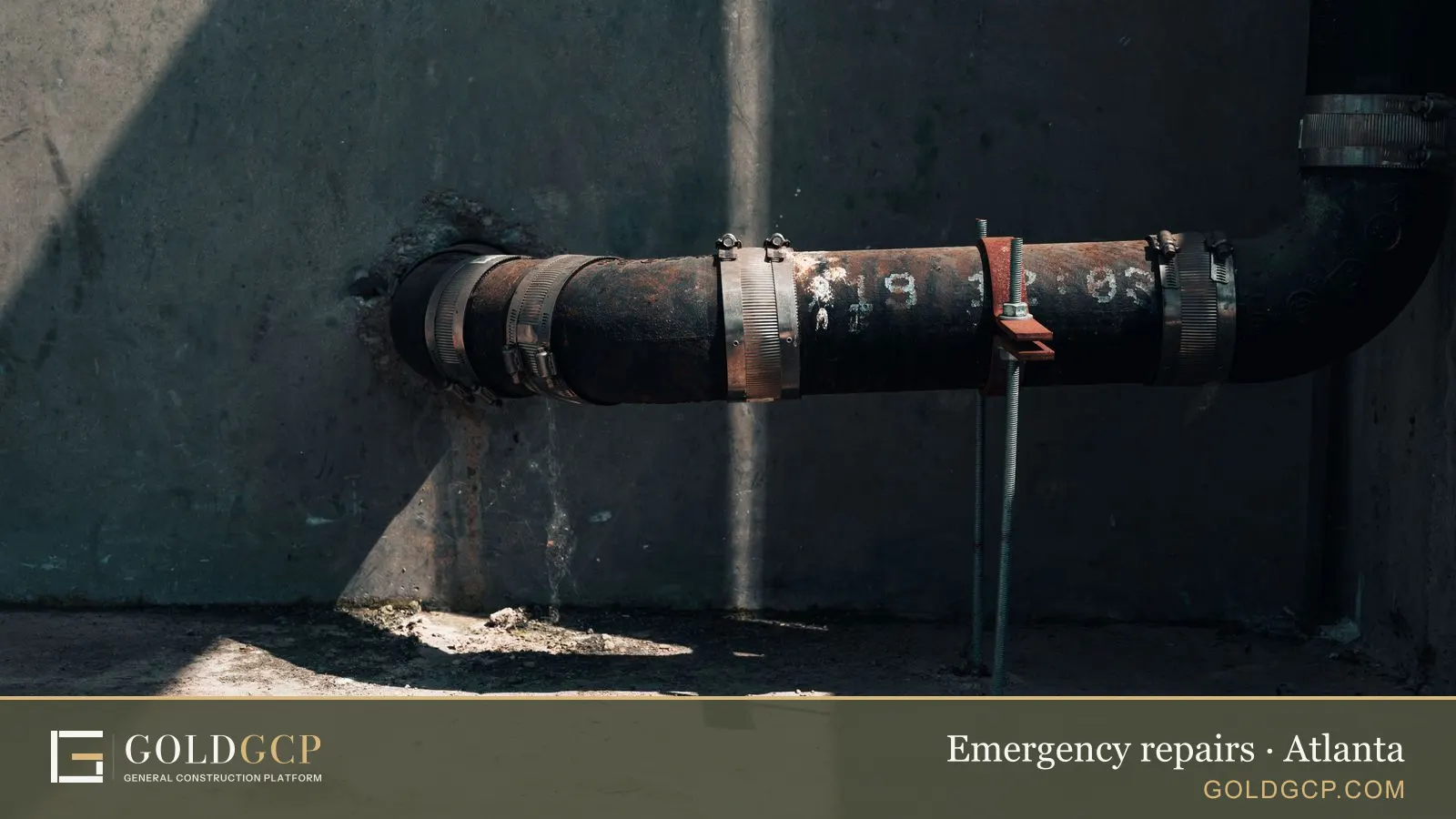
An emergency plumber in Atlanta bills $85 to $300 an hour, and an emergency electrician $130 to $170 an hour. After-hours calls cost more, at the top of those ranges. In the first ten minutes, shut the main valve. If you smell gas, leave the house and call Atlanta Gas Light before you call anyone else.
What emergency repairs cost in Atlanta
Prices come from GOLDGCP price data for this metro, adjusted with Atlanta's construction cost factor of 0.85 from the U.S. Army Corps of Engineers Area Cost Factors. The table shows prices for your ZIP code.
| Job | Atlanta (typical range) | US average |
|---|---|---|
| Emergency plumber, per hour | $85–$300/hr | $100–$350/hr |
| Emergency electrician, per hour | $130–$170/hr | $150–$200/hr |
| Burst or leaking pipe | $425–$4,250 | $500–$5,000 |
| Clogged drain or toilet, after hours | $255–$680 | $300–$800 |
| Sewer backup | $425–$3,250 | $500–$3,800 |
| No hot water | $130–$640 | $150–$750 |
| Gas line repair | $300–$1,700 | $350–$2,000 |
Estimates for 2026, including labor and standard parts. Atlanta prices use the metro's construction cost factor of 0.85 (US average = 1.00) from the U.S. Army Corps of Engineers Area Cost Factors. Your quote depends on access, materials and the condition of the home.
What common emergencies cost to fix in Atlanta
| Emergency | Typical Atlanta cost |
|---|---|
| Burst or leaking supply pipe | $425 to $4,250 |
| Toilet or drain clog after hours | $255 to $680 |
| Sewer backup | $425 to $3,250 |
| No hot water, emergency repair | $130 to $640 |
| Gas line repair | $300 to $1,700 |
| Emergency electrician, per hour | $130 to $170 |
Pipes inside walls, under a slab, or out under the yard cost the most because they take the longest to reach. Cleanup, drywall and flooring repairs are billed separately. For everyday plumbing prices, see our Atlanta plumbing guide. It also covers Atlanta's older pipes and Office of Buildings permit fees.
The first hour: what to do before help arrives
Water coming through a ceiling or wall
Close the main water valve, usually where the supply line enters the house. Shut off breakers for any room where water is reaching outlets, light fixtures, or appliances. Open a faucet on the lowest floor to drain what is left in the pipes. Photograph everything before you start mopping.
In the City of Atlanta, the Department of Watershed Management owns the water line from the main to the meter. The line from the meter to your house is yours, and so is the repair. If water is pouring from the street or the sidewalk, that is a city problem. Report a main break to ATL311 at 3-1-1 or 404-546-0311.
You smell gas, or hear hissing
Leave first, then call from a safe distance. Atlanta Gas Light answers gas leak, odor and emergency calls around the clock at 877-427-4321. The Georgia Public Service Commission's gas guide also lists 770-907-4231 for metro Atlanta. Call 911 if there is fire or anyone is hurt.
Not every address in the metro is on Atlanta Gas Light. The City of Lawrenceville runs its own gas system, with an emergency number of 770-963-3332. Check the number on your bill before you need it.
Do not light anything or flip switches. Shut the meter only if you smell or hear gas and can reach it safely. Once it is off, leave it off. The gas utility has to turn it back on and relight the pilots.
The power is out, or something is sparking
Check whether the whole street is dark before you call. Georgia Power reports outages at 1-888-891-0938, by texting OUT to 42687, or in its app. Call 911 for a downed line that is touching something, a fire or an injury. Treat any downed wire as live and keep your distance.
Some metro homes are not on Georgia Power. Electric membership corporations such as Cobb EMC, Sawnee EMC and Jackson EMC serve parts of the metro, and Marietta runs its own electric utility. Save the number printed on your bill.
Inside the house, a hot panel, a burning smell or smoke from an outlet means shut off the main breaker if you can do it without touching water, then leave and call 911.
Who to call in Atlanta
| Situation | Number |
|---|---|
| Fire, injury, gas with flames, downed line touching something | 911 |
| Gas smell or suspected leak, Atlanta Gas Light areas | 877-427-4321 (24 hours) |
| Gas leak, City of Lawrenceville gas system | 770-963-3332 |
| Power outage or downed line, Georgia Power | 1-888-891-0938 |
| Water main break or sewer spill, City of Atlanta | 3-1-1 or 404-546-0311 |
| Before any digging | 811 or 800-282-7411, at least 48 hours ahead |
| Plumbing, electrical or roof repair on your property | A licensed pro, or our 24/7 line |
Which trade handles which emergency
Calling the right trade first can save you a second service fee. Georgia licenses the trades through the State Construction Industry Licensing Board, and the license is valid statewide. Cities may not add their own trade licensing, though they can charge business license taxes.
| Problem | Who fixes it | Georgia license |
|---|---|---|
| Burst pipe, leak, clog, sewer backup on your lot | Plumber | Master Plumber, Class I or II |
| Gas line repair after the utility finds the leak | Plumber | Master Plumber (gas piping past the meter is plumbing work) |
| Dead circuits, burning outlet, storm-damaged service | Electrician | Class I or Class II electrical contractor |
| Roof leaking in a storm, wind or hail damage | Roofer | Residential or general contractor license above $2,500 |
| Furnace or AC failure | HVAC contractor | Conditioned air, Class I or II |
A Class I Master Plumber is limited to single-family and one-level two-family homes, and to commercial structures up to 10,000 square feet. A Class I electrical contractor is limited to single-phase work that does not exceed 200 amperes at the service. If your job is bigger, ask for a Class II license.
For electrical detail, see our electrical pillar. For storm and roof questions, see roofing. If the emergency is a failed water heater, the water heater guide covers repair versus replacement.
Sewer backups: your lateral or the city's main?
When sewage rises through a shower or floor drain, find out where the blockage is. In the City of Atlanta, the Department of Watershed Management states that maintenance and repair of the entire sewer service lateral is the property owner's responsibility. The pipe from your house to the city main is yours.
The same rule holds in the suburbs. Clayton County Water Authority, which runs its own system, puts the property owner on the hook for the private lateral up to the connection at the sewer main, and says the owner pays for cleanup and restoration when the clog or break is on that private line.
If neighbors are backing up too, or sewage is coming out of a manhole in the street, call ATL311 at 3-1-1 or 404-546-0311 so the city can check the main.
Two more Atlanta points matter after a backup:
- Central Atlanta still has combined sewers in places, where one pipe carries stormwater and sewage. Heavy rain can push water back toward the lowest drain in the house. The EPA reports that Atlanta has separated 33 miles of combined sewers and built 18 miles of storage since 2001, and cut combined sewer overflows by 62 percent. Older intown neighborhoods built before the mid-1900s are the ones still on combined lines.
- A backwater valve on the lateral lets flow go out only, blocking reverse flow from the city main. Installing one usually means opening the floor to reach the lateral, and it needs a licensed plumber and a permit.
Sewer backup water is contaminated as soon as it appears. Do not enter standing water in a basement that has a floor drain connected to the sewer line. Do not run the washing machine or dishwasher, and do not flush more than you must, while a backup is active, because every fixture drains into the same lateral.
Atlanta weather that causes emergency calls
Tornadoes and severe storms
On March 14, 2008, an EF2 tornado tracked through the heart of downtown Atlanta between 9:38 and 9:50 PM. The National Weather Service put the path at 6 miles, peak winds near 130 mph, and at least 50 homes damaged. Roofs came off and trees fell on buildings. The city now asks residents to register for its emergency alert system to get severe weather warnings.
Flooding
The September 2009 floods dropped about 20 inches of rain over six days in a narrow band, with a maximum 24-hour total of 21.03 inches. About 20,000 homes, businesses and other buildings had major damage. Hurricane Helene in September 2024 brought 12 to 13 inches to the Atlanta metro, and floodwaters entered at least 200 homes and buildings in greater Atlanta.
Heavy rain finds every weak spot in a roof and every low drain in a basement. During an active leak, put a bucket under the drip, move belongings out of the way, and switch off the breaker for any light fixture that is getting wet. Call a roofer to tarp or repair it once it is safe to get up there.
Ice storms and freezing nights
The January 2005 ice storm brought down tree limbs and power lines across North and Central Georgia, and more than a quarter of a million customers lost power at some point. Atlanta averages about 36 nights a year at or below freezing. That matters for exposed pipes in crawlspaces and attics. Insulate them before the first hard freeze.
Hail
Hail claims in Georgia are expensive. State Farm reported paying nearly $110 million in Georgia hail claims in 2025, at an average of about $17,000. After a hailstorm, photograph the roof and any dented gutters or vents before you call anyone.
Do you need a permit for emergency work?
Yes, and the repair can usually come first. The City of Atlanta Office of Buildings exempts repair work under $10,000 total valuation from a permit, if the work is otherwise lawful. That covers many emergency fixes. Anything above that, or any work that changes a system rather than repairing it, needs a permit.
Atlanta permit applications go through the Accela Citizen portal. The minimum application fee is $175, which includes a $25 technology fee, and permits that need plan review pay 50 percent of the building permit fee up front. The Office of Buildings will not issue a permit without a notarized Contractor License Affidavit on file, so your pro has to be licensed to pull it.
In Sandy Springs, emergency stabilization after a fire or disaster may start first, but the permit must be applied for within 48 hours or the next business day, whichever is sooner. That is a good rule of thumb for the whole metro.
The permit office depends on where the house sits. Inside a city, the city issues permits. In unincorporated areas, the county does.
| Area | Permit office |
|---|---|
| Atlanta | City of Atlanta, Office of Buildings |
| Marietta | City of Marietta Permits and Inspections, or Cobb County in unincorporated areas |
| Sandy Springs | City of Sandy Springs Community Development |
| Decatur | City of Decatur, or DeKalb County in unincorporated areas |
| Lawrenceville | City of Lawrenceville Planning and Development, or Gwinnett County in unincorporated areas |
| Alpharetta and Roswell | The city's own building department |
In Marietta, homeowners cannot apply for mechanical, electrical or plumbing permits. The licensed professional has to apply. Ask your pro to confirm in writing that they will pull the permit.
Insurance: what to record during an emergency
Insurers pay for sudden events far more often than slow ones. Three gaps matter in Atlanta:
- Flood: most homeowners policies do not cover flood water coming in from outside. The September 2009 and Helene flooding are the kind of events that need separate coverage.
- Sewer backup: Clayton County Water Authority notes that typical homeowners insurance does not always cover backups in sewers and drains. Ask whether you have the endorsement.
- Tree damage: a tree that falls on the house in a storm is usually covered. A tree that was already dead and leaning is a different conversation.
Before cleanup, take wide photos of each room and close-ups of the damage, the water line on walls and the failed part. Keep the broken part if the plumber removes it. Ask for an invoice that states the cause in plain words, and save every receipt for drying, cleanup and hotel stays. Call your insurer the same day if you can.
How to check an emergency plumber or electrician before you hire
Late at night it is tempting to take whoever answers, but five minutes of checking still matters.
- Get the license number and look it up on the Georgia Secretary of State's verification site at verify.sos.ga.gov. Match the license to the job: Master Plumber for plumbing and gas piping, electrical contractor for wiring.
- Ask for the service call fee and hourly rate before the truck rolls, and get the repair price in writing before work starts.
- Avoid paying cash. Ask for the statutory lien waiver form with each payment. Under Georgia law, a lien waiver signed in advance of the work is void.
- If the job needs a residential or general contractor license, the threshold is $2,500. A contract signed with an unlicensed contractor is unenforceable by that contractor, and they have no lien rights.
After a declared disaster, Georgia adds a protection. Under O.C.G.A. 10-1-393.4 and 10-1-438, businesses may not raise prices on repair or rebuilding services above what they charged before the state of emergency, unless their own costs went up. Violators can be fined $2,000 to $15,000 per violation. The Georgia Attorney General's Consumer Protection Division investigates complaints. Read more about milestone payments in our payment protection guide.
Areas we cover
GOLDGCP's 24/7 line takes emergency calls across the Atlanta metro, including:
- Atlanta, from intown neighborhoods to Buckhead
- Marietta
- Alpharetta
- Sandy Springs
- Decatur
- Roswell
- Lawrenceville
Enter your ZIP code to see emergency pros and prices for your area.
How GOLDGCP works
- Call the 24/7 emergency line or send the form with what is happening and your ZIP code.
- We match you with a vetted, licensed pro for that trade. Every pro passes six-step vetting: state license verification, an insurance check, a background and business check, a portfolio review, client reference calls, and onboarding with a quality score.
- You see prices for your ZIP code before anyone visits.
- Larger repairs are paid in milestones, each one after you approve that stage.
Frequently asked questions
How much does an emergency plumber cost in Atlanta?
Expect $85 to $300 an hour, plus a service call fee for a night or weekend visit. A burst pipe repair often lands between $425 and $4,250, depending on where the pipe is and how hard it is to reach. An emergency electrician runs $130 to $170 an hour.
Is a 24 hour plumber in Atlanta worth it at night?
It is worth it when water keeps spreading, sewage is coming up, or you smell gas. If you can close the main valve and nothing is getting worse, waiting for business hours usually costs less. A clog cleared after hours runs $255 to $680.
Who do I call for a gas leak in Atlanta?
Leave the house first, without touching switches. From outside, call Atlanta Gas Light at 877-427-4321, or 911 if there is fire or injury. In Lawrenceville, which runs its own gas system, the emergency number is 770-963-3332. Shut the meter only if you smell or hear gas and can reach it safely.
Is a sewer backup my problem or the city's in Atlanta?
It depends on where the blockage is. The City of Atlanta says the entire sewer service lateral, from the house to the city main, is the property owner's responsibility. If only your home is backing up, call a plumber. If neighbors are affected too, call ATL311 at 3-1-1 or 404-546-0311.
Can a plumber fix a leak tonight and get the permit later in Atlanta?
Often yes. The City of Atlanta exempts repair work under $10,000 total valuation from a permit. Anything larger needs one, and the Office of Buildings requires a notarized Contractor License Affidavit before it will issue. Ask the plumber to put that commitment in writing.
Does insurance cover flood or sewer backup damage in Atlanta?
Most homeowners policies do not cover flood water coming in from outside, and typical policies do not always cover sewer and drain backups. Both usually need a separate endorsement. A sudden burst pipe is more often covered. Photograph the damage before cleanup and keep the plumber's note on the cause.
Do you send emergency pros to Marietta, Decatur and Lawrenceville?
Yes. Our 24/7 line covers Atlanta, Marietta, Alpharetta, Sandy Springs, Decatur, Roswell and Lawrenceville. Each city has its own permit office, and some run their own utilities, so check your bill for the right outage and gas emergency numbers.
How we calculate these prices
GOLDGCP starts from national price ranges for each job, taken from published 2026 cost guides and checked against local price guides where they exist. To get a local price, we multiply the national range by the construction cost factor for the metro from the U.S. Army Corps of Engineers Area Cost Factors (US average = 1.00). Where that table has no entry for a metro, we use the nearest listed location or the state value. For ZIP codes outside the 50 largest metros, the cost estimator uses the state's price level from the Bureau of Economic Analysis Regional Price Parities. Ranges include labor and standard materials but not unusual site conditions, so a written quote after an inspection is always the final price.
Sources

About this guide
Written by the GOLDGCP editorial team. Prices come from national cost guides adjusted with official construction cost factors for Atlanta; rules and statistics come from the agencies and reports linked in the text. We update this page when prices or codes change.