
The short answer
An emergency plumber in the New York area usually bills $130 to $460 an hour, plus an after-hours service fee of about $195 to $330. Nights, weekends and holidays cost the most. What matters most here is knowing your utility: gas emergencies in this metro go to one of several companies, so find the number on your bill before you need it.
What emergency repairs cost in New York
These figures start from HomeGuide's national emergency rates and apply the New York City cost factor of 1.31 from the U.S. Army Corps of Engineers. The table fills in prices for your part of the metro.
| Job | New York (typical range) | US average |
|---|---|---|
| Emergency plumber, per hour | $130–$460/hr | $100–$350/hr |
| Emergency electrician, per hour | $195–$260/hr | $150–$200/hr |
| Burst or leaking pipe | $655–$6,550 | $500–$5,000 |
| Clogged drain or toilet, after hours | $395–$1,050 | $300–$800 |
| Sewer backup | $655–$5,000 | $500–$3,800 |
| No hot water | $195–$985 | $150–$750 |
| Gas line repair | $460–$2,600 | $350–$2,000 |
Estimates for 2026, including labor and standard parts. New York prices use the metro's construction cost factor of 1.31 (US average = 1.00) from the U.S. Army Corps of Engineers Area Cost Factors. Your quote depends on access, materials and the condition of the home.
How the time of the call changes the rate
HomeGuide splits emergency rates by when you call. Converted to New York prices, the hourly labor looks like this, before the service fee and parts:
| When you call | Typical New York hourly rate |
|---|---|
| Same day, business hours | $130 to $260 |
| Weeknight, after closing | $155 to $395 |
| Saturday or Sunday | $195 to $460 |
| Holiday | $260 to $590 or more |
Pay for the night call when water keeps spreading, sewage is rising or there is gas in the air. If you can stop the water at a valve and nothing is getting worse, a daytime visit usually costs a few hundred dollars less.
What common emergencies cost to fix
| Emergency | Typical New York cost |
|---|---|
| Burst or leaking supply pipe | $655 to $6,550 |
| Clog after hours, cleared by snaking | $395 to $1,050 |
| Severe clog needing hydro jetting | $785 to $2,100 or more |
| Sewer backup, from a blockage to a broken line | $655 to $5,000 |
| Gas leak in piping to one appliance | $460 to $2,600 |
| Leak in a buried gas line | $1,300 to $6,550 |
| No hot water, emergency repair | $195 to $985 |
| Emergency electrician, per hour | $195 to $260 |
Pipes inside walls, behind tile or under a slab take longest to reach and cost the most. Drying, drywall and flooring repairs are billed separately. For everyday plumbing prices, licensing and the pipes in older New York buildings, see our New York plumbing guide.
The first hour: what to do before help arrives
Water coming through a ceiling or wall
Close the nearest shutoff, then the main. In an apartment, tell the super or managing agent right away, since the leak may be coming from the unit above. Switch off the breakers for any room where water is reaching outlets, fixtures or appliances. Take photos before you mop.
If water is pouring out of the street or sidewalk in the five boroughs, report it to 311.
You smell gas
Leave first. Don't flip switches or use anything that could spark on the way out. From outside, call your gas company or 911. In New Jersey, PSE&G tells customers to wait at least 350 feet from the building. Which company to call depends on where you live:
- Manhattan, the Bronx, parts of Queens and Westchester: Con Edison
- Brooklyn, Staten Island, parts of Queens and Long Island: National Grid
- Most of northern New Jersey: PSE&G, Elizabethtown Gas or New Jersey Natural Gas, depending on the town
Before any digging in the yard to reach a buried line, call 811 so the utilities can mark their lines.
The power is out, or something is sparking
Check whether the street is dark too, then report it to your electric company. If a wire is down, keep your distance, treat it as live and call 911. Inside, a hot panel, a burning smell or smoke from an outlet means you shut off the main breaker if you can do it without standing in water, leave and call 911.
Who to call in the New York metro
| Situation | Number |
|---|---|
| Fire, injury, downed wire, gas with flames | 911 |
| Gas smell, Con Edison area | 1-800-75-CONED (1-800-752-6633) or 911 |
| Gas smell, National Grid area (Brooklyn, Staten Island, parts of Queens, Long Island) | 1-718-643-4050 or 911 |
| Power outage, Con Edison area | 1-800-75-CONED (1-800-752-6633) |
| Power outage or downed wire, Long Island and the Rockaways | PSEG Long Island, 1-800-490-0075 |
| Gas leak, PSE&G (New Jersey) | 1-800-880-PSEG (7734) or 911 |
| Power outage, JCP&L (New Jersey) | 1-888-LIGHTSS (1-888-544-4877) |
| Gas leak, Elizabethtown Gas (New Jersey) | 1-800-492-4009 |
| Gas leak, New Jersey Natural Gas | 800-GAS-LEAK (800-427-5325) |
| Sewer backup, water main break or street flooding in NYC | 311 |
| Repair on your own property | A licensed contractor, or our 24/7 line |
Which trade handles which emergency
Calling the right trade first saves a second service fee. Licensing differs across the metro:
| Problem | Who fixes it | License to ask for |
|---|---|---|
| Burst pipe, leak, clog, sewer backup on your property | Plumber | NYC: Licensed Master Plumber (DOB). Suffolk and Westchester: county license. NJ: licensed master plumber |
| Gas piping repair after the utility finds the leak | Plumber | Same as above |
| Dead circuits, burning outlet, storm-damaged service | Electrician | NYC: DOB Master Electrician. Suffolk and Westchester: county license. NJ: licensed electrical contractor |
| Roof leak in a storm | Roofer | NYC: DCWP home improvement license. Nassau, Suffolk and Westchester: county home improvement license. NJ: HIC registration |
| Boiler or furnace failure | Heating contractor or plumber | Depends on the work and the town |
For electrical detail, see our electrical pillar. For storm and roof questions, see roofing. If a water heater failed, the water heater guide covers repair versus replacement.
Sewer backups in New York City
When sewage comes up through a basement drain or toilet, report it to 311 right away or use the online form, and keep both the 311 tracking number and the DEP service request number. The city's Department of Environmental Protection says it inspects within six hours of the complaint, though heavy rain or snowmelt can delay that.
What happens next depends on where the blockage is. DEP runs 7,500 miles of sewers and 148,000 catch basins. If the problem is in the city sewer, DEP repairs it. If it is in your private sewer line, which belongs to you all the way to the main in the street, DEP issues a Notice to Repair and you hire a plumber. DEP says the most common cause of backups is grease, wipes and other things flushed or poured down drains.
If you believe the city's sewer caused the damage, file a claim with the New York City Comptroller within 90 days. After a heavy rain you do not need a DEP service request number to file.
On Long Island, in Westchester and in New Jersey, call the town, village or sewer utility that bills you for sewer service.
Flash floods and basements
What Ida showed
On September 1, 2021, the remnants of Hurricane Ida dropped 3.15 inches of rain on Central Park between 8:51 and 9:51 p.m., according to the National Weather Service, with rates of three to five inches an hour across northeast New Jersey and the city. A peer-reviewed study counted 13 deaths in New York City directly related to the storm, 11 of them people who drowned in basement apartments.
DEP explains why basements flood in storms like that: when rain falls faster than the sewers can carry it, water comes back up through manholes, catch basins and basement sewer connections. Groundwater can also push in through foundation cracks and floor drains after long rain.
What to do
- If you live in a basement apartment, NYC Emergency Management says to be ready to move to a higher floor during heavy rain.
- Sign up for Notify NYC and check your block on the city's stormwater flood map.
- Keep the catch basin grate outside your house clear, and send downspouts away from the foundation.
- Ask a plumber about a backwater valve, which DEP's Rainfall Ready guide suggests homeowners consider.
- After a flood, pump a basement out slowly. NYCEM warns that draining it too fast can damage the walls.
- Don't turn lights or appliances back on until an electrician has checked the system.
Coastal storms
Hurricane Sandy struck on October 29, 2012. In New York City, 44 people died, damage and lost economic activity topped $19 billion, and about 150,000 residents were displaced. In New Jersey, 346,000 homes were damaged or destroyed. NYC Emergency Management warns that a major hurricane could push more than 30 feet of storm surge into parts of the city. If you are told to evacuate, NYCEM advises turning off utilities at the main switch and closing the main gas valve before you go.
Winter freeze-ups
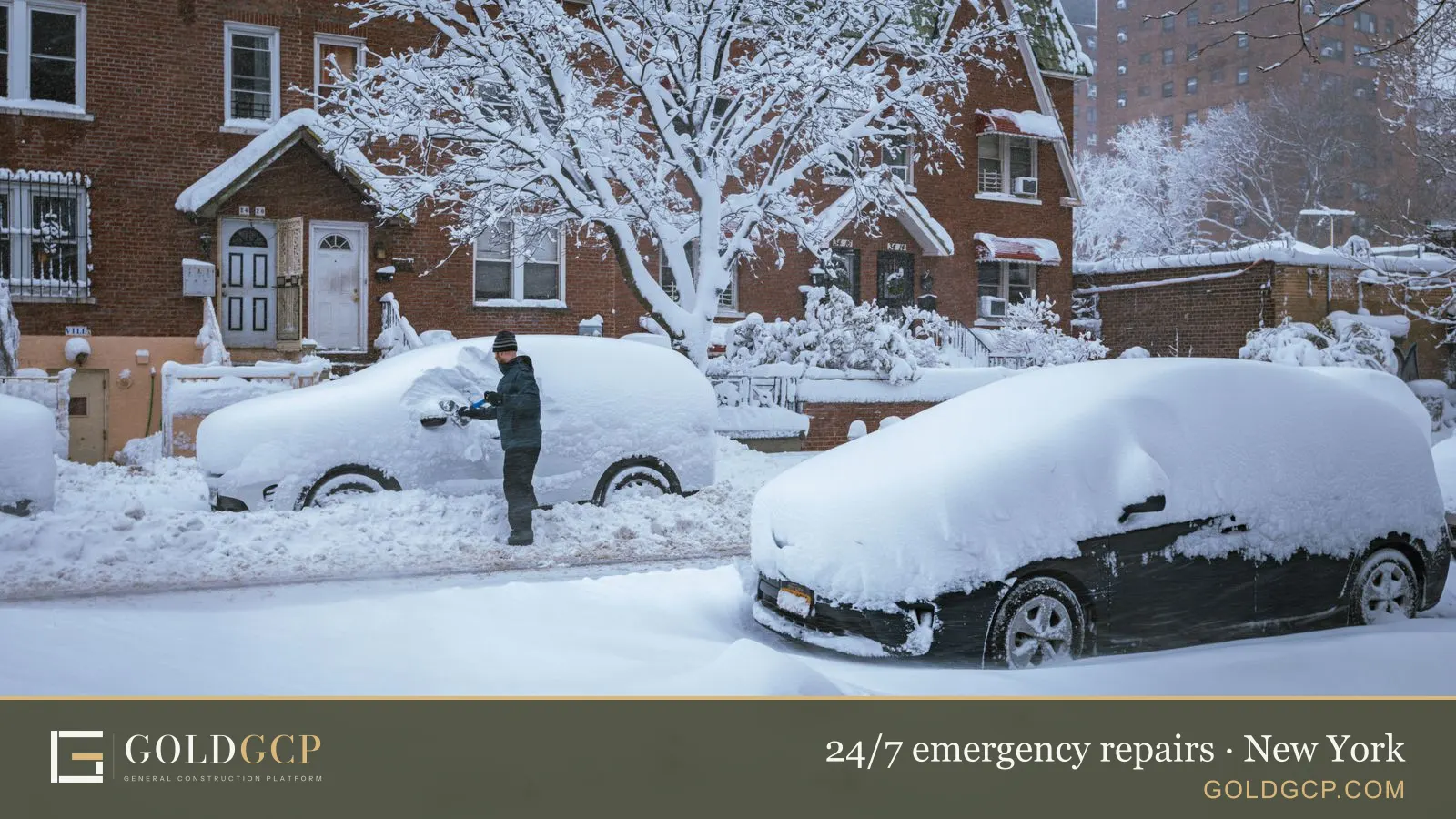
Central Park's average January low is 27.9°F, and the area averages 29.8 inches of snow a year. The January 2016 blizzard dropped 27.5 inches on Central Park, its biggest snowstorm on record, 30.5 inches at JFK and 24.5 at Newark.
Cold snaps freeze pipes on outside walls, in unheated basements, crawl spaces and garages, and in empty apartments. NYC Emergency Management suggests letting faucets drip a little during deep cold. If a pipe has already frozen, close the main before it thaws, because a split pipe starts leaking as soon as the ice melts. Use only space heaters approved for indoor use.
Do you need a permit for emergency work?
Usually yes, and both states let the repair come first.
- New York City: under Administrative Code 28-105.4.1, a licensed contractor may do emergency work before the permit as long as the application is filed within two business days after work starts, with a description of the emergency. DOB's examples include gas leak repairs, stabilizing unsafe structures and replacing heating or hot water equipment in homes during heating season.
- New Jersey: the Uniform Construction Code lets emergency work start without a permit, but the contractor must notify the construction office as soon as practicable and apply for the permit within 72 hours.
- Long Island and Westchester: each town or village building department sets its own process under the state code, so ask the contractor how they will handle it.
Get the contractor's promise to file in writing.
Insurance: what to record
Insurers pay for sudden events more often than slow ones. HomeGuide notes that policies typically cover a pipe that bursts and the water damage it causes, but not a leak from slow corrosion. Two gaps matter most in New York:
- Flood: FEMA says most homeowners insurance does not cover flood damage. A new National Flood Insurance Program policy usually has a 30-day waiting period, so buy it before storm season, not when a storm is forecast.
- Sewer backup: the Insurance Information Institute says most policies leave it out unless you add an endorsement.
Before cleanup, take wide photos of each room and close-ups of the damage, the water line on walls and the failed part. Keep the broken part. Ask for an invoice that names the cause, save every receipt for drying, cleanup and hotel stays, and call your insurer the same day if you can.
How to check an emergency pro before you hire
- Get the license number and check it: DOB's Know Your Construction Professional lookup in the city, Suffolk Consumer Affairs at (631) 853-4600, the Westchester county license card, or the New Jersey electrical board at (973) 504-6410.
- Ask for the service fee and hourly rate before anyone heads out, and get the repair price in writing before work starts.
- Avoid cash. New Jersey's Division of Consumer Affairs warns against contractors who demand cash or more than a third of the price before work begins. New York law says payments should track the work done.
- On larger repairs, get a written contract. Both states require one for home improvement jobs over $500.
After a declared emergency, both states limit price hikes. New York's General Business Law 396-r bans unconscionably excessive prices for vital goods and services during an abnormal disruption of the market. New Jersey bans increases of more than 10% over pre-emergency prices during a state of emergency and for 30 days after it ends. Read about milestone payments in our payment protection guide.
Areas we cover
GOLDGCP's 24/7 line takes emergency calls across the New York metro, including:
- Manhattan
- Brooklyn
- Queens
- The Bronx
- Staten Island
- Long Island (Nassau and Suffolk)
- Westchester
- Newark, Jersey City and the rest of northern New Jersey
Enter your ZIP code below to see emergency pros and prices for your area.
How GOLDGCP works
- Call the 24/7 emergency line or send the form with what is happening and your ZIP code.
- We match you with a vetted, licensed pro for that trade. Every pro passes six-step vetting: state license verification, an insurance check, a background and business check, a portfolio review, client reference calls, and onboarding with a quality score.
- You see prices for your ZIP code before anyone visits.
- Larger repairs are paid in milestones, each one after you approve that stage.
Frequently asked questions
How much does an emergency plumber cost in NYC?
Expect $130 to $460 an hour, plus a service fee of about $195 to $330 for a night or weekend call. Holiday rates can pass $590 an hour. A burst pipe repair in New York often lands between $655 and $6,550, depending on where the pipe is.
Who do I call for a gas leak in New York?
Leave first, then call 911 or your gas company from outside. Con Edison is 1-800-75-CONED, National Grid 1-718-643-4050, PSE&G 1-800-880-PSEG, Elizabethtown Gas 1-800-492-4009 and New Jersey Natural Gas 800-GAS-LEAK.
Is a sewer backup my problem or the city's in NYC?
Call 311 first. DEP inspects and fixes the city sewer if that is the cause. If the blockage is in your private line, which runs to the main in the street, DEP issues a Notice to Repair and you hire a plumber.
Can a plumber fix it tonight and file the permit later in New York?
Yes. In New York City, a licensed contractor can do emergency work first and file within two business days. In New Jersey, the permit application is due within 72 hours. Long Island and Westchester towns set their own process.
Is a 24 hour plumber in New York worth it at night?
When water keeps spreading, sewage is rising or you smell gas, yes. If a valve stops the water and nothing is getting worse, waiting saves money. Weeknight rates here run about $155 to $395 an hour against $130 to $260 during the day.
Does insurance cover basement flooding in New York?
Usually not from storm water. FEMA says most homeowners policies exclude flood, and a new flood policy usually has a 30-day wait. Sewer backup needs an added endorsement in most policies. A sudden burst pipe is more often covered.
Do you cover emergency calls on Long Island and in New Jersey?
Yes. Our 24/7 line covers all five boroughs, Nassau and Suffolk, Westchester, and northern New Jersey including Newark and Jersey City. Each area has its own utilities and permit office, so keep the numbers from your bills handy.
How we calculate these prices
GOLDGCP starts from national price ranges for each job, taken from published 2026 cost guides and checked against local price guides where they exist. To get a local price, we multiply the national range by the construction cost factor for the metro from the U.S. Army Corps of Engineers Area Cost Factors (US average = 1.00). For ZIP codes outside the 50 largest metros, the calculator uses the state's price level from the Bureau of Economic Analysis Regional Price Parities. Ranges include labor and standard materials but not unusual site conditions, so a written quote after an inspection is always the final price.
Sources
- How much does an emergency plumber cost? · HomeGuide
- Gas leak FAQ · Con Edison
- Report a gas emergency · National Grid
- Sewer Backups · NYC Department of Environmental Protection
- Plan for Hazards: Flooding · NYC Emergency Management
- Service Assessment: Hurricane Ida (2021) · National Weather Service
- N.J.A.C. 5:23-2.14: Construction permits, when required · Legal Information Institute
- Flood Insurance · FEMA
- Area Cost Factors, PAX Newsletter 3.2.1 (2024) · U.S. Army Corps of Engineers
- Regional Price Parities by State · U.S. Bureau of Economic Analysis

About this guide
Written by the GOLDGCP editorial team. Prices come from national cost guides adjusted with official construction cost factors for New York; rules and statistics come from the agencies and reports linked in the text. We update this page when prices or codes change.