
The short answer
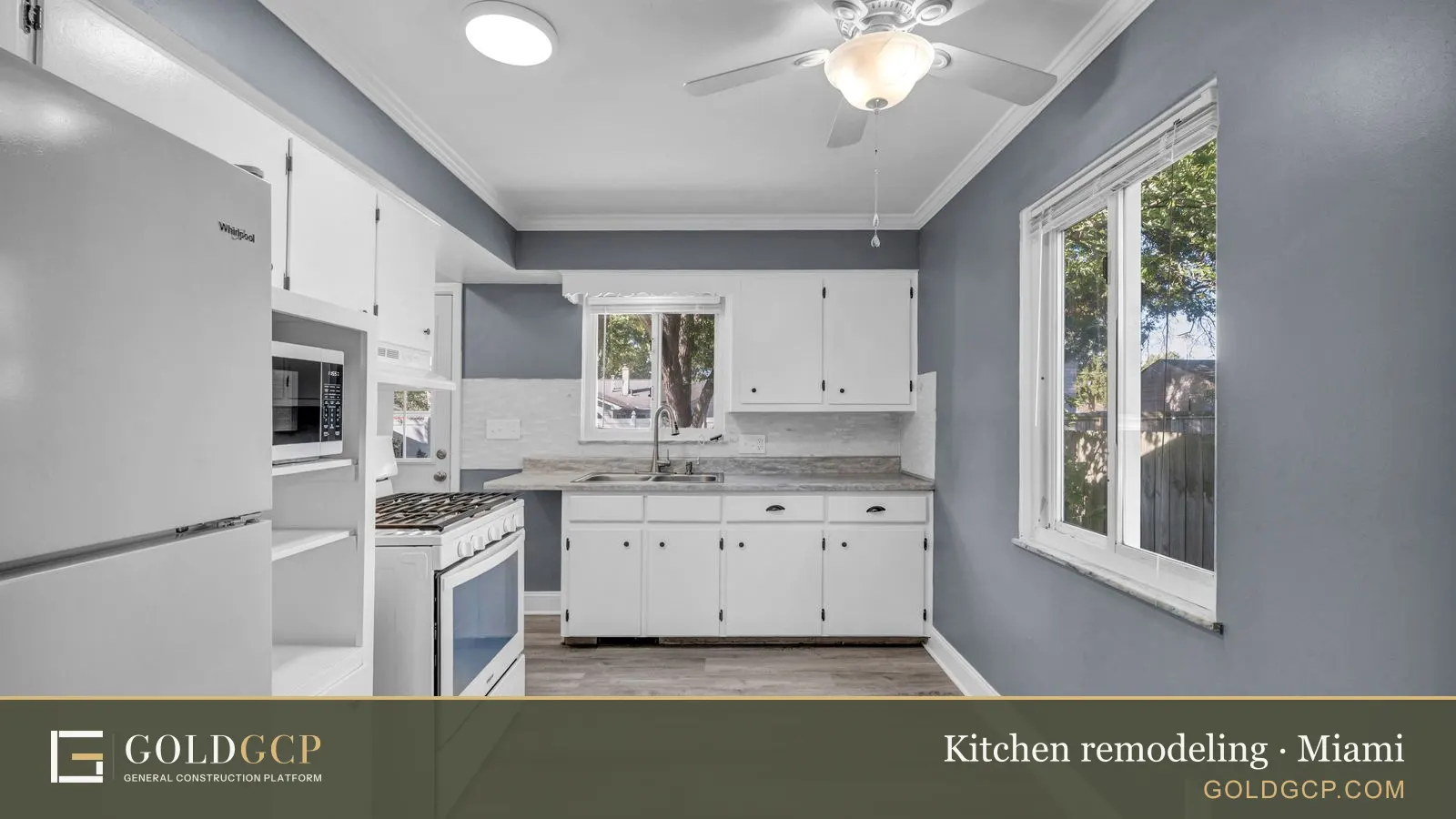
A mid-range remodel of a 150-square-foot kitchen in Miami runs about $20,950 to $34,900 by our cost-adjusted figures. The permit path matters most here. Keep the layout and most cities issue a simple permit. Move a wall or a drain line and you need sealed drawings, plan review and weeks of extra time.
What a kitchen remodel costs in Miami
The table applies the Miami construction cost factor of 0.93 from the U.S. Army Corps of Engineers to national remodeling cost data. Miami runs about 7% below the US average for the same work.
| Job | Miami (typical range) | US average |
|---|---|---|
| Cosmetic refresh, 150 sq ft kitchen | $10,450–$20,950 | $11,250–$22,500 |
| Mid-range remodel, 150 sq ft kitchen | $20,950–$34,900 | $22,500–$37,500 |
| High-end remodel, 150 sq ft kitchen | $34,900–$62,800 | $37,500–$67,500 |
| Small kitchen (10×10 ft), mid-range | $13,950–$23,250 | $15,000–$25,000 |
| Large kitchen (15×15 ft), mid-range | $31,400–$52,300 | $33,750–$56,250 |
| Stock cabinets, installed | $93–$370/lin ft | $100–$400/lin ft |
| Semi-custom cabinets, installed | $140–$650/lin ft | $150–$700/lin ft |
| Custom cabinets, installed | $465–$1,100/lin ft | $500–$1,200/lin ft |
| Appliance package | $2,350–$18,600 | $2,500–$20,000 |
| Moving plumbing or walls (add-on) | $4,650–$23,250 | $5,000–$25,000 |
| Permits | $465–$1,400 | $500–$1,500 |
Estimates for 2026, including labor and standard parts. Miami prices use the metro's construction cost factor of 0.93 (US average = 1.00) from the U.S. Army Corps of Engineers Area Cost Factors. Your quote depends on access, materials and the condition of the home.
To price your own kitchen by size, finish and ZIP code, use the cost estimator. You can also open the full kitchen cost estimator.
Where the money goes in a Miami kitchen
Cabinets are the largest single purchase. Installed, stock boxes cost about $93 to $370 per linear foot here, semi-custom $140 to $650, and custom $465 to $1,100. A galley kitchen and a U-shaped kitchen with a long run of cabinets are very different budgets at the same finish level.
Three other lines often surprise South Florida homeowners:
| Cost line | Why it shows up in Miami | Typical effect |
|---|---|---|
| Moving plumbing, gas or walls | An open plan usually means taking out a wall or moving the sink | About $4,650 to $23,250 on top of the remodel |
| Code upgrades | A permit can pull in water-saving fixtures and other work elsewhere in the house (see below) | Depends on what the house already has |
| Hidden conditions | About half of Miami-Dade and Broward homes were built before 1980 | Local remodelers hold 10% to 20% in reserve on older houses |
Census figures put the median year built at 1980 in Miami-Dade County and 1980 in Broward, with older pockets in Hollywood (median 1969), Miami Beach (1969), Fort Lauderdale (1973) and Coral Gables (1969). Opening a 50-year-old kitchen wall can reveal undersized wiring, cast iron drain lines or termite damage that no one could price beforehand.
Homes built before 1978 add one more rule. Under the EPA's Renovation, Repair and Painting program, a contractor who disturbs painted surfaces in an older home must be a certified firm and follow lead-safe work practices. Tearing out old cabinets and drywall qualifies.
Humidity and termites
Miami's climate adds cost too. The normal dew point at Miami International averages 74.4°F in August, so moisture sits in the air for months. That affects cabinet materials, drywall and paint schedules. Florida also has 20 established termite species, the most in the mainland United States, according to UF/IFAS. The Formosan and Asian subterranean termites both occur in South Florida. If your remodeler opens a wall and finds termite damage, the repair is a change order. Ask for a termite inspection before demolition.
Layout changes and what triggers a permit
Miami-Dade and Broward are in Florida's High-Velocity Hurricane Zone, the state's strictest building code area. The 2023 Florida Building Code, 8th Edition, took effect December 31, 2023 and applies until the 9th Edition takes effect December 31, 2026. Permits are issued by each city, or by the county for unincorporated areas.
| What you are doing | Permit path | What it means for you |
|---|---|---|
| Paint, backsplash, new counters, cabinets in the same spots | No building permit in unincorporated Miami-Dade | Start when materials arrive |
| New circuits, a moved sink or dishwasher, a new gas line, a ducted hood | Trade permits, often with no plan review | Fees and inspections, usually weeks not months |
| Removing or opening a wall, moving a drain, enlarging a window or door | Plan review, often with sealed drawings | An architect or engineer prepares drawings first |
Miami-Dade County's permit page lists kitchen cabinets, vanities or paneling replaced inside a residential unit in the same configuration as work not regulated under the Florida Building Code, so no building permit. Relocating plumbing, ventilation or electrical does need one. The county also warns that a project cannot be split into smaller phases to avoid permitting rules.
For more complex work, Miami-Dade's guide explains that signed and sealed drawings from a licensed architect or engineer may be required. Our page on permit drawings covers what reviewers expect to see.
What a Miami kitchen permit costs
Miami-Dade County adopted a revised building permit fee schedule effective October 1, 2025, its first increase in more than 17 years. Fees include charges from other agencies such as the Department of Transportation and Public Works, DERM, Fire Rescue and WASD. Permit fee sheets must be submitted with electrical, mechanical or plumbing permit applications. Across our price data, Miami kitchen permits come to roughly $465 to $1,400.
Refunds are limited. For an unused permit with no work performed, the county grants a full refund less $130 or 50% of the fee, whichever is greater. No refund is granted on fees of $130 or less, on expired permits, or once work has started.
Who issues the permit in your city
Most incorporated cities in Miami-Dade run their own building departments, including Miami, Miami Beach, Coral Gables, Hialeah and Doral. The county building department only issues permits for unincorporated areas. In Broward, the county Building Code Division serves unincorporated areas and municipalities with which it contracts, so confirm who handles your address before you apply. The Herbert S. Saffir Permitting and Inspection Center at 11805 SW 26 Street in Miami is open Monday through Friday, 7:30 a.m. to 4:00 p.m.
Review times vary. A guide to impact window permits reports that Miami-Dade County handles residential impact window and door permits in 1 to 2 weeks, while the City of Miami can approach or exceed 6 weeks for standard projects because of high application volume. Kitchen permits go through the same offices, so ask your remodeler what the current review time is for your address.
Electrical, gas and ventilation rules in Miami kitchens
Inspectors check kitchens against the Florida Building Code, which adopts the National Electrical Code with Florida amendments. These items most often change a design.
Counter circuits and GFCI protection
The code requires ground-fault circuit-interrupter protection in kitchens, and the GFCI device must be installed in a readily accessible location. Outdoor outlets for dwellings on single-phase branch circuits of 150 volts to ground or less and 50 amperes or less also need GFCI protection. Many older Miami houses fed the whole kitchen from one shared circuit. Bringing that up to code often means new wire runs back to the panel, and sometimes a larger panel.
Gas lines to the range
Extending or adding a gas line to a range or cooktop is plumbing work under the permit. The inspector sees the new piping under an air pressure test before the walls close. If you are switching from electric to gas, confirm with your remodeler that the gas service and meter can carry the added load before you buy the range.
Range hoods and ventilation
A ducted range hood that vents outside is the usual choice for a gas range in South Florida. The duct runs through the wall or roof, and the penetration has to be flashed and sealed against rain. In the HVHZ, any exterior penetration is a place where wind-driven water can get in, so the flashing detail matters. Ask your remodeler how the hood duct exits and who seals it.
Water-saving fixtures
Miami-Dade County requires high-efficiency plumbing fixtures in permit applications for new residential structures, per a 2008 ordinance. The limits are 1.0 gallon per minute for private lavatory faucets at 60 psi, 1.5 gpm for shower heads at 80 psi, and 1.28 gallons per flush for water closets. Fixtures must comply with EPA WaterSense or Uniform North American Requirements specifications. If your kitchen permit includes plumbing work, expect the reviewer to check the fixture schedule.
What else a Miami permit makes you fix
A kitchen permit can pull in work outside the kitchen. Two rules matter most in South Florida.
The 50% rule. If an improvement or repair costs 50% or more of the building's market value before the work, the whole structure must meet current floodplain rules, which can mean raising it. This is an NFIP rule applied by Miami-Dade and each city. A kitchen remodel rarely hits 50% on its own, but a kitchen plus a roof plus an addition in the same permit year can. Check your flood zone at FEMA's map service before you plan a large project.
Elevation certificates. Miami-Dade has collected FEMA Elevation Certificates from builders since 1995 as a permit requirement. Owners of homes built before 1995 may need to hire a surveyor. The county flood info line is 786-315-2800.
The new small-work exemption. Beginning July 1, 2026, Florida House Bill 803 creates permit exemptions for certain small home improvement projects valued under $7,500. Units in multi-family buildings do not qualify, and properties partly or fully in a flood hazard area do not qualify. Even under $7,500, electrical, plumbing, structural, mechanical and gas work always requires permits. Structural work including windows and doors always requires a permit.
Impact products. If your kitchen remodel includes a new window or exterior door, Miami-Dade and Broward require products with a current Miami-Dade Notice of Acceptance or an applicable Florida Product Approval accepted for the installation. Each NOA specifies maximum dimensions, design pressure ratings, installation substrate and accepted fastening methods. Ask for the NOA number on the quote. Our guide to impact windows explains the ratings.
How long a Miami kitchen remodel takes
| Phase | Same layout | Wall removed or layout changed |
|---|---|---|
| Permit | Days to a few weeks, depending on the city | Plan review, often 4 to 8 weeks in busy cities |
| Construction | About 4 to 8 weeks | About 8 to 12 weeks |
| Total, start to finish | About 2 to 3 months | About 4 to 6 months |
Semi-custom and custom cabinets usually set the pace, so the order goes in as soon as measurements are final. A typical sequence runs demolition, rough plumbing, electrical and mechanical with the walls open, inspections, insulation and drywall, cabinets, counters, then final inspection. Condo owners should add time for the association's renovation requirements, including contractor documents, access, deliveries and work hours.
Will a kitchen remodel pay off in Miami?
Small kitchen jobs tend to pay back better than full gut renovations. The 2025 Cost vs. Value report breaks results out by region. Miami sits in the South Atlantic region, which covers Florida and neighboring states. The report's national figures show the pattern: a minor midrange kitchen remodel recoups most of its cost, while a major midrange remodel recoups a smaller share. Ask your remodeler for the current South Atlantic numbers for your project type before you decide how far to go. Our remodel return estimator runs the numbers for your own budget.
If you plan to sell within a few years, a same-layout refresh on a simple permit is the safer spend. If you plan to stay, weigh the open plan by how you cook and live, since the sale price will not cover it.
How to check a kitchen remodeler before you hire
A kitchen remodel touches several trades, so in Florida the usual license is a certified general, building or residential contractor from the Department of Business and Professional Regulation. Certified license codes begin with C and allow work anywhere in Florida. Registered licenses begin with R and allow work only in the jurisdiction that issued them. A building contractor may remodel, repair or improve any size building if the work does not affect structural members. A residential contractor is limited to one-, two- or three-family residences not exceeding two habitable stories.
Miami-Dade County also issues local certificates of competency through its Construction Trades Qualifying Board, under Chapter 10 of the County Code. Applicants need one to four years of field experience depending on the license, an open-book exam passed at 70% or above, and proof of liability and workers' compensation insurance after Board approval. A business license application adds $315.
- Look up the license number on the DBPR license verification portal. Confirm the status is active, the business name matches, and the class covers your scope.
- Check workers' compensation coverage through the Florida Department of Financial Services.
- Ask who pulls the permit. The answer should be the contractor, with the permit fee as its own line on the bid.
- Read the payment schedule. Florida law makes a contract with an unlicensed contractor unenforceable by that contractor, so the license check protects your money too.
- Ask what contingency they recommend for your house's age, and what happens if they find bad wiring or termite damage behind the walls.
A handyman exemption exists for work of a casual, minor or inconsequential nature with an aggregate contract price under $2,500, but not when it is part of a larger job or split into small contracts to evade the law. That rules out any kitchen remodel. More on safe payments is in our guide to paying a contractor.
Areas we cover
GOLDGCP kitchen remodelers work across Miami-Dade, Broward and Palm Beach counties, including:
- Miami and Miami Beach
- Coral Gables
- Fort Lauderdale and Hollywood
- Boca Raton
- West Palm Beach
Each city runs its own building department with its own fees and forms, but all enforce the same Florida Building Code and the same state license rules. Miami-Dade and Broward are in the High-Velocity Hurricane Zone; Palm Beach County is outside it but still in the wind-borne debris region. To see prices for your exact ZIP code, start with the search below.
How GOLDGCP works
- Tell us about your kitchen through the form, a call or WhatsApp: its size, what you want to change and your budget.
- We match you with up to 3 vetted, licensed remodelers who work in your area, and you see ZIP-based prices before anyone visits.
- If you are removing a wall, our in-house architects can prepare the drawings for plan review.
- Your remodeler pulls the permits and books the inspections.
- You pay in milestones, each one after you approve that stage, and track progress in the client portal.
If you are sourcing cabinets or stone from overseas, our GCP Source and Ship service handles sourcing, factory inspection, shipping, customs and delivery to the jobsite.
Frequently asked questions
How much does a kitchen remodel cost in Miami?
By our cost-adjusted figures, a 150-square-foot kitchen costs about $10,450 to $20,950 for a cosmetic refresh, $20,950 to $34,900 for a mid-range remodel and $34,900 to $62,800 for high-end work. A small 10×10 kitchen at mid-range runs $13,950 to $23,250, and a large 15×15 kitchen $31,400 to $52,300.
Do I need a permit to remodel a kitchen in Miami?
Not for paint, counters, flooring or cabinets set in the same spots in unincorporated Miami-Dade. You do need one for new circuits, a moved sink, a gas line or a ducted hood. Removing a wall, moving a drain or enlarging a window requires plan review, often with sealed drawings from an architect or engineer.
Can I remove a kitchen wall in Miami without plan review?
No. Any change to walls or openings falls outside the simple permit path. You need drawings of the existing and new layout, and for a load-bearing wall an engineered beam. In Miami-Dade and Broward the wall also has to meet High-Velocity Hurricane Zone requirements, which is why the review takes longer than in most of Florida.
What does a Miami-Dade permit require when I remodel a kitchen?
Beyond the kitchen work itself, the county requires high-efficiency plumbing fixtures in permit applications for new residential structures, with limits of 1.0 gpm for lavatory faucets, 1.5 gpm for shower heads and 1.28 gallons per flush for toilets. If your property is in a flood zone, the 50% rule can require the whole structure to meet current floodplain rules.
Does a range hood have to vent outside in Miami?
A ducted hood that vents outside is the usual choice for a gas range, and the duct penetration has to be flashed and sealed against rain. In the High-Velocity Hurricane Zone, any exterior penetration is a place where wind-driven water can get in, so ask your remodeler how the duct exits and who seals it.
Is a kitchen remodel worth it in Miami?
Small kitchen jobs tend to pay back better than full gut renovations. The 2025 Cost vs. Value report breaks results out by region, and Miami sits in the South Atlantic region. Ask your remodeler for the current South Atlantic numbers for your project type before you decide how far to go.
What license should a kitchen remodeler have in Florida?
A certified general, building or residential contractor from the DBPR, with a license code beginning with C. A building contractor may remodel any size building if the work does not affect structural members. Miami-Dade also issues local certificates of competency. Check the license on the DBPR portal and confirm workers' compensation coverage before you sign.
How we calculate these prices
GOLDGCP starts from national price ranges for each job, taken from published 2026 cost guides and checked against local price guides where they exist. To get a local price, we multiply the national range by the construction cost factor for the metro from the U.S. Army Corps of Engineers Area Cost Factors (US average = 1.00). Where that table has no entry for a metro, we use the nearest listed location or the state value. For ZIP codes outside the 50 largest metros, the cost estimator uses the state's price level from the Bureau of Economic Analysis Regional Price Parities. Ranges include labor and standard materials but not unusual site conditions, so a written quote after an inspection is always the final price.
Sources
- U.S. EPA
- ask.ifas.ufl.edu
- Powerful Impact Solutions
- FEMA
- myfloridalicense.com
- Miami-Dade County · Miami-Dade County Permit
- Miami-Dade County · Building Fee Schedules, Refunds &…
- Miami-Dade County Board of County Commissioners
- U.S. Army Corps of Engineers
- U.S. Bureau of Economic Analysis

About this guide
Written by the GOLDGCP editorial team. Prices come from national cost guides adjusted with official construction cost factors for Miami; rules and statistics come from the agencies and reports linked in the text. We update this page when prices or codes change.