
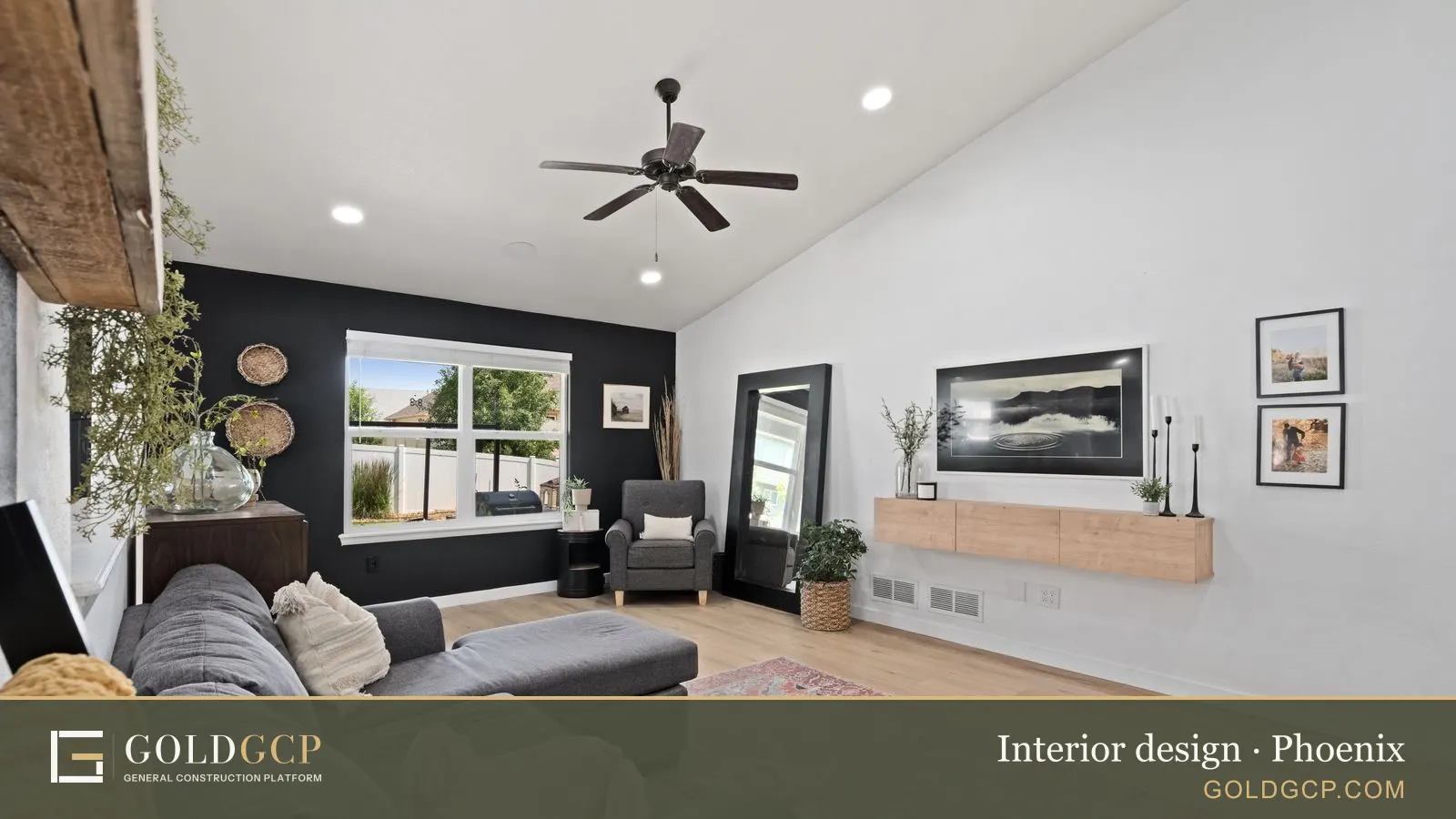
The short answer
An interior designer in Phoenix charges $45 to $405 an hour, and a single room runs $405 to $1,350 for design only. Arizona does not license interior designers, so the contract and the fee structure are what you check. Sun, dust, monsoon storms and hard water decide which finishes survive.
What interior designers cost in Phoenix
The ranges below apply the Phoenix construction cost factor of 0.90 from the U.S. Army Corps of Engineers to national cost data. They cover design fees only; furniture is separate.
| Job | Phoenix (typical range) | US average |
|---|---|---|
| Interior designer, per hour | $45–$405/hr | $50–$450/hr |
| In-home consultation | $45–$405 | $50–$450 |
| One room, design only | $405–$1,350 | $450–$1,500 |
| One room, design and furnishing | $900–$10,800 | $1,000–$12,000 |
| Whole home, per sq ft | $4.5–$15.5/sq ft | $5–$17/sq ft |
| Whole home, 2,000 sq ft | $9,000–$30,600 | $10,000–$34,000 |
Estimates for 2026, including labor and standard parts. Phoenix prices use the metro's construction cost factor of 0.90 (US average = 1.00) from the U.S. Army Corps of Engineers Area Cost Factors. Your quote depends on access, materials and the condition of the home.
Fees move with the size of the job, the designer's experience and how much buying they do for you. A firm principal bills near the top of the hourly range and a junior designer near the bottom. A whole-home project is usually priced by the square foot, and a single room is usually priced flat.
The cost estimator asks about your rooms and scope and applies the rate for your ZIP code.
How Phoenix designers bill
Most firms use one of six fee structures. Many combine two on the same project, such as hourly for the concept and cost plus for the furniture.
| Fee structure | What it means in practice |
|---|---|
| Hourly | Time, logged and billed, from $45 to $405 an hour |
| Flat fee per room | A fixed scope for one room, $405 to $1,350 for design only |
| Per square foot | Whole-home or large remodel work, $4.50 to $15.50 per square foot |
| Percent of construction cost | Design on a remodel priced as a share of the build |
| Cost plus | A percentage added to product and trade costs |
| Markup on retail | A markup on furnishings at retail price |
A room that includes furnishing costs $900 to $10,800, because the furniture budget is part of that figure. A 2,000 square foot home runs $9,000 to $30,600.
Charges that surprise people
Ask about the retainer before you sign. Many firms want a nonrefundable deposit at signing. Product deposits on furniture orders are common, and a designer who manages trades during construction usually adds a management fee. Travel time is often billed, which matters on a drive from Scottsdale to Peoria. Drawings may be billed separately from design time.
On a cost-plus arrangement, the fee is a percentage added to the product and trade costs, so ask for the percentage in writing before any order is placed.
Transaction privilege tax on furnishings
Arizona has no state sales tax in the usual sense. It has transaction privilege tax, and the Arizona Department of Revenue licenses businesses that sell taxable products or services. A business needs a TPT license from the state and a TPT or business license from each city where it is based or operates, at $12 per license per location.
The tax rate on your furniture depends on the city. Phoenix, Scottsdale, Mesa, Tempe, Chandler, Gilbert, Glendale and Peoria each set a rate on top of the state rate. Ask the designer whether their markup is calculated before or after tax and whether tax appears as its own line on the invoice.
Does an interior designer need a license in Arizona?
No. Arizona has no practice license for interior design. The Arizona State Board of Technical Registration licenses architects, engineers, landscape architects, geologists, land surveyors, home inspectors and alarm agents, and interior designers are not on that list.
When the job crosses into contracting
The line is construction. Under Arizona law, any business that contracts to build, alter, repair, add to, improve, move, wreck or demolish a building or structure needs a license from the Arizona Registrar of Contractors. Contractors must be licensed before they submit bids.
A designer who only specifies finishes, furniture and colors needs no license. A designer who offers to build the project, or who takes a contract to alter your house, needs an ROC license. The license belongs to the business, not to the individual who qualified for it. Check the business name on your contract against the ROC record.
What the ROC license covers
The ROC license is issued to a sole proprietorship, partnership, LLC or corporation. The qualifying party must pass the required exams with at least 70%, and the Arizona Statutes and Rules Exam cannot be waived unless that person was a qualifying party on an Arizona license within the past five years. Applicants must post a license bond, and LLCs and corporations must be registered with the Arizona Corporation Commission and in good standing.
Arizona has no direct reciprocity with any state. An out-of-state applicant may request a waiver of the trade exam and experience if they held a comparable license in another state within the past five years and got it by trade examination.
What a designer can draw, and when you need an architect
A designer can plan finishes, furniture layouts, cabinetry, lighting selections and color. Structural work is different. Removing a bearing wall, adding a beam, cutting a new opening in an exterior wall or adding square footage calls for a licensed architect or engineer, and the drawings that go to the city need the right stamp.
Arizona adopts its building codes locally, mostly the International Codes. Phoenix uses the 2018 Phoenix Building Construction Code, which includes amendments to the 2018 IBC and the 2017 National Electrical Code, and the city adopted the 2018 IRC with local amendments. Arizona has no mandatory statewide energy code, so the energy rules that apply to your project come from your city.
For the structural side, see the structural coordination guide and the permit drawings guide. If the project adds rooms, the additions and remodels guide covers how that work is scoped.
Do you need a permit?
Interior design itself needs no permit. The work it leads to often does, and the office that reviews it depends on where you live.
Which office reviews your permit
| Area | Permit authority |
|---|---|
| Phoenix | City of Phoenix, under the 2018 Phoenix Building Construction Code |
| Scottsdale | City of Scottsdale |
| Mesa | City of Mesa |
| Tempe | City of Tempe, online through the Citizen Access Portal |
| Chandler | City of Chandler, which adopted the 2024 International Codes with the 2023 NEC for plans submitted on or after July 1, 2025 |
| Gilbert | Town of Gilbert |
| Glendale | City of Glendale |
| Peoria | City of Peoria, through its Development Services online portal |
| Unincorporated Maricopa County | Maricopa County Planning and Development |
Maricopa County's rule: a project inside unincorporated Maricopa County needs a county permit; otherwise you start with your city or town. All new county permit and plan applications go through the Permit Center, the online system launched in June 2024.
What triggers a permit
Cosmetic work such as paint, flooring and furniture does not need a permit. Moving walls, adding or relocating plumbing and electrical, changing a window or door opening, and adding square footage do. Tempe requires plan approval before permits can be issued for new homes, remodels and accessory structures. Peoria requires civil or building plans to be reviewed before a building permit is issued for most projects.
Chandler offers walk-in plan review Monday through Friday from 8 a.m. to 4:30 p.m. for residential and small commercial projects, and most residential additions and renovations qualify. Chandler also requires a free Pre-technical Review for any new building or substantial building addition.
HOA rules come first
Before any modification, review your HOA CC&Rs. Maricopa County states that this is the property owner's responsibility, not the County's, and that a building permit does not stop an HOA from enforcing its rules. In a metro full of planned communities, that review can change the design before the designer draws anything.
Designing for the desert
The figures come from NOAA and the National Weather Service.
Sun and heat
Phoenix's 1991-2020 average annual temperature is 75.6°F, and Scottsdale's is 73.3°F, up 0.8°F from the prior normal. In the Southwest, average monthly temperatures rose for every month except May between the two normals periods. NOAA notes the entire West is considerably warmer in July normals, by up to 2°F.
That shapes window treatments, fabric choices and how much heat a west-facing room takes on in the afternoon. Climate normals include cooling degree days, which show how hard a house will work to stay cool. Ask your designer how the window coverings and finishes handle afternoon sun on the west side of the house.
Rain, dust and monsoon storms
Phoenix's average annual rainfall is 7.22 inches, down 0.81 inches from the prior normal. Scottsdale averages 8.73 inches and Phoenix/Deer Valley Airport averages 8.90 inches. The Southwest is drier under the new normals, and the largest percentage reductions in Southwest precipitation came in the spring and autumn transition months.
Dry does not mean safe. The monsoon usually runs from the latter half of June through September. Downburst winds can reach 50, 60 and 70 mph and in rare cases exceed 100 mph. They topple trees, fences, utility poles and lines, and blowing dust can cut visibility to near zero. The National Weather Service advises staying away from windows during a downburst because wind can loft debris that breaks glass.
For a designer, that means window coverings that survive wind-driven rain at an open window, exterior finishes that handle dust, and furniture placed away from glass that could break in a storm.
Hard water and low humidity
Arizona water is hard, and that shows up on fixtures, stone and glass. Ask what the designer specifies for shower glass, natural stone and metal finishes, and how those surfaces are maintained. Low humidity also affects wood: solid wood flooring and wood furniture can gap and crack in a dry house, so the designer should account for indoor humidity when specifying materials.
Cooling load and the building shell
Arizona has no mandatory statewide energy code, so the energy rules come from your city. Mesa adopted the 2009 IECC effective January 1, 2012, and Peoria adopted the 2012 IECC effective May 1, 2013. If your design changes windows, doors or the building shell, the city may check those changes against its adopted energy code. The energy-efficient windows guide covers the window side, and the Title 24 guide explains how energy compliance is documented in states that require it.
How long design takes in Phoenix
Schedules depend on scope and on how fast you make decisions.
| Project | What sets the pace |
|---|---|
| Furnish or restyle a room | Your decisions, then order and delivery times |
| Kitchen or bath, same layout | Selections, then the city permit |
| Kitchen or bath with wall changes | Floor plans, then plan review |
| Remodel touching structure | Architect and engineer drawings, then plan review |
Maricopa County processes non-technical minor permits in 1 to 2 business days by email. Technical review takes longer, and electrical service over 200 amps, roof-mounted HVAC and roof-mounted solar all require technical review with a site plan. Tempe publishes plan review turn-around times for first review, subsequent reviews and revisions, so you can check the current wait before you commit to a start date.
Changes after drawings are finished cost the most time, because plans may need to go back through review.
How to check an interior designer before you hire
- Ask what the fee structure is and get it in writing, including retainer, markup and product deposits.
- Look at completed Valley projects of a similar size and budget.
- Ask who draws anything structural and who pulls the permit.
- Confirm the designer carries insurance.
- Make sure the contract lists the number of revision rounds.
- If the designer also builds, look up the business on the Arizona Registrar of Contractors search before you sign. Check the license status, grant date and expiration date.
The ROC investigates complaints against licensed pros and unlicensed entities and works to resolve them. Its customer service hours are Monday through Friday, 8:30 a.m. to 4:30 p.m. For milestone payment practices, see how payment protection works.
Areas we cover
GOLDGCP matches homeowners with interior designers across the Valley, including:
- Phoenix
- Scottsdale
- Mesa
- Tempe
- Chandler
- Gilbert
- Glendale
- Peoria
Enter your ZIP code to see design prices for your area and get matched.
How GOLDGCP works
- Tell us about the room or project through the form, a call or WhatsApp.
- You see prices for your ZIP code before anyone visits, and we match you with up to 3 vetted pros.
- Our in-house architects take over the parts that touch structure, permits or an addition.
- You approve each stage and release each milestone payment, and you follow the project in the client portal.
Pros pass six-step vetting before they get a job: state license verification, an insurance check, a background and business check, portfolio review, client reference calls, and onboarding with a quality score. For the plumbing side of a kitchen or bath redesign, see our Phoenix plumbing guide.
Frequently asked questions
How much does an interior designer cost in Phoenix?
Most Phoenix projects cost $405 to $1,350 for a single room designed only, or $900 to $10,800 when furnishing is included. Hourly rates run $45 to $405. A 2,000 square foot home runs $9,000 to $30,600. Furniture, transaction privilege tax and any markup are on top.
Do interior designers need a license in Arizona?
No. Arizona has no practice license for interior design, and the State Board of Technical Registration does not regulate the trade. A designer who contracts to build or alter your house needs a license from the Arizona Registrar of Contractors.
Can an interior designer remove a wall in my Phoenix home?
They can plan it, but the structural work needs a licensed architect or engineer if the wall is load bearing. The city that reviews the permit depends on where you live, and unincorporated Maricopa County projects go through the County Permit Center.
Do I need a permit to redo my kitchen in Phoenix?
Usually yes if walls, plumbing or electrical change. Cosmetic work such as paint and flooring does not need one. Phoenix reviews under the 2018 Phoenix Building Construction Code, and Tempe requires plan approval before it issues permits for remodels.
How do Phoenix designers charge for furniture?
Through cost plus, a markup on retail, or a flat purchasing fee. Product deposits are common. Ask how the city bills transaction privilege tax, since Phoenix, Scottsdale, Mesa and the other cities each set their own rate.
What should a desert design account for?
Sun and heat on west-facing rooms, dust and wind-driven rain during the monsoon, hard water on fixtures and stone, and low indoor humidity that affects wood. Phoenix averages 7.22 inches of rain a year, and monsoon downburst winds can reach 50 to 70 mph.
How long does an interior design project take in Phoenix?
A furnishing-only project moves at the speed of your decisions and furniture lead times. A remodel that needs a permit waits on plan review, and Maricopa County processes non-technical minor permits in 1 to 2 business days while technical review takes longer.
How we calculate these prices
GOLDGCP starts from national price ranges for each job, taken from published 2026 cost guides and checked against local price guides where they exist. To get a local price, we multiply the national range by the construction cost factor for the metro from the U.S. Army Corps of Engineers Area Cost Factors (US average = 1.00). Where that table has no entry for a metro, we use the nearest listed location or the state value. For ZIP codes outside the 50 largest metros, the cost estimator uses the state's price level from the Bureau of Economic Analysis Regional Price Parities. Ranges include labor and standard materials but not unusual site conditions, so a written quote after an inspection is always the final price.
Sources
- Arizona Registrar of Contractors · Arizona Registrar of Contractors
- Arizona State Board of Technical Registration
- Arizona Registrar of Contractors · Applying for a License
- U.S. Army Corps of Engineers
- U.S. Bureau of Economic Analysis

About this guide
Written by the GOLDGCP editorial team. Prices come from national cost guides adjusted with official construction cost factors for Phoenix; rules and statistics come from the agencies and reports linked in the text. We update this page when prices or codes change.