
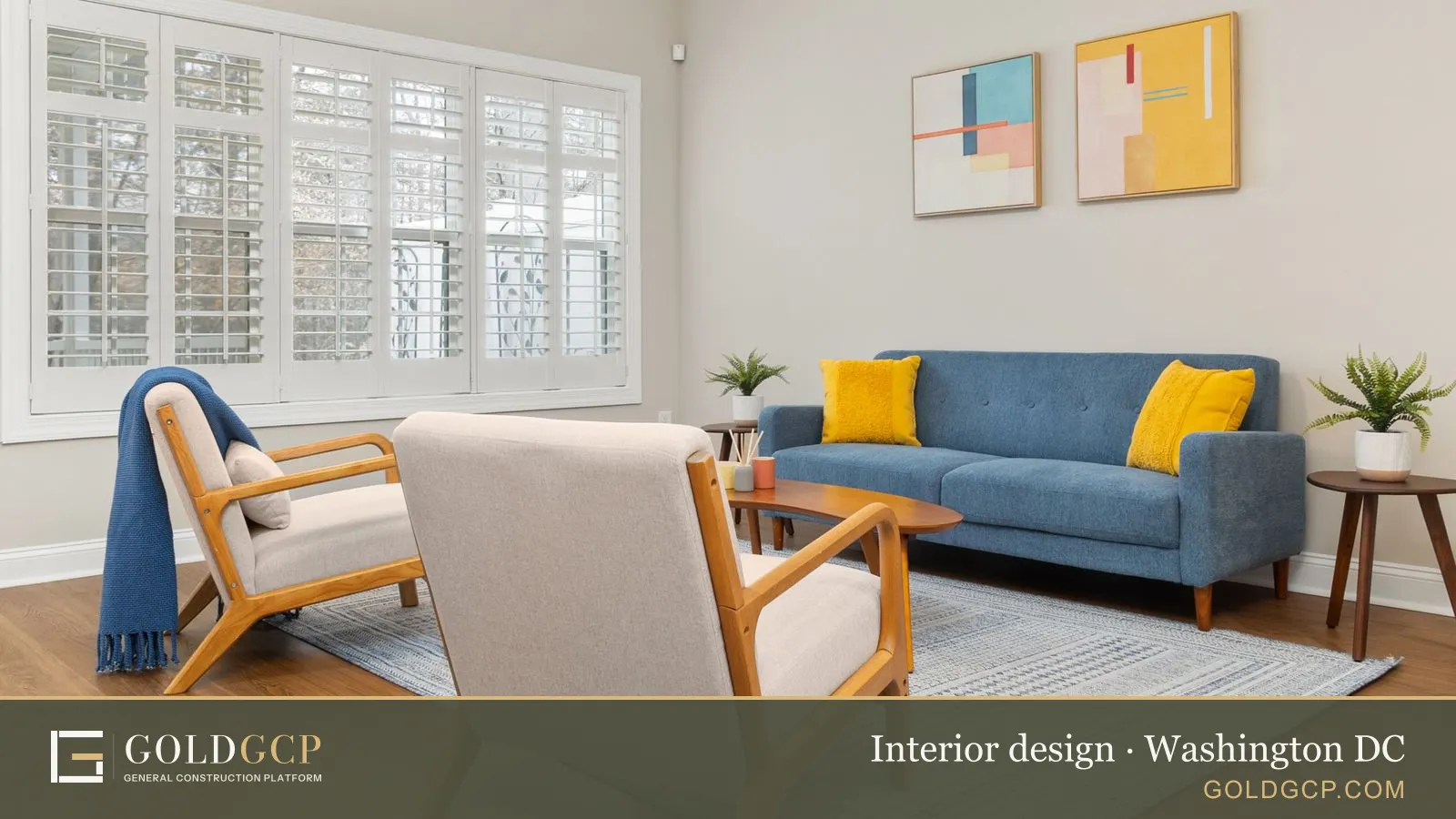
The short answer
An interior designer in Washington DC charges about $52 to $470 an hour, and most projects come to $470 to $1,550 for one room of design work or $10,400 to $35,350 for a whole 2,000 sq ft home. Where you build matters most. DC licenses interior designers. Maryland and Virginia only protect the title.
What interior designers cost in Washington DC
These ranges come from national cost data adjusted by the metro's construction cost factor of 1.04 from the U.S. Army Corps of Engineers. They cover design fees only. Furniture is separate.
| Job | Washington DC (typical range) | US average |
|---|---|---|
| Interior designer, per hour | $52–$470/hr | $50–$450/hr |
| In-home consultation | $52–$470 | $50–$450 |
| One room, design only | $470–$1,550 | $450–$1,500 |
| One room, design and furnishing | $1,050–$12,500 | $1,000–$12,000 |
| Whole home, per sq ft | $5–$17.5/sq ft | $5–$17/sq ft |
| Whole home, 2,000 sq ft | $10,400–$35,350 | $10,000–$34,000 |
Estimates for 2026, including labor and standard parts. Washington DC prices use the metro's construction cost factor of 1.04 (US average = 1.00) from the U.S. Army Corps of Engineers Area Cost Factors. Your quote depends on access, materials and the condition of the home.
Fees depend on the size of the job, the designer's experience and how much buying they do for you. A firm principal bills near the top of the hourly range. A junior designer bills near the bottom. A single room with design only sits at the low end of the one-room range. Add furnishings and the same room runs from about $1,050 to $12,500, because the designer now specifies, orders and receives furniture.
Whole-home work is usually priced by the square foot. At $5 to $17.50 per sq ft, a 2,000 sq ft house comes to $10,400 to $35,350. A rowhouse in Columbia Heights and a colonial in Bethesda can have the same square footage and very different budgets, mostly because of what goes inside.
The cost estimator below asks about your rooms and scope and applies the rate for your ZIP code.
How DC designers bill
Most firms pick one of six fee structures, and many combine two on the same project, for example hourly for the concept and cost plus for the furniture. HomeGuide's national figures:
| Fee structure | National range | What you are paying for |
|---|---|---|
| Hourly | $50 to $450, average $150 | Time, logged and billed |
| Flat fee per room | $1,000 to $12,000 | A fixed scope for one room |
| Per square foot | $5 to $17, average $9 | Whole-home or large remodel work |
| Percent of construction cost | 10% to 30%, average 20% | Design on a remodel priced as a share of the build |
| Cost plus | 17% to 45% added to product and trade costs, average 30% | The designer buys and marks up |
| Markup on retail | 10% to 35%, average 22% | A markup on furnishings at retail price |
Charges that surprise people
A retainer is normally due at signing. HomeGuide puts it at about 10% of the project, nonrefundable, though some firms ask for 10% to 50% up front. Product deposits can reach 50% of the furniture the firm orders for you. A designer who manages trades during construction usually adds a management fee of about 25%. Travel time is often billed at half the hourly rate, which matters when a designer based in Georgetown drives to a job in Loudoun County. CAD drawings are often billed separately.
For example, on a $15,000 package of furniture and trade work with a 30% markup, the fee is $4,500.
Sales tax on furnishings
Sales tax is one place the three jurisdictions in this metro differ. A designer buying furniture for a DC project, a Bethesda project and an Arlington project is dealing with three different tax authorities. Ask whether the markup is calculated before or after tax and whether tax appears as its own line on the invoice. On a furnishing budget of $40,000, a few points of tax difference is real money. The rate depends on where the goods are delivered, not where the designer's office sits.
Is interior design licensed here?
The answer changes when you cross Western Avenue or the Potomac.
District of Columbia: a licensed practice
DC is the strictest of the three. The DC Board of Architecture, Interior Design, and Landscape Architecture regulates the practice of interior design, and D.C. Code 47-2853.103 makes it unlawful for anyone not licensed as an interior designer to engage in the practice, advertise as one or use the title "interior designer." 47-2853.101 defines the practice broadly: consultations, studies, drawings, specifications, space planning and aesthetic planning of building interiors using knowledge of interior construction, building systems, codes and materials.
To be licensed in DC, a designer must hold a current certificate from CIDQ (the Council for Interior Design Qualification, formerly NCIDQ) showing they met its education, experience and examination requirements. The license costs $110 for up to two years, renews for $120, and expires April 30. Fees are nonrefundable under D.C. Code § 47-2853.10.
Firms are licensed too. Under D.C. Code § 47-2853.65, no firm, partnership or corporation may offer professional design services in the District unless it holds a professional design firm license, with at least one licensed architect, interior designer or landscape architect among its principals. Only a person licensed in DC may sign and stamp a professional design document for the firm.
In DC, ask for the license number and look it up with the DC Department of Licensing and Consumer Protection. A decorator without a license can still sell you a sofa. They cannot call themselves an interior designer or sell interior design services in the District.
Maryland: a title act
Maryland certifies interior designers but does not require a license to practice. The State Board of Certified Interior Designers, under the Maryland Department of Labor, certifies and regulates certified interior designers under Business Occupations and Professions Article, Title 8 and COMAR 09.18. The protected titles are "certified interior designer" and "certified interior design services."
Certification requires being at least 18 and passing the NCIDQ examination, plus the education and experience needed to qualify for it. The application costs an $86 certification fee plus a $56 nonrefundable application fee, and certification is valid for two years. Renewal requires at least 10 hours of continuing education per term, including one hour on green design approved by both IDCEC and the U.S. Green Building Council. Excess hours do not carry over. Reinstating an expired certification costs $112 plus the $86 fee, and reciprocity typically takes no more than a month.
The Board also investigates complaints against certified designers. Its offices are at 100 S. Charles St., Tower 1, Baltimore. Appointments run Monday to Friday, 10 a.m. to 4 p.m. There are no walk-ins.
Virginia: a title act
Virginia also protects only the title. Only people certified by the APELSCIDLA Board may use "certified interior designer." Others may still provide interior design services. If a Northern Virginia designer claims the certified title, ask for the certificate.
What this means for a metro-wide project
A designer licensed in DC is not automatically certified in Maryland or Virginia. A Maryland certified designer is not licensed to practice in DC. If your project crosses jurisdictions, ask which license or certification applies to each address and get it in writing.
What a designer can draw, and when you need an architect
Structure and occupancy mark the line between a designer's drawings and an architect's.
In DC, a design professional must be identified on permit applications for additions, alterations and repairs, excavation, demolition, foundation, new building, and sheeting and shoring. DC also licenses architects separately: no one may practice architecture or use the titles "architect," "registered architect," "licensed architect" or "architectural designer" unless licensed under D.C. Code 47-2853.63.
Virginia gives designers more room on houses. Under Code of Virginia 54.1-402, no architect or engineer license is needed to prepare plans for single- and two-family homes, townhouses and multifamily dwellings up to three stories, excluding electrical and mechanical systems, or for additions, remodeling or interior design with no change in occupancy, structure, exits or fire hazard, as long as the plans carry the author's name, address and occupation. If you move a bearing wall or change the exit path, that exemption stops applying.
If your project removes a bearing wall, adds a beam, opens a large window in an exterior wall or adds square footage, bring in an architect or structural engineer. GOLDGCP's in-house architects handle that side. The structural coordination guide explains how the engineer fits in. For drawings that go to a permit office, see permit drawings, and for a full residential scope, residential design.
Do you need a permit?
Interior design itself needs no permit. The work it leads to often does. Each jurisdiction runs its own office.
District of Columbia
The DC Department of Buildings (DOB) requires permits for interior alterations, including finished basements, and for new and replacement gas appliances, HVAC equipment and plumbing fixtures. Finish work such as cabinets, countertops, flooring and tiling needs no permit, unless the property is in a historic district, where the no-permit list does not apply.
Fees are based on the entire cost of construction. An alteration valued between $1,001 and $1 million costs $30 plus 2% of construction value, plus a 10% enhanced fee. The first payment is a filing deposit of 50% of the assessed permit fee, capped at $20,000, plus 10%. A signed construction contract is required before any DC permit is issued. The contractor, subcontractor, design professional and master tradesmen must all be licensed in DC. Homeowners of single- or two-family homes can act as their own contractor of record, but they cannot pull trade permits. Only licensed master trade professionals can. DOB's general line is (202) 671-3500.
Montgomery County, Maryland
The Montgomery County Department of Permitting Services (DPS) enforces the Maryland Building Performance Standards. A permit is required before construction that increases the area, height or overall footprint of a one- or two-family dwelling. Regular review may take up to 17 calendar days. WSSC Water must also review before the permit is issued. A contractor needs a Maryland Home Improvement Commission (MHIC) license to obtain a permit. Inspections must be requested at least 24 hours ahead. DPS is at 2425 Reedie Drive, 7th floor, Wheaton, and the main number is 240-777-0311.
Northern Virginia
The 2021 Virginia Uniform Statewide Building Code governs, enforced by each county or city building official. Fairfax County requires a permit for kitchen renovations, bathroom remodels, finished basements, removing or adding walls including non-load-bearing ones, and new window or door openings. It does not require one for kitchen cabinets and countertops, bathroom vanities, tile and flooring replacement, or painting. Fairfax permits are filed in the PLUS system, and the LDS number is 703-222-0801. Arlington issues permits through Permit Arlington and its Accela portal. Alexandria, Loudoun and Prince William each have their own building official.
For build costs once the design is set, see the kitchen remodeling guide and the bathroom remodeling guide.
How long design takes
Schedules depend on scope and on how fast you make decisions. HomeGuide's architect guide gives a yardstick for projects that need drawings: first concept drafts arrive 2 weeks to 1 month after the first meeting, and a full set of plans ready for permits takes 2 to 6 months. A furnishing-only project skips the drawings and the permit office, so the wait is mostly furniture lead times.
| Project | What sets the pace |
|---|---|
| Furnish or restyle a room | Your decisions, then order and delivery times |
| Kitchen or bath, same layout | Selections, then the local permit |
| Kitchen or bath with wall changes | Floor plans, then plan review |
| Remodel touching structure | Architect and engineer drawings, then plan review |
Montgomery County's 17-day review and DC's plan review both start only after a complete application. Changes after drawings are finished cost the most time, because plans may need to go back through review.
How to check an interior designer before you hire
- In DC, ask for the interior design license number and confirm it with DLCP. In Maryland or Virginia, ask whether they are a certified interior designer and confirm it with the state board.
- Ask whether the firm holds a DC professional design firm license if the project is in the District.
- Look at completed projects of a similar size and budget in this metro.
- Get the fee structure in writing, including any markup, retainer and product deposit.
- Ask who draws anything structural and who pulls the permit.
- Ask whether they carry errors and omissions insurance.
- Make sure the contract lists the number of revision rounds.
If a designer offers to build the project too, look up the contractor license separately: an MHIC license in Maryland, a DPOR Class A, B or C license in Virginia, a Home Improvement Contractor license in DC. For milestone payment practices, see how payment protection works.
Areas we cover
GOLDGCP matches homeowners with interior designers across the Washington metro, including:
- Washington DC
- Arlington and Alexandria
- Fairfax and Northern Virginia
- Bethesda and Silver Spring
- Montgomery County
Enter your ZIP code to see design prices for your area and get matched with pros.
How GOLDGCP works
- Tell us about the room or project through the form, a call or WhatsApp.
- You see prices for your ZIP code before anyone visits, and we match you with up to 3 vetted pros.
- Our in-house architects take over the parts that touch structure, permits or an addition.
- You approve each stage and release each milestone payment, and you follow the project in the client portal.
Pros pass six-step vetting before they get a job: state license verification, an insurance check, a background and business check, portfolio review, client reference calls, and onboarding with a quality score. For the full process, see how we vet pros.
Frequently asked questions
How much does an interior designer cost in Washington DC?
Most projects come to $470 to $1,550 for one room of design work, or $10,400 to $35,350 for a whole 2,000 sq ft home, based on national data adjusted by the metro's 1.04 cost factor. Hourly rates run $52 to $470. Furniture, sales tax and any markup are extra.
Do interior designers need a license in Washington DC?
Yes. DC licenses the practice of interior design, and only licensed designers may offer interior design services or use the title. Licensing requires a current CIDQ certificate. Maryland and Virginia only protect the "certified interior designer" title, so an unlicensed designer can practice there.
What is a certified interior designer in Maryland?
A designer certified by the Maryland Board of Certified Interior Designers after passing the NCIDQ exam. Certification costs $86 plus a $56 application fee, lasts two years, and requires 10 hours of continuing education per term, including one hour on green design.
Can an interior designer remove a wall in my DC rowhouse?
They can plan it, but the structural part needs an architect or engineer, and DC requires a design professional on alteration permits. Moving a bearing wall or changing the exit path goes past what a designer can stamp alone.
Do I need a permit to redo my kitchen in Fairfax County?
Usually yes. Fairfax requires a permit for kitchen renovations, bathroom remodels and removing or adding walls, including non-load-bearing ones. Replacing cabinets and countertops alone needs no permit. Permits are filed in the PLUS system.
How do Washington designers charge for furniture?
Usually through cost plus, 17% to 45% on top of product and trade costs, or a markup on retail of 10% to 35%. Product deposits of up to 50% are common. Ask how sales tax is billed, since DC, Maryland and Virginia each set their own rate.
How long does an interior design project take in the DC area?
Furnishing-only projects move at the speed of your decisions and furniture lead times. Projects that need drawings take 2 weeks to 1 month for first concepts and 2 to 6 months for a permit-ready set. Montgomery County's permit review alone can take up to 17 days.
How we calculate these prices
GOLDGCP starts from national price ranges for each job, taken from published 2026 cost guides and checked against local price guides where they exist. To get a local price, we multiply the national range by the construction cost factor for the metro from the U.S. Army Corps of Engineers Area Cost Factors (US average = 1.00). Where that table has no entry for a metro, we use the nearest listed location or the state value. For ZIP codes outside the 50 largest metros, the cost estimator uses the state's price level from the Bureau of Economic Analysis Regional Price Parities. Ranges include labor and standard materials but not unusual site conditions, so a written quote after an inspection is always the final price.
Sources

About this guide
Written by the GOLDGCP editorial team. Prices come from national cost guides adjusted with official construction cost factors for Washington DC; rules and statistics come from the agencies and reports linked in the text. We update this page when prices or codes change.