

The short answer
A new asphalt shingle roof on a typical Austin house runs about $5,750 to $11,500 for 2,000 square feet, and metal runs $8,200 to $26,250. Most leak repairs land between $125 and $820. Texas does not license roofers, so you have to check insurance and the contract yourself.
What roofers charge in Austin
The table uses national cost data adjusted for Texas. The U.S. Army Corps of Engineers puts Texas construction costs at 0.82 times the national average, so a roof that costs $10,000 elsewhere tends to cost around $8,200 here. The Corps has no separate Austin entry, so the whole state uses the same factor.
| Job | Austin (typical range) | US average |
|---|---|---|
| Asphalt shingle roof, 2,000 sq ft | $5,750–$11,500 | $7,000–$14,000 |
| Metal roof, 2,000 sq ft | $8,200–$26,250 | $10,000–$32,000 |
| Tile roof, 2,000 sq ft | $11,500–$41,000 | $14,000–$50,000 |
| Flat roof, 1,000 sq ft | $2,450–$9,000 | $3,000–$11,000 |
| Tear-off of one old layer, 2,000 sq ft | $1,650–$3,300 | $2,000–$4,000 |
| Vent boot repair | $61–$125 | $75–$150 |
| Replace up to 25 shingles | $82–$245 | $100–$300 |
| Flashing repair | $165–$410 | $200–$500 |
| Minor leak repair | $125–$820 | $150–$1,000 |
| Leak with water damage | $820–$4,900 | $1,000–$6,000 |
| Roof deck repair, per 100 sq ft | $165–$410 | $200–$500 |
Estimates for 2026, including labor and standard parts. Austin prices use the Texas statewide construction cost factor of 0.82 (US average = 1.00) from the U.S. Army Corps of Engineers Area Cost Factors, which have no separate Austin entry. Your quote depends on access, materials and the condition of the home.
What raises a quote in Austin:
- Material. Asphalt is the budget choice. Metal and tile cost two to four times more up front.
- Tear-off. Each old layer that has to come off adds $1,650 to $3,300 on a 2,000-square-foot roof.
- Deck repairs. Soft or rotted sheathing found after tear-off runs $165 to $410 per 100 square feet.
- Access. Steep lots in Westlake and the hills west of town make staging and hauling slower.
- Storm timing. After a hail event, crews are booked and prices firm up.
Run your own numbers with the cost estimator below, or open the full roofing cost estimator. Both use your ZIP code rate. For national prices and how roofers measure a roof, see our roofing cost guide.
The same estimator has its own page, easy to share or bookmark: Roof replacement cost estimator.
Roofing materials that suit Austin
These are the common choices at Austin prices for 2,000 square feet of roof:
| Material | Austin installed cost, 2,000 sq ft | Typical lifespan | Austin notes |
|---|---|---|---|
| Asphalt (composition) shingles | $5,750 to $11,500 | Architectural shingles last longer than standard ones | Most common here; hail resistance varies by product line |
| Metal | $8,200 to $26,250 | Long-lived; outlasts most other roof coverings | Handles heat and hail well; costs more up front |
| Concrete or clay tile | $11,500 to $41,000 | 30 to 100+ years | Heavy; the underlayment wears out before the tile |
| Low-slope (flat) roof, 1,000 sq ft | $2,450 to $9,000 | 5 to 60 years by type | Common on older central Austin homes and additions |
Asphalt shingles: the local default
Most Austin roofs are asphalt, the cheapest option and the easiest to repair after hail. Ask what impact rating the product line carries and whether the manufacturer's warranty covers hail, because a standard shingle warranty often does not.
Metal: built for the sun
Metal reflects summer heat and stands up to hail better than most shingles. Standing seam costs the most and exposed-fastener panels cost less. On a low-slope section, a metal panel system is often the practical choice.
Tile: watch the underlayment
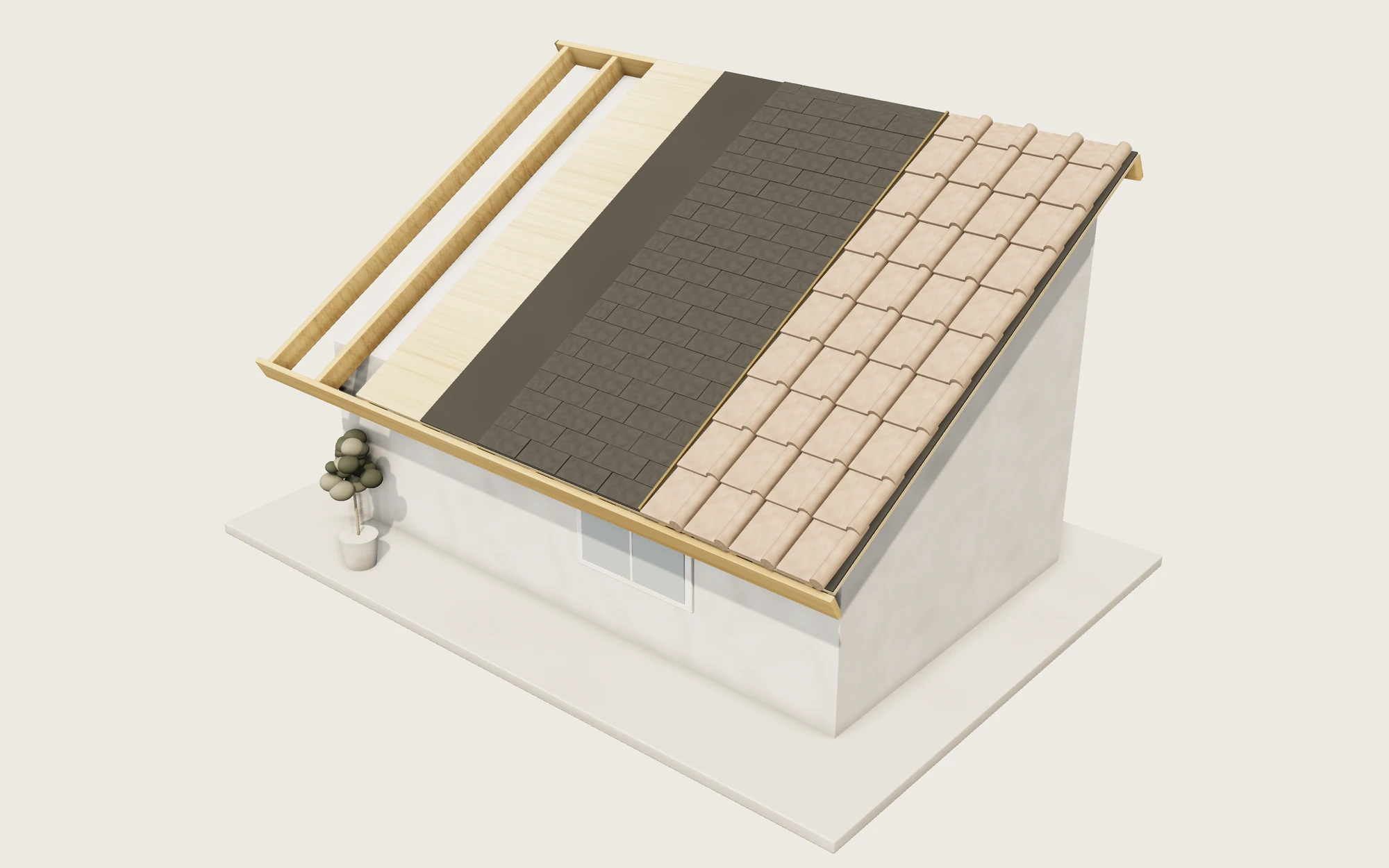
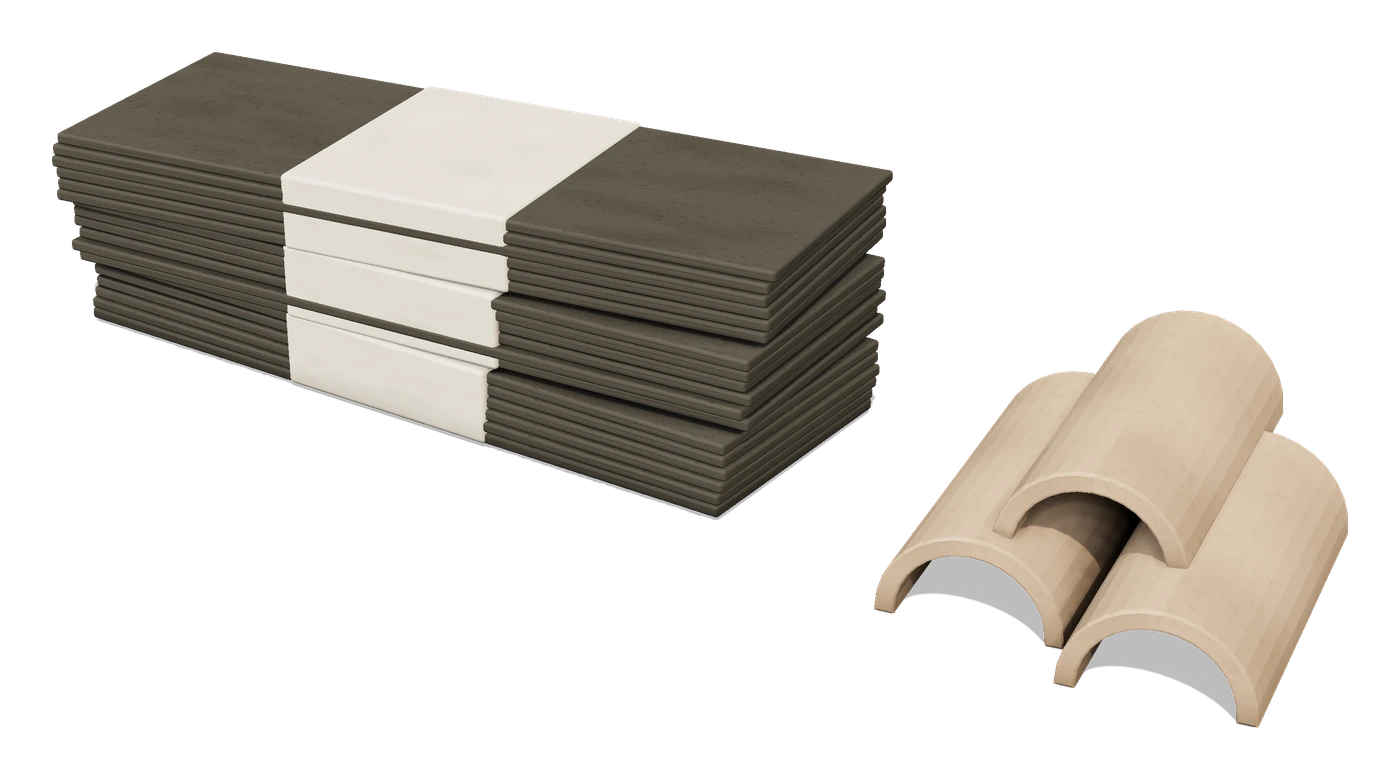
Tile can outlast the house, but the felt or synthetic layer under it does not. When that layer fails, water slips between the tiles and reaches the deck. The fix is a lift and relay: pull the tiles, install new underlayment and flashing, then reset the same tiles and replace the broken ones.
Flat roofs on older homes
Central Austin has a lot of low-slope roofs on mid-century houses and additions. These are usually membrane or coating systems, and they need a different crew than a shingle roof. Get a roofer who names the membrane product in the estimate.
Why Austin roofs fail when they do
Austin's summers are the main stress. Weeks of 100-degree days bake shingles, dry out sealant and crack pipe boots. Spring brings hail, high wind and the occasional tropical downpour. Trees add the rest: live oaks and pecans drop limbs on roofs across older neighborhoods.
Hail is the event that drives most insurance claims. After a storm, shingles can look fine from the ground while their granules are knocked off and the mat is bruised. An adjuster and a roofer should both get on the roof.
Heat also shortens the life of anything rubber or plastic on the roof: vent boots, pipe collars and the seals around skylights. A cracked vent boot is one of the cheapest fixes on the list, $61 to $125, and a common source of a ceiling stain.
Book an inspection in late winter or early spring, before storm season. A roofer can reseal flashing, replace cracked boots and check the deck at the eaves while the schedule is open. If a storm is already overhead and water is coming in, call our 24/7 emergency line.
After a hail or wind storm: insurance claims
The Texas Department of Insurance says insurance companies cannot decline or not renew a home policy based on the age of the house or its roof (TDI). An older roof is not automatically uninsurable.
What to do after a storm:
- Photograph the damage inside and out before anything is moved or patched.
- Call your insurer and open a claim. Get the adjuster's scope in writing.
- Have your own roofer inspect and write a line-item estimate. Compare the two documents line by line.
- Do not sign anything from a crew that knocks on your door the day after a storm.
TDI also issued a bulletin pushing insurers to give premium discounts to homeowners who make their homes more resistant to storm and wildfire damage (TDI). Ask your insurer whether an impact-rated roof or a wind mitigation feature qualifies.
If you have a claim problem, TDI's consumer Help Line is open 8 a.m. to 5 p.m. Central at 800-252-3439. TDI also publishes guidance on filing claims and avoiding contracting scams after a storm.
Do you need a permit?
It depends on the city and on how much of the roof you are replacing.
City of Austin
Austin exempts asphalt shingles that replace existing asphalt shingles, and any roof covering replacement that does not affect the roof structure, from a building permit. If the property is in the Wildland-Urban Interface area and 50% or more of the roofing is being replaced, a permit is required (Austin Development Services). Roof decking repairs of 128 square feet or less are also exempt. Exempt work still has to meet the building code.
For permitted work, Austin publishes a residential building plan review and permit fee schedule. Paying by credit card through the AB+C portal adds a 2.35% service fee with a $2 minimum; paying by checking account avoids it. In-person credit card payments are only accepted under $10,000 (City of Austin). The city also has a "Do I Need A Permit?" tool and a Development Process Team that helps homeowners.
Round Rock
Round Rock requires a building permit for construction, alteration, repair and replacement work within the city and in the Chandler Creek and Vista Oaks municipal utility districts (Round Rock Building Inspection). The city runs a strict one-permit system, so every contractor on the job must be listed on the application before the permit issues. Contractors must register with the city, and there is no registration fee. A permit becomes invalid if work does not start within six months. Two inspections of each type are included; after two failed inspections of the same type, a $75 re-inspection fee applies.
Cedar Park
Cedar Park requires building permits for any construction that adds a structure or physically changes an existing one (Cedar Park). All contractors must register with the city, and registration is free. Applications go through the MGO Connect portal. Development Services is at Building 1, 450 Cypress Creek Road, phone 512-401-5100.
Pflugerville
Pflugerville requires a reroof inspection certificate for roofing work (Pflugerville). Applications go through the CityWorks PLL portal. Permit payments are temporarily accepted only by check, payable to the City of Pflugerville with the permit number, delivered to 100 W. Main St. The city publishes a Fiscal Year 2027 fee schedule.
Leander
Leander handles permits through its Development Hub, a mostly paperless system for applications, plan uploads, fee payment and inspection scheduling (Leander). Residential application requirements and inspection guidelines are published on the city site.
West Lake Hills
West Lake Hills requires any contractor working on a project valued at $25,000 or more to register with Building and Development Services before a permit issues. All contractors except general contractors under $25,000 must show a certificate of general liability insurance with at least $600,000 in coverage (West Lake Hills). The department is at 4010 Bee Cave Road, phone 512-327-3628.
Travis and Williamson counties
Outside city limits, Travis County requires a development permit for construction, and repair applications must include a line item cost estimate on contractor letterhead (Travis County). The permit desk is at 700 Lavaca, Suite 540, open Monday to Thursday 9 a.m. to 2 p.m., phone (512) 854-4215.
Williamson County has not adopted residential building code standards for unincorporated areas and does not require new residential construction to conform to a building code (Williamson County). If the property is in a city or city ETJ, check with that city. The County Engineer's office handles floodplain questions at 512-943-3330.
Repair or replace?
Repair makes sense when the damage is local: a cracked vent boot, a handful of missing shingles, flashing that has pulled loose at a chimney. At Austin prices those run from about $61 to $410. A minor leak runs $125 to $820. A leak that has already soaked the deck or a ceiling costs $820 to $4,900.
Replacement starts to make sense when:
- Leaks show up in more than one place after the same storm
- Shingles are bald, curled or brittle over large areas
- The tile is fine but the underlayment is failing across the roof (a lift and relay may be the middle option)
- The roof is near the end of its material's lifespan
- Your insurer's adjuster has scoped a full replacement
How to check a roofer before you hire
Texas does not license roofers. The City of Austin says plainly that in Texas anyone can be a general contractor and no state license is required (Austin Development Services). That makes the checks below essential.
- Ask for the certificate of general liability insurance and call the insurer to confirm it is current. West Lake Hills requires at least $600,000 for registered contractors; use that as a floor even where the city does not require it.
- Ask for workers' compensation coverage or a statement that the company has none. If a crew member is hurt on your roof and the company has no coverage, the claim can come back to you.
- Check the business name against the Texas Secretary of State records and look for complaints with the Better Business Bureau.
- Get a written contract that names the product line, the underlayment, the flashing, who pulls the permit and who hauls away the old roof.
- Keep the deposit small and tie the rest to stages: tear-off and deck inspection, then final inspection.
- Ask for the manufacturer's product data sheet so you can confirm what is actually going on the roof.
GOLDGCP checks every roofer before they join: state license verification, insurance, a business and public-records check, a portfolio review, client reference calls, and onboarding with a quality score. You pay your pro directly, stage by stage, each milestone after you approve that stage. Read more about how milestone payments work.
Areas we cover
Roofers in the GOLDGCP network work across greater Austin and the surrounding cities:
- Austin, from central neighborhoods to the hills west of town
- Round Rock
- Cedar Park
- Georgetown
- Pflugerville
- Leander
- Westlake
Enter your ZIP code to see roofing prices for your street and get matched with a local roofer.
How GOLDGCP works
- Tell us about the roof: material, rough size, the leak or the plan. Use the form, call or send a WhatsApp message.
- You see prices for your ZIP code, then we match you with up to 3 vetted roofers.
- Your roofer inspects, gives a written estimate, pulls the city or county permit where one is required, and orders the product.
- You pay by milestone: for example after tear-off and deck inspection, and after the final inspection. Track it all in the client portal.
For an active leak during a storm, call our 24/7 emergency line.
Frequently asked questions
How much does a new roof cost in Austin?
For about 2,000 square feet of roof, expect $5,750 to $11,500 in asphalt shingles, $8,200 to $26,250 in metal and $11,500 to $41,000 in tile. Tear-off of an old layer adds $1,650 to $3,300, and deck repairs add $165 to $410 per 100 square feet.
How much does roof repair cost in Austin?
Small fixes such as a vent boot, a few shingles or a flashing repair cost about $61 to $410. A minor leak runs $125 to $820. If water has already damaged the deck, insulation or a ceiling, plan on $820 to $4,900.
Do I need a permit to replace my roof in Austin?
Often no. Austin exempts asphalt shingles that replace existing shingles, and roof covering replacements that do not affect the structure, unless the property is in the Wildland-Urban Interface and 50% or more of the roof is replaced. Decking repairs of 128 square feet or less are also exempt.
Does Texas license roofers?
No. Texas has no state roofing license, and the City of Austin notes that anyone can be a general contractor in Texas without a state license. That is why insurance, a written contract and milestone payments matter here.
What roof holds up best to Austin hail?
Metal handles hail better than most shingles, and impact-rated asphalt products are available. Ask for the product data sheet and the manufacturer's warranty terms, because a standard shingle warranty often does not cover hail damage.
Can my insurer drop me because my roof is old?
No. The Texas Department of Insurance says companies cannot decline or not renew a home policy based on the age of the house or its roof. TDI also pushed insurers to offer discounts for storm and wildfire resistant upgrades.
When should I get my roof inspected in Austin?
Late winter or early spring, before hail season. Summer heat cracks boots and sealant, and spring storms finish the job. An inspection in February or March catches small problems while crews are available and prices are steady.
How we calculate these prices
GOLDGCP starts from national price ranges for each job, taken from published 2026 cost guides and checked against local price guides where they exist. To get a local price, we multiply the national range by the construction cost factor for the metro from the U.S. Army Corps of Engineers Area Cost Factors (US average = 1.00). Where that table has no entry for a metro, we use the nearest listed location or the state value. For ZIP codes outside the 50 largest metros, the cost estimator uses the state's price level from the Bureau of Economic Analysis Regional Price Parities. Ranges include labor and standard materials but not unusual site conditions, so a written quote after an inspection is always the final price.
Sources

About this guide
Written by the GOLDGCP editorial team. Prices come from national cost guides adjusted with official construction cost factors for Austin; rules and statistics come from the agencies and reports linked in the text. We update this page when prices or codes change.