
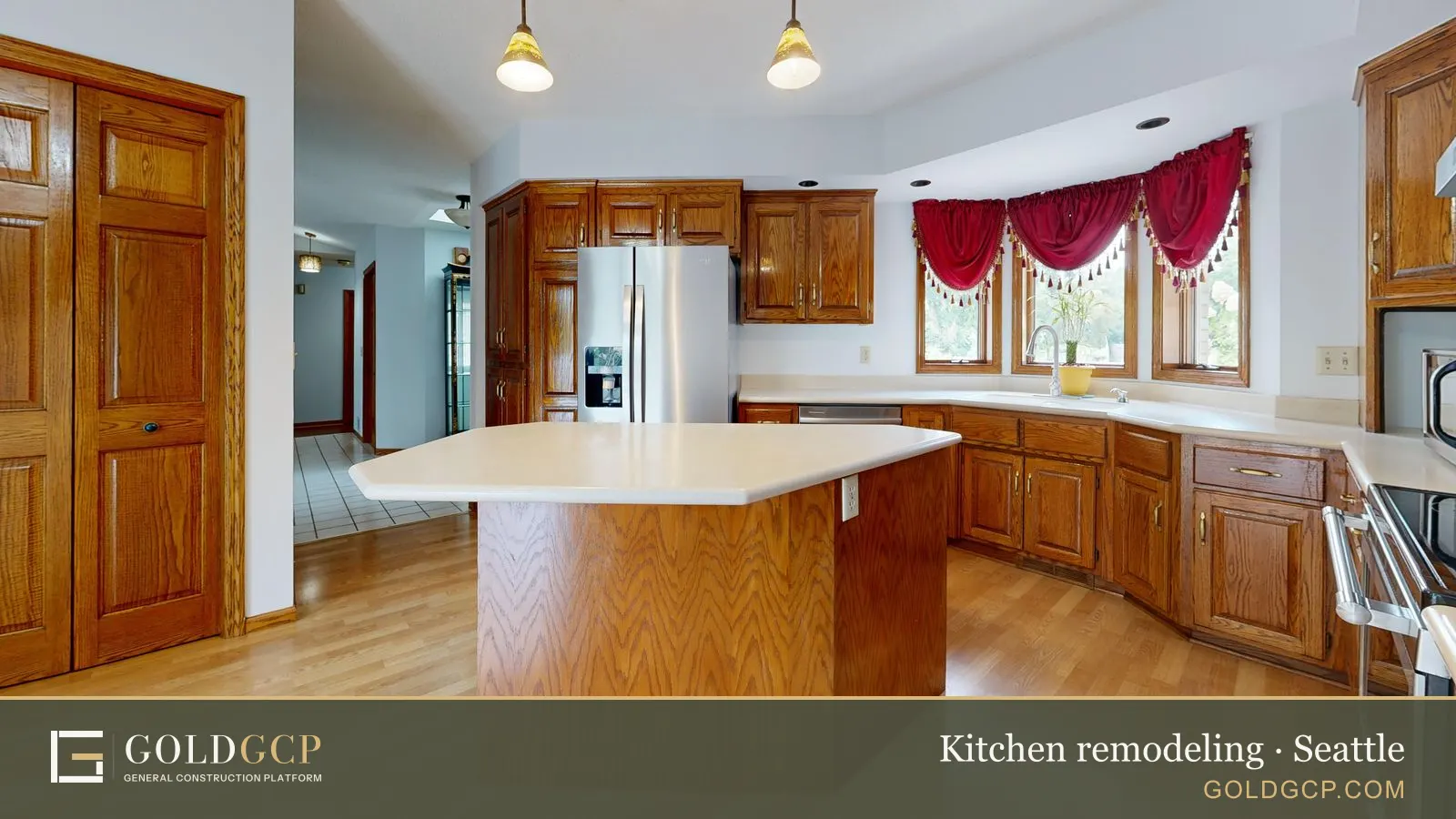
The short answer
A mid-range remodel of a 150-square-foot kitchen in Seattle runs about $25,850 to $43,150 by our cost-adjusted figures. The layout drives the permit path. Keeping the walls and the sink in place usually means a simple remodel permit. Moving a wall means stamped plans and plan review.
What a kitchen remodel costs in Seattle
The table applies the Seattle construction cost factor of 1.15 from the U.S. Army Corps of Engineers to national remodeling cost data. That puts the metro about 15% above the US average for the same work, using the average of Tacoma (1.07) and the Puget Sound bases (1.21).
| Job | Seattle (typical range) | US average |
|---|---|---|
| Cosmetic refresh, 150 sq ft kitchen | $12,950–$25,850 | $11,250–$22,500 |
| Mid-range remodel, 150 sq ft kitchen | $25,850–$43,150 | $22,500–$37,500 |
| High-end remodel, 150 sq ft kitchen | $43,150–$77,650 | $37,500–$67,500 |
| Small kitchen (10×10 ft), mid-range | $17,250–$28,750 | $15,000–$25,000 |
| Large kitchen (15×15 ft), mid-range | $38,800–$64,700 | $33,750–$56,250 |
| Stock cabinets, installed | $115–$460/lin ft | $100–$400/lin ft |
| Semi-custom cabinets, installed | $175–$805/lin ft | $150–$700/lin ft |
| Custom cabinets, installed | $575–$1,400/lin ft | $500–$1,200/lin ft |
| Appliance package | $2,900–$23,000 | $2,500–$20,000 |
| Moving plumbing or walls (add-on) | $5,750–$28,750 | $5,000–$25,000 |
| Permits | $575–$1,700 | $500–$1,500 |
Estimates for 2026, including labor and standard parts. Seattle prices use a construction cost factor of 1.15 (US average = 1.00) from the U.S. Army Corps of Engineers Area Cost Factors, based on drawn from Tacoma (1.07) and Puget Sound bases (1.21). Your quote depends on access, materials and the condition of the home.
Bellevue and Redmond carry some of the highest kitchen budgets in the region, while Tacoma and Everett sit closer to the national average.
To price your own kitchen by size, finish and ZIP code, use the cost estimator or open the full kitchen cost estimator.
The same estimator has its own page, easy to share or bookmark: Kitchen remodel cost estimator.
Where the money goes in a Seattle kitchen
Cabinets are the largest single purchase. Installed, stock boxes cost about $115 to $460 per linear foot here, semi-custom $175 to $805, and custom $575 to $1,400. A galley with 20 feet of cabinets and a U-shaped kitchen with 35 feet carry very different budgets even at the same finish level.
Three other cost lines often surprise Puget Sound homeowners:
| Cost line | Why it shows up here | Typical effect |
|---|---|---|
| Moving plumbing, gas or walls | An open plan usually means taking out a wall | About $5,750 to $28,750 added to the remodel |
| Code upgrades | A permit can trigger retrofits elsewhere in the house (see below) | Depends on what the house already has |
| Hidden conditions | Much of the metro's housing dates to the mid-20th century | Budget a contingency for older houses |
Under the EPA's Renovation, Repair and Painting program, a contractor who disturbs painted surfaces in a pre-1978 home must be a certified firm and follow lead-safe work practices. Demolishing old cabinets and plaster qualifies. Washington runs its own RRP certification through the Department of Commerce, and the firm fee is $25.
Before any renovation, Puget Sound Clean Air Agency rules require a survey for asbestos-containing materials. Owners who live in and own a single-family house may do their own survey; every other situation needs an AHERA-certified inspector. Keep a copy of the survey at the project site.
Layout changes and what triggers plan review
Each city in the metro sorts kitchen work into its own paths, and the path you land in decides your schedule.
| What you are doing | Typical path | What it means for you |
|---|---|---|
| Paint, backsplash, new counters, cabinets in the same spots, flooring | Often no building permit | Start when materials arrive |
| New circuits, a moved sink or dishwasher, a new gas line, a ducted hood | Trade permits, often over the counter | Issued quickly in most cities |
| Removing or opening a wall, adding a beam, enlarging a window | Building permit with plan review | Stamped plans, then review |
In Bellevue, a remodel with no structural work can require a permit. The process runs application, plan review, contractor approval and inspections. Bellevue accepts applications and plans online through MyBuildingPermit. Redmond requires a building permit for alterations and remodels, and its plan reviewer checks plans but does not do design work, so sizing of structural members is the owner's or builder's responsibility. Renton notes that structural changes may require plans stamped by a licensed Washington State architect or engineer. Everett requires a permit for most work except what code exempts, and Tacoma requires permits for remodels and additions.
If you are considering an open plan, have a structural engineer or an architect look at the wall first. Our page on permit drawings covers what reviewers expect to see, and structural coordination explains how the engineer and designer work together.
What a kitchen permit costs
None of these cities has a flat kitchen fee. Permit fees are based on the value of construction. Redmond and Renton both say fees depend on scope and the number of permits required. Renton offers a fee estimator on its online permit portal. Everett adds a 2.3% credit card convenience fee to card transactions. Across our price data, Seattle-area kitchen permits come to roughly $575 to $1,700.
Renton requires separate permits for electrical, plumbing, mechanical, fire sprinklers and alarms. In unincorporated King County, electrical inspections are scheduled through the state Department of Labor and Industries, not the county.
Electrical, gas and ventilation rules in Seattle kitchens
Inspectors check kitchens against the Washington State codes each city adopts. These items most often change a design.
Counter circuits and outlets
At final inspection, countertops need two 20-amp small-appliance circuits with GFCI protection. Bringing an older kitchen up to code often means new wire runs back to the panel, and sometimes a larger panel too. In Seattle, many residential electrical permits are issued over the counter, and the permit must be posted on site. A plan review is required when three or more over-the-counter permits are issued in a single building and could affect a feeder, service or fire alarm system.
Gas lines to the range
Extending or adding a gas line to a range or cooktop is plumbing work covered by the permit. The inspector sees the new piping under an air pressure test before the walls close. Ask your remodeler who pulls the gas permit and when the test is scheduled.
Range hoods and ventilation
Washington's mechanical code sets detailed rules for kitchen exhaust, published by the State Building Code Council. An enclosed kitchen has permanent openings to adjacent spaces that total 60 square feet or less. Cooking exhaust must discharge outdoors through a smooth, airtight duct with a backdraft damper, independent of other exhaust systems. It cannot end in an attic, crawl space or inside the building.
The airflow depends on the fuel. A hood over an electric range must meet 65% capture efficiency or 160 cfm, and a hood over a gas range must meet 80% capture efficiency or 250 cfm. Downdraft and other intermittent fans must move at least 300 cfm. Intermittent fans must be rated at no more than 3 sones at 100 cfm, and continuous fans at no more than 1 sone. Enclosed kitchens need 100 cfm intermittent or 5 air changes per hour continuous.
Seattle's residential code adds two points. Range hood ducts must be galvanized steel, stainless steel or copper. A hood capable of exhausting more than 400 cfm needs makeup air at roughly the exhaust rate, with at least one accessible damper. Exhaust openings must sit at least 3 feet from property lines and building openings, and 10 feet from mechanical air intakes.
Lighting
When you replace kitchen lighting, the new fixtures must meet the state energy code's high-efficacy rules. In practice, that means LED fixtures that qualify. Ask your remodeler to show the fixture schedule with the permit.
What else a permit makes you fix
A kitchen permit can bring in work outside the kitchen. The retrofit list depends on the city and the permit value, so ask your permit technician what applies to your address before you sign a contract. In older homes, expect the inspector to look at smoke detectors and water-saving fixtures throughout the house.
Seattle's plumbing code sets fixture limits that apply when fixtures are replaced. High-efficiency toilets are capped at 1.28 gallons per flush, showerheads at 2.0 gallons per minute at 80 psi, bathroom faucets at 1.2 gpm and kitchen faucets at 1.8 gpm. Many local projects also require products with the EPA WaterSense label. Seattle Public Utilities offers up to $70 for replacing a high-use toilet and up to $100 for a qualifying smart irrigation controller.
How long a Seattle kitchen remodel takes
| Phase | Same layout | Wall removed or layout changed |
|---|---|---|
| Permit | Days to a few weeks | Stamped plans plus plan review |
| Inspections | Rough and final | Framing, rough and final |
| Total, start to finish | About 2 to 3 months | About 4 to 6 months |
Semi-custom and custom cabinets usually set the pace, so order them as soon as measurements are final. Redmond permits are valid for 365 days without any inspections, and each passed inspection extends the expiration date by another 365 days. Keep a copy of the permit card and a set of plans on site at all times during construction.
Will a kitchen remodel pay off in Seattle?
Small kitchen jobs pay back better than full gut renovations. A minor midrange kitchen remodel, which keeps the layout and replaces cabinet fronts, counters, sink, faucet, appliances and flooring, tends to return more of its cost than a major remodel with a new layout. A full gut with a new layout recovers far less. If you plan to sell within a few years, a same-layout refresh on a simple permit is the safer spend. If you plan to stay, weigh the open plan by how you cook and live. The sale price will not cover it. Our remodel return estimator runs the numbers for your own budget.
How to check a kitchen remodeler before you hire
A kitchen remodel touches several trades. In Washington, the usual credential is a registered general contractor from the Department of Labor and Industries. State law requires contractors to register. It is a criminal penalty to hire or act as an unregistered contractor. Registered contractors must carry a bond and insurance. Registration is suspended if coverage lapses.
- Look up the registration on the L&I contractor list. Confirm the status is active and the business name matches.
- Check the bond and insurance on file. A homeowner can take action against the bond.
- Ask who pulls the permit. Building permit offices must verify a contractor's registration before issuing permits. The answer should be the contractor, with the permit fee as its own line on the bid.
- Read the payment schedule. Washington requires a disclosure statement, and that statement is a prerequisite to filing a lien claim.
- Ask what contingency they recommend for your house's age, and what happens if they find bad wiring or rot behind the walls.
- In Everett, confirm the contractor holds a current City of Everett business license.
A contractor must be registered before they can sue a homeowner over a project. Violations of the registration chapter can be treated as consumer protection act violations. Washington also runs a homeowner recovery program for people harmed by contractors. More on safe payments is in our guide to paying a contractor.
Areas we cover
GOLDGCP kitchen remodelers work across the Seattle metro, including:
- Seattle, from Ballard and Capitol Hill to West Seattle and Rainier Valley
- Bellevue and Redmond
- Kirkland and Renton
- Tacoma and Everett
Bellevue, Redmond, Kirkland, Renton, Tacoma and Everett run their own building departments with their own fees and forms. Unincorporated King County and Pierce County handle permits outside city limits. All of them enforce the same state electrical, plumbing and energy codes. To see prices for your ZIP code, use the search below.
How GOLDGCP works
- Tell us about your kitchen through the form, a call or WhatsApp: its size, what you want to change and your budget.
- We match you with up to 3 vetted, licensed remodelers who work in your area. You see ZIP-based prices before anyone visits.
- If you are removing a wall, our in-house architects can prepare the drawings for plan review.
- Your remodeler pulls the permits and books the inspections.
- You pay in milestones, each one after you approve that stage. You track progress in the client portal.
If you are sourcing cabinets or stone from overseas, our GCP Source and Ship service handles sourcing, factory inspection, shipping, customs and delivery to the jobsite.
Frequently asked questions
How much does a kitchen remodel cost in Seattle?
By our cost-adjusted figures, a 150-square-foot kitchen costs about $12,950 to $25,850 for a cosmetic refresh, $25,850 to $43,150 for a mid-range remodel, and $43,150 to $77,650 for high-end work. A small 10 by 10 kitchen runs $17,250 to $28,750 mid-range, and a 15 by 15 kitchen $38,800 to $64,700.
Do I need a permit to remodel a kitchen in Bellevue?
Bellevue lists remodels with no structural work among projects that can require a permit. The process includes plan review and inspections. New circuits, a moved sink, a gas line or a ducted hood need trade permits. Removing a wall or enlarging a window needs a building permit with plans.
Can I remove a kitchen wall in Seattle without plan review?
No. Any change to walls or openings needs a building permit with plans. Renton notes that structural changes may require plans stamped by a licensed Washington State architect or engineer. Redmond's reviewer checks plans but does not design them. Get an engineer to look at the wall before you buy cabinets.
Does a range hood have to vent outside in Washington?
Yes, in most cases. State mechanical code requires cooking exhaust to discharge outdoors through a smooth, airtight duct with a backdraft damper. It cannot end in an attic or crawl space. A ductless hood is allowed only in an enclosed kitchen with continuous local exhaust. A hood over a gas range must meet 80% capture efficiency or 250 cfm.
What does a kitchen permit cost in the Seattle area?
None of the cities publish a flat kitchen fee. Fees are based on the value of construction. Renton offers a fee estimator on its online permit portal. Across our price data, Seattle-area kitchen permits come to roughly $575 to $1,700. Everett adds a 2.3% credit card convenience fee.
Is a kitchen remodel worth it in the Seattle area?
A minor midrange kitchen remodel tends to return more of its cost than a major remodel with a new layout. Same-layout updates are the better bet if you plan to sell soon. A full gut with a new layout recovers far less.
How do I check a kitchen contractor in Washington?
Look up the registration on the state Department of Labor and Industries contractor list. Confirm the bond and insurance are on file, ask who pulls the permit, and read the disclosure statement before you sign. It is a criminal penalty to hire an unregistered contractor. A contractor must be registered before they can sue you over a project.
How we calculate these prices
GOLDGCP starts from national price ranges for each job, taken from published 2026 cost guides and checked against local price guides where they exist. To get a local price, we multiply the national range by the construction cost factor for the metro from the U.S. Army Corps of Engineers Area Cost Factors (US average = 1.00). Where that table has no entry for a metro, we use the nearest listed location or the state value. For ZIP codes outside the 50 largest metros, the cost estimator uses the state's price level from the Bureau of Economic Analysis Regional Price Parities. Ranges include labor and standard materials but not unusual site conditions, so a written quote after an inspection is always the final price.
Sources
- U.S. EPA
- commerce.wa.gov
- pscleanair.gov
- bellevuewa.gov
- City of Redmond, WA
- City of Renton · Residential Interior Remodels
- everettwa.gov
- tacoma.gov
- City of Renton · Building Permits Frequently Asked Questions
- Washington State Building Code Council
- jlconline.com
- apps.leg.wa.gov
- U.S. Army Corps of Engineers
- U.S. Bureau of Economic Analysis

About this guide
Written by the GOLDGCP editorial team. Prices come from national cost guides adjusted with official construction cost factors for Seattle; rules and statistics come from the agencies and reports linked in the text. We update this page when prices or codes change.