
The short answer
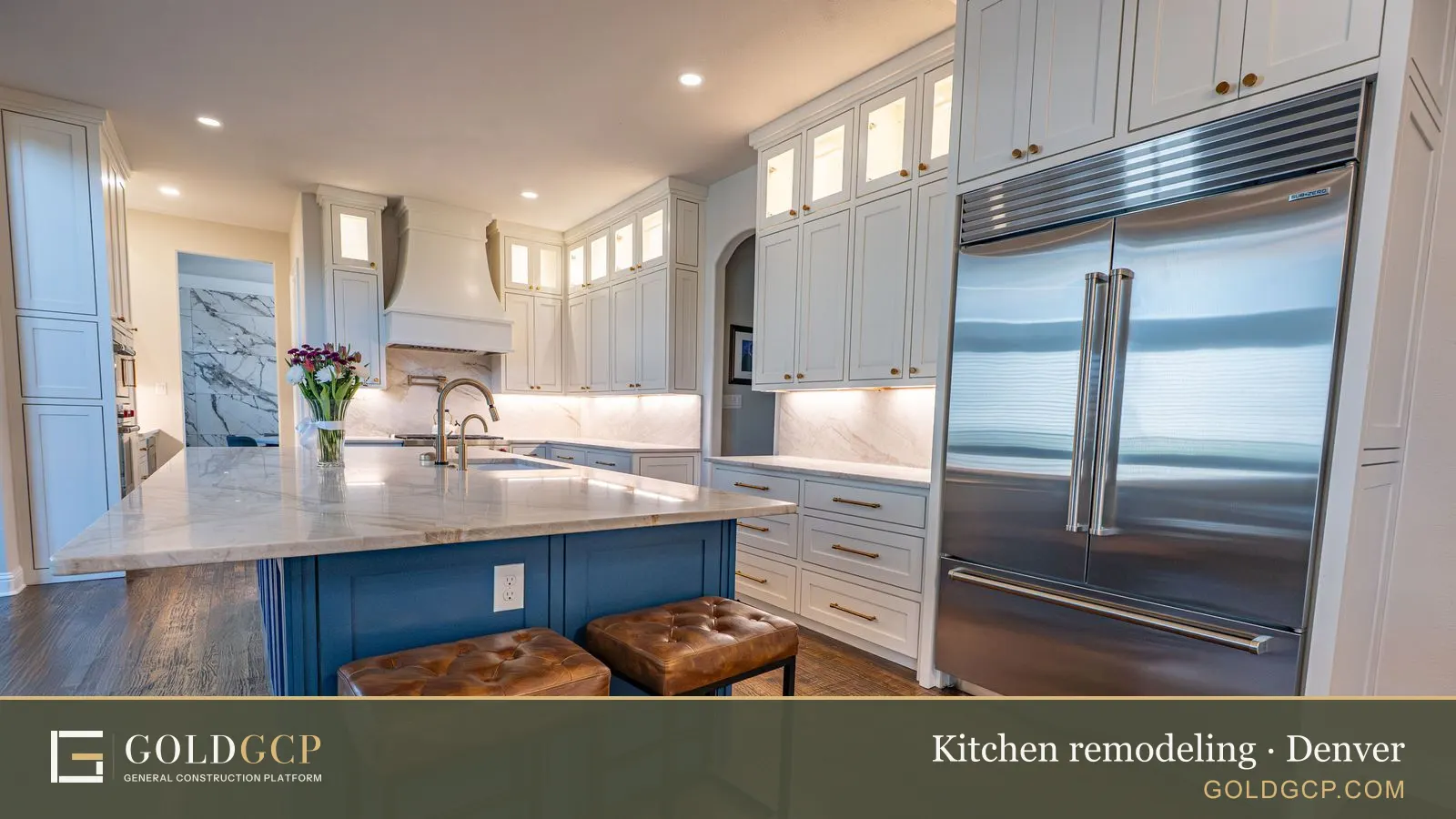
A mid-range remodel of a 150-square-foot kitchen in Denver runs about $23,650 to $39,400 by our cost-adjusted figures. The layout drives the cost and the schedule. If the walls and plumbing stay where they are, most metro building departments issue the permit over the counter. Moving a wall means drawings, plan review and more time.
What a kitchen remodel costs in Denver
The table starts from national remodeling cost data and applies the Denver construction cost factor of 1.05 from the U.S. Army Corps of Engineers. That puts Denver about 5% above the US average for the same work.
| Job | Denver (typical range) | US average |
|---|---|---|
| Cosmetic refresh, 150 sq ft kitchen | $11,800–$23,650 | $11,250–$22,500 |
| Mid-range remodel, 150 sq ft kitchen | $23,650–$39,400 | $22,500–$37,500 |
| High-end remodel, 150 sq ft kitchen | $39,400–$70,900 | $37,500–$67,500 |
| Small kitchen (10×10 ft), mid-range | $15,750–$26,250 | $15,000–$25,000 |
| Large kitchen (15×15 ft), mid-range | $35,450–$59,050 | $33,750–$56,250 |
| Stock cabinets, installed | $105–$420/lin ft | $100–$400/lin ft |
| Semi-custom cabinets, installed | $160–$735/lin ft | $150–$700/lin ft |
| Custom cabinets, installed | $525–$1,250/lin ft | $500–$1,200/lin ft |
| Appliance package | $2,650–$21,000 | $2,500–$20,000 |
| Moving plumbing or walls (add-on) | $5,250–$26,250 | $5,000–$25,000 |
| Permits | $525–$1,600 | $500–$1,500 |
Estimates for 2026, including labor and standard parts. Denver prices use the metro's construction cost factor of 1.05 (US average = 1.00) from the U.S. Army Corps of Engineers Area Cost Factors. Your quote depends on access, materials and the condition of the home.
To price your own kitchen by size, finish and ZIP code, use the cost estimator below. You can also open the full kitchen cost estimator.
The same estimator has its own page, easy to share or bookmark: Kitchen remodel cost estimator.
Where the money goes in a Denver kitchen
Cabinets are the largest single purchase. Installed, stock boxes cost about $105 to $420 per linear foot here. Semi-custom runs $160 to $735, and custom $525 to $1,250. A galley kitchen with 20 feet of cabinets and a U-shaped kitchen with 35 feet cost very different amounts even at the same finish level.
Three other cost lines often surprise Denver homeowners:
| Cost line | Why it shows up here | Typical effect |
|---|---|---|
| Moving plumbing, gas or walls | An open plan usually means taking out a wall | About $5,250 to $26,250 on top of the remodel |
| Code upgrades | A permit can pull in energy testing and water-efficiency rules (see below) | Depends on what the house already has |
| Hidden conditions | Older metro housing and dry air that cracks and shrinks wood | Local remodelers hold a contingency in reserve for surprises behind the walls |
Denver's dry air adds a cost line that coastal cities do not have. Wood cabinets, hardwood floors and trim move as humidity swings between summer and winter. A remodeler who lets cabinet stock and flooring acclimate in the house before installation avoids callbacks for gaps and squeaks. Altitude also matters for gas appliances. A range or cooktop rated for sea level can need a different orifice kit above 5,000 feet, so ask before the appliance package is ordered.
Layout changes and what triggers plan review
Denver-area building departments sort kitchen work into three paths, and the path decides your schedule.
| What you are doing | Typical path | What it means for you |
|---|---|---|
| Paint, backsplash, new counters, cabinets in the same spots, flooring | Often no building permit | Start when materials arrive |
| New circuits, a moved sink or dishwasher, a new gas line, a ducted hood | Trade permits | Electrical, plumbing and mechanical permits, often issued online |
| Removing or opening a wall, adding a beam, enlarging a window | Building permit with plan review | Drawings, then review by the building department |
Jefferson County, which covers Lakewood and much of the west metro, publishes a rule. Jefferson County says all interior renovations that move, modify or remove walls or windows require a building permit, while renovations that only replace cabinets, flooring or counters in the same general locations may not need one. Simple wall moves that do not create a new room likely only need Building Safety review and can skip Planning & Zoning. Creating a new kitchen, bedroom or bathroom can require Planning & Zoning review too.
Boulder draws the line in a similar place. The City of Boulder lists cabinets, countertops, flooring and tiling outside a shower enclosure as finish work that does not need a permit. Any structural modification to a building in Boulder requires plans prepared by a structural engineer licensed in Colorado, so a load-bearing wall removal there needs an engineer.
Lakewood requires a permit for most construction, including structural changes and electrical, plumbing and mechanical work, according to the Lakewood permit guide. A demolition permit is required before any demolition work starts. That matters if you are gutting the kitchen.
If you are thinking about an open plan, get a structural engineer or an architect to look at the wall first. Our page on permit drawings covers what reviewers expect to see.
What a kitchen permit costs in the Denver metro
There is no flat kitchen fee. Lakewood bases building permit fees on the project's valuation, which reflects the estimated cost of labor and materials. It collects plan review fees at application and the permit fee and use tax after plans are approved. Across our price data, Denver kitchen permits come to about $525 to $1,600.
Review time varies by city. Lakewood's intake review takes two to three days when the application is complete. Non-building department reviews take two to 10 days, and building department reviews take 20 to 25 working days. A Lakewood building permit is valid for 180 days from issuance, and each valid inspection extends it another 180 days. The permit must be posted at the job site.
Boulder contractor license applications take 5 to 10 business days to process. Contractors must hold a Boulder license before applying for any permits. Boulder does not accept reciprocal licenses from other jurisdictions. Licensed pros there must carry general liability insurance of at least $1,000,000 per occurrence and $2,000,000 aggregate.
Electrical, gas and ventilation rules in Denver kitchens
Inspectors check kitchens against the codes each city adopts. The electrical permit can come from the city or the state depending on where you live.
Who issues the electrical permit
Colorado splits electrical inspection between the state and local programs. The Colorado Division of Professions and Occupations says the state does not inspect in local jurisdictions that have their own electrical inspection program. The homeowner is responsible for determining the correct authority. Denver County runs its own program, so electrical permits there go through the City and County of Denver. Adams, Arapahoe, Boulder, Douglas and Jefferson counties are among the local jurisdictions with their own electrical inspection programs.
If you hire an electrical contractor, the contractor is responsible for obtaining the permits, and the homeowner should not continue the state application. State law bars anyone other than the homeowner who is not a registered electrical or plumbing contractor from installing an electrical or plumbing project on the property.
Counter circuits and outlets
At final inspection, countertops need small-appliance circuits with GFCI protection and receptacles spaced so no point along the counter is far from an outlet. Many older metro houses fed the whole kitchen from one shared circuit. Bringing that up to code often means new wire runs back to the panel, and sometimes a larger panel. Boulder adopted the 2023 National Electrical Code effective Aug. 1, 2023. All permits applied for on or after Aug. 1, 2026 will be reviewed under the 2026 National Electrical Code.
Gas lines to the range
Extending or adding a gas line to a range or cooktop is plumbing work under the permit. The inspector sees the new piping under an air pressure test before the walls close. Douglas County has adopted the 2024 International Fuel Gas Code, so gas work there follows that edition.
Range hoods and ventilation
Denver's updated energy code requires mechanical ventilation and requires all exhaust fans to be tested, according to a summary of the Denver code updates. All duct systems must have a duct blast test performed to determine air leakage. A ducted hood that runs outside in metal duct is the safe choice for a gas range. Ask your remodeler how the hood will be tested and documented before the final inspection.
Energy code testing
Denver adopted the 2022 Denver Building and Fire Code and the 2022 Denver Green Code, effective May 1, 2023. Under the Denver Energy Code residential requirements, air leakage, duct leakage and mechanical ventilation test results must be provided to the code official before a certificate of occupancy is issued. The tests must be conducted by an approved third-party tester not affiliated with the construction. Using a Certified Rater for energy compliance reduces building permit fees by $150.00.
What else a Denver permit makes you fix
A kitchen permit can bring in work outside the kitchen.
Water-saving fixtures
Denver's green code sets fixture flow limits. Kitchen faucets may not exceed 1.8 gallons per minute, with a temporary override up to 2.2 that must revert automatically, according to the ICC code text. Dishwashers must meet ENERGY STAR requirements and use no more than 3.5 gallons per full cycle. If the permit reaches a bathroom, lavatory faucets are capped at 1.0 gallon per minute and showerheads at 1.5 gallons per minute, both meeting WaterSense criteria.
Denver Water offers up to a $100 rebate on a WaterSense-labeled toilet that uses an average of 0.8 gallons per flush or less, according to Denver Water. If your kitchen remodel touches a bathroom, that rebate can offset the fixture cost.
Radon
Radon is at elevated levels in one out of every two Colorado homes, according to the Colorado Department of Public Health and Environment. A do-it-yourself test kit costs about $10 to $50, and a short-term test needs the house closed for 12 hours with the device in place for 48 hours or more. Mitigation in Colorado usually costs about $1,000 to $2,000. A kitchen remodel is a good time to test, especially if the kitchen sits over a basement or crawl space.
How long a Denver kitchen remodel takes
| Phase | Same layout | Wall removed or layout changed |
|---|---|---|
| Permit | Days to a few weeks, depending on the city | Plan review, which in Lakewood runs 20 to 25 working days for building review |
| Inspections | Rough and final | Framing, rough and final, plus energy testing |
| Total, start to finish | About 2 to 3 months | About 4 to 6 months |
Semi-custom and custom cabinets usually set the pace, so the order goes in as soon as measurements are final. In Boulder, building inspections run between 7 a.m. and 5:30 p.m. Monday through Friday. Required inspection photos must be sent by 2 p.m. on the inspection date, or the inspection fails and must be rescheduled. In Lakewood, the permit must be posted at the job site throughout the work.
Will a kitchen remodel pay off in Denver?
Resale data for the Mountain region is thinner than for the coasts, so treat any payback figure as a guide rather than a promise. Across markets, same-layout updates recover more of their cost than full gut jobs with new layouts. If you plan to sell within a few years, a cosmetic refresh on a simple permit is the safer spend. If you plan to stay, weigh the open plan by how you cook and live. Our remodel return estimator runs the numbers for your own budget.
How to check a kitchen remodeler before you hire
Colorado has no state general contractor license. Licensing happens at the city and county level, and the rules differ from one side of the metro to the other.
- Check the local registration. Lakewood requires contractors applying for building permits to have a current registration with the city. A first-year registration for classes A through D costs $150.00, with a $400 renewal every three years. Arvada requires a license before a contractor can get building permits: a Class A General Contractor License at $150 and a Class B at $200, reviewed within 5 business days. Boulder requires a contractor license before any permit application and does not accept reciprocal licenses from other jurisdictions.
- Check the trade licenses. Electrical and plumbing contractors must hold Colorado state licenses. Douglas County verifies state-issued electrical and plumbing contractor and company master licenses through the Department of Regulatory Agencies before a permit is issued. You can look up a license on the state's DORA lookup.
- Confirm insurance. Douglas County requires proof of workers' compensation insurance if applicable and business liability insurance. Boulder requires $1,000,000 per occurrence and $2,000,000 aggregate.
- Ask who pulls the permit. The answer should be the contractor, with the permit fee as its own line on the bid.
- Read the payment schedule. Colorado's prompt payment law for construction contracts of at least $150,000 requires the owner to pay at least 95% of the value of satisfactorily completed work and to release the withheld amount within 60 days after satisfactory completion, according to HB20-1046. That law does not apply to a single-family dwelling, so for a house the payment schedule in your contract is what protects you. More on safe payments is in our guide to paying a contractor.
- Ask what contingency they recommend for your house's age, and what happens if they find bad wiring or rot behind the walls.
Areas we cover
GOLDGCP kitchen remodelers work across the Denver metro, including:
- Denver
- Aurora
- Lakewood
- Littleton
- Highlands Ranch
- Arvada
- Boulder
Each city runs its own building department with its own fees, forms and contractor registration, but they enforce the same state electrical and plumbing licensing. Littleton, for example, requires new applicants for certain contractor classes to pass an International Code Council exam. Its permit center takes walk-ins on Mondays from 1:00 pm to 4:30 pm and Thursdays from 8:00 am to 11:30 am. To see prices for your exact ZIP code, start with the search below.
How GOLDGCP works
- Tell us about your kitchen through the form, a call or WhatsApp. We need its size, what you want to change and your budget.
- We match you with up to 3 vetted, licensed remodelers who work in your area, and you see ZIP-based prices before anyone visits.
- If you are removing a wall, our in-house architects can prepare the drawings for plan review.
- Your remodeler pulls the permits and books the inspections.
- You pay in milestones, each one after you approve that stage, and track progress in the client portal.
If you are sourcing cabinets or stone from overseas, our GCP Source and Ship service handles sourcing, factory inspection, shipping, customs and delivery to the jobsite.
Frequently asked questions
How much does a kitchen remodel cost in Denver?
By our cost-adjusted figures, a 150-square-foot kitchen costs about $11,800 to $23,650 for a cosmetic refresh, $23,650 to $39,400 for a mid-range remodel and $39,400 to $70,900 for high-end work. A small 10 by 10 kitchen at mid-range runs $15,750 to $26,250. A large 15 by 15 kitchen runs $35,450 to $59,050.
Do I need a permit to remodel a kitchen in Denver?
Not always. Jefferson County says cabinet, flooring or counter replacements in the same general locations may not need a permit, and Boulder lists cabinets and countertops as finish work. You do need one for new circuits, a moved sink, a gas line, a ducted hood or any wall change.
Can I remove a kitchen wall in Denver without plan review?
No. Moving, modifying or removing a wall requires a building permit, and in Boulder any structural modification requires plans prepared by a structural engineer licensed in Colorado. Simple wall moves that do not create a new room likely only need Building Safety review in Jefferson County.
Who issues the electrical permit for a Denver kitchen?
It depends on the county. Denver County runs its own electrical inspection program, so permits go through the City and County of Denver. Adams, Arapahoe, Boulder, Douglas and Jefferson counties also have their own programs. The state does not inspect in those jurisdictions.
Does a Denver kitchen permit require energy testing?
In Denver, yes for projects that reach the energy code. Air leakage, duct leakage and mechanical ventilation test results must go to the code official before a certificate of occupancy, and the tests must be done by an approved third-party tester. Using a Certified Rater reduces the building permit fee by $150.00.
Is a kitchen remodel worth it in Denver?
Same-layout updates generally recover more of their cost at resale than full gut jobs with new layouts. If you plan to sell within a few years, a cosmetic refresh on a simple permit is the safer spend. If you plan to stay, weigh the open plan by how you cook and live.
What license should a kitchen remodeler have in Colorado?
Colorado has no state general contractor license. Check the city or county registration, such as Lakewood's contractor registration or Arvada's Class A or B license, and verify electrical and plumbing contractors through the state DORA lookup. Confirm liability insurance and who pulls the permit.
How we calculate these prices
GOLDGCP starts from national price ranges for each job, taken from published 2026 cost guides and checked against local price guides where they exist. To get a local price, we multiply the national range by the construction cost factor for the metro from the U.S. Army Corps of Engineers Area Cost Factors (US average = 1.00). Where that table has no entry for a metro, we use the nearest listed location or the state value. For ZIP codes outside the 50 largest metros, the cost estimator uses the state's price level from the Bureau of Economic Analysis Regional Price Parities. Ranges include labor and standard materials but not unusual site conditions, so a written quote after an inspection is always the final price.
Sources
- Jefferson County, CO
- City of Boulder
- City of Lakewood
- dpo.colorado.gov
- E3 Power
- City & County of Denver Community Planning & Development
- International Code Council
- Denver Water
- Colorado Department of Public Health and Environment
- apps.colorado.gov
- leg.colorado.gov
- U.S. Army Corps of Engineers
- U.S. Bureau of Economic Analysis

About this guide
Written by the GOLDGCP editorial team. Prices come from national cost guides adjusted with official construction cost factors for Denver; rules and statistics come from the agencies and reports linked in the text. We update this page when prices or codes change.