
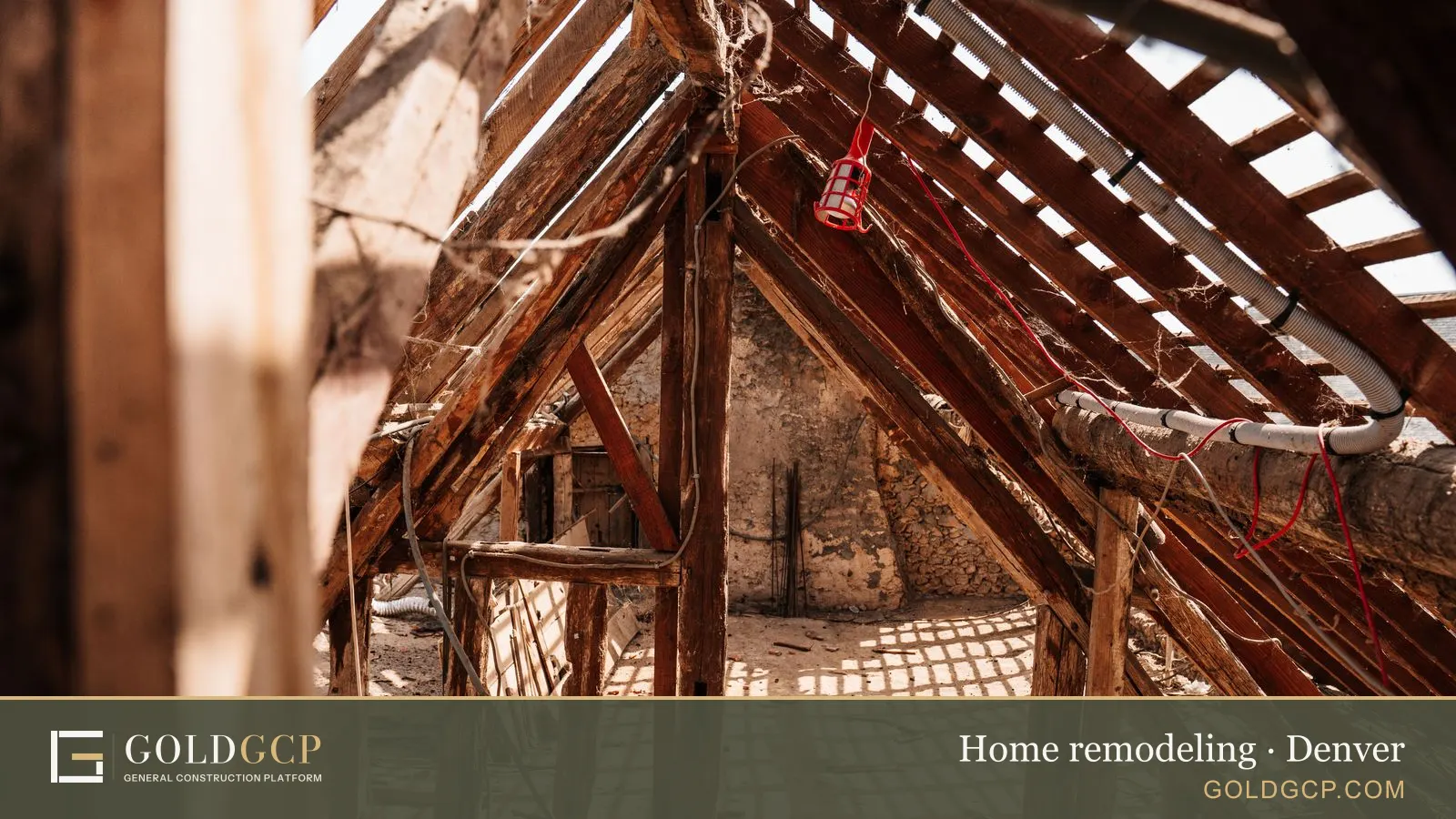
The short answer
A standard renovation of a 1,500-square-foot Denver house runs about $63,000 to $157,500. A gut remodel runs $94,500 to $236,250. Colorado has no statewide general contractor license. Your remodeler's credential is a city or county registration, and each city or county has its own rules.
What a remodel costs in Denver
These ranges start from national remodeling data and apply the Denver Area cost factor of 1.05 from the U.S. Army Corps of Engineers. They cover labor, materials and the general contractor's markup for a typical single-family house.
| Job | Denver (typical range) | US average |
|---|---|---|
| Cosmetic update, 1,500 sq ft home | $23,650–$63,000 | $22,500–$60,000 |
| Standard renovation, 1,500 sq ft home | $63,000–$157,500 | $60,000–$150,000 |
| Gut renovation, 1,500 sq ft home | $94,500–$236,250 | $90,000–$225,000 |
| Kitchen remodel, mid-range, 150 sq ft | $23,650–$39,400 | $22,500–$37,500 |
| Full bathroom remodel, mid-range | $9,450–$29,400 | $9,000–$28,000 |
| Bedroom or living room refresh | $1,600–$10,500 | $1,500–$10,000 |
| Basement or attic finish | $21,000–$78,750 | $20,000–$75,000 |
| Exterior update | $6,300–$21,000 | $6,000–$20,000 |
| Roof replacement, 2,000 sq ft, asphalt | $7,350–$14,700 | $7,000–$14,000 |
Estimates for 2026, including labor and standard parts. Denver prices use the metro's construction cost factor of 1.05 (US average = 1.00) from the U.S. Army Corps of Engineers Area Cost Factors. Your quote depends on access, materials and the condition of the home.
Denver bids often land above these figures. Older housing stock, expansive soils and freeze-thaw conditions push quotes up. A house that needs new wiring, plumbing and insulation once the walls come open will cost more than the same square footage in a newer suburb.
Use the cost estimator to get a figure for your ZIP code and scope. National averages by room are in our home remodeling cost guide.
Price it now
Cost estimators for each room
Price the parts of your project for your ZIP code: kitchen, bathroom, flooring, painting, roofing, windows and doors, or open all cost estimators.
Additions, basements and single rooms
| Project | Denver range |
|---|---|
| Basement or attic finish | $21,000 to $78,750 |
| Kitchen remodel, mid-range, 150 sq ft | $23,650 to $39,400 |
| Full bathroom remodel, mid-range | $9,450 to $29,400 |
| Bedroom or living room refresh | $1,600 to $10,500 |
| Exterior update | $6,300 to $21,000 |
| Roof replacement, 2,000 sq ft, asphalt | $7,350 to $14,700 |
Basement finishes are common in the metro, and the code details matter. Bedrooms need egress windows and a minimum ceiling height, and a bathroom down there needs a working drain, which may mean breaking concrete. Our guide to designing an addition covers the design fees, and structural engineer coordination explains when calculations are needed.
What the general contractor's share pays for
General contractors usually charge 10% to 20% of construction cost on large jobs, according to HomeGuide, or $50 to $150 an hour for small ones. That fee covers scheduling the trades, buying materials, pulling permits, meeting inspectors, carrying insurance and fixing problems between trades. On a large remodel, the GC's share is a fifth or less of the total.
What a general contractor does, and how Colorado licenses the work
A general contractor runs a project with several trades. A typical Denver kitchen and bath remodel might need demolition, framing, plumbing, electrical, drywall, tile, cabinets and paint. The GC hires and sequences those trades, so the electrician does not wait on the framer and the tile setter does not work over an uninspected drain.
Colorado does not issue a statewide general contractor license. The state licenses plumbers and electricians through the Division of Professions and Occupations. It registers businesses through the Secretary of State, which is a filing registry and does not certify that a business is operating legally. For the general contractor, the credential is local.
The city and county registrations that apply
| Where you live | Who registers the contractor |
|---|---|
| Denver | City building department |
| Aurora | City building department |
| Lakewood | City contractor registration, A-3 Residential covers new construction and remodels |
| Littleton | City contractor license, Class C for one- and two-family dwellings |
| Arvada | City contractor license, Class A or Class B general contractor |
| Boulder | City contractor license, Class C for one- and two-family dwellings |
| Unincorporated Douglas County | County contractor registration, fees currently waived |
Lakewood's A-4 Commercial/Residential remodel registration covers remodels and repairs, but the work may not exceed 30 percent of the original structure's area. A bigger job needs the A-3 Residential registration, which decides which contractor can legally take your project.
Littleton accepts reciprocal licenses from Denver, Aurora, Colorado Springs, Thornton, Wheat Ridge, Fort Collins, Longmont and others, or an ICC certificate. Boulder does not accept reciprocal licenses from any other jurisdiction, so a contractor licensed in Denver still needs a Boulder license to work inside city limits.
Arvada licenses run one year and must be re-applied for every year. Boulder applications take 5 to 10 business days to process. If a contractor says the license is "in the mail," the job cannot start yet.
The trade licenses that do exist
Plumbing and electrical contractors hold State of Colorado licenses. Lakewood requires plumbing and electrical contractors to show state contractor's and master's licenses. Douglas County verifies state electrical and plumbing licenses through the Department of Regulatory Agencies before a permit is issued. Arvada requires a plumbing contractor to be or employ full time a master plumber licensed by the state.
You can check any of these at the state's license lookup.
Do you need a permit?
Almost any remodel in the metro needs a permit. Adams County's rule is typical: a permit is required to construct, enlarge, alter, repair, move, demolish or change the occupancy of a building, or to install, enlarge, repair, remove, convert or replace electrical, gas, mechanical or plumbing systems. Moving a wall, adding a window, finishing a basement or building an addition all need a permit.
How plan review works in each city
- Denver and Aurora run their own building departments, each with its own submittal portal and fee schedule.
- Lakewood uses the eTRAKiT system for permits and inspections. Contractors must be registered and have a contractor account. Homeowners need their own eTRAKiT account to apply. Lakewood publishes a building permit fee schedule and a list of permit exemptions.
- Littleton takes contractor license applications through eTRAKiT. Inspections scheduled Monday through Friday before 4:00 pm go on the next available day.
- Arvada adopted the 2024 International Codes with amendments. Permits that do not need plan review are typically issued within three business days. First plan review for major projects can take 4 to 6 weeks. Inspections run Monday through Friday, 8 a.m. to 4 p.m., and someone over 18 must be on site.
- Douglas County issues building permits only for unincorporated areas. It encourages electronic submittals, and each email should carry one application with individual PDFs. Applications after 4 p.m. are post-dated to the next business day.
- Boulder requires a Landmark Alteration Certificate before a permit application for any exterior change to a designated landmark or a property in a historic district.
Permit fees are based on project valuation, which is the total cost of materials and labor. Some projects use a cost-per-square-foot calculation. Arvada also charges a use tax on construction materials at the city sales tax rate.
Inspections and what happens without a permit
Arvada warns that work done without a permit can lead to stop work orders, fines, penalties and mandatory demolition. Douglas County suspends a permit if the contractor changes mid-project until a new registered contractor is selected. Inspectors there also conduct random on-site checks of licenses and installer-to-apprentice ratios.
Keep the approved plans on site and call inspections at the rough stage, before insulation and drywall cover the framing, plumbing and wiring. For help with the drawings, see our guide to permit drawings.
Basements, additions and ADUs
Basement finishes
A finished basement is the cheapest way to add living space in the metro, at $21,000 to $78,750. The code points that matter are egress from any sleeping room, ceiling height and the bathroom drain. On expansive soils, check the foundation and slab before you plan a finished floor over a crack.
Additions and zoning
An addition needs a survey of setbacks and lot coverage before design starts. Arvada's plan review for major projects can take 4 to 6 weeks, and a certificate of occupancy can take up to 5 business days after final inspection.
ADUs
State law and city rules govern accessory dwelling units, and each metro city runs its own review. Ask your designer which path fits your lot before you pay for drawings. Our ADU design guide covers sizes, setbacks and plan costs.
Local risks that affect a Denver remodel
- Expansive soils. The clay soils along the Front Range swell and shrink with moisture, which cracks slabs, foundations and basement floors. You may need a structural engineer before an addition or a basement finish.
- Freeze-thaw. Foundations, exterior stairs, driveways and hose bibs take a beating. Insulate and air-seal before the drywall goes up.
- Hail. The metro sits in hail alley. Roof replacement costs $7,350 to $14,700 for a 2,000-square-foot asphalt roof, and a remodel that includes a new roof should specify impact-resistant shingles.
- Radon. Test before you finish a basement, because mitigation is far cheaper before the drywall.
- Snow load. Additions and covered patios need the roof designed for the local snow load, which is part of the structural drawings.
- Older housing. Older houses often have galvanized plumbing, two-prong outlets and little insulation. Budget for surprises once the walls open.
Contracts and payments under Colorado law
Colorado's payment rules for private construction contracts come from HB20-1046. The law applies to contracts of at least $150,000, and it does not apply to a contract for one single-family dwelling or one multi-family dwelling of no more than 4 units. Most single-house remodels fall outside it, so the contract you sign is your main protection.
For larger projects the law requires:
- Partial payments at the end of each calendar month, or as soon as practicable after.
- At least 95% of the value of satisfactorily completed work paid to the contractor.
- The withheld percentage paid within 60 days after the contract is completed satisfactorily.
- Subcontractors paid within 30 calendar days after the contractor receives payment, with a withheld percentage not to exceed 5%.
- 1.5% interest per month on late payments.
A separate bill, HB24-1008, on wage claims in the construction industry was vetoed by the Governor on May 17, 2024, and did not become law.
Whatever the project size, put these in writing: the scope, the schedule, the payment milestones, who pulls permits, how change orders are priced, and how disputes are handled. Our guide to paying a contractor walks through milestone schedules and lien waivers.
How to check a remodeling contractor before you hire
- Ask which city or county the contractor is registered in, and confirm the registration covers your project type. Lakewood's A-4 registration, for example, caps remodel work at 30 percent of the original structure's area.
- Look up the registration in that city's portal. Lakewood, Littleton and Arvada all run online permit systems, and Boulder has a Customer Self Service portal.
- Check the state license for the plumber and electrician on the job at the DORA license lookup.
- Confirm general liability insurance. Littleton requires $500,000 per occurrence for Class A and B licenses and $300,000 for the rest. Boulder requires $1,000,000 per occurrence and $2,000,000 aggregate.
- Confirm workers' compensation coverage, or a Colorado Rejection of Coverage form if the company has no employees.
- Ask for three local references from similar projects and call them.
Every contractor in the GOLDGCP network passes our six-step vetting: license verification, an insurance check, a business and public-records check, a portfolio review, client reference calls, and onboarding with a quality score.
Areas we cover
GOLDGCP matches homeowners with licensed remodeling contractors across the Denver metro, including:
- Denver
- Aurora
- Lakewood
- Littleton
- Highlands Ranch
- Arvada
- Boulder
Enter your ZIP code to see local prices and contractors who serve your street.
How GOLDGCP works
- Describe your project online, by phone or on WhatsApp. You see prices for your ZIP code before anyone visits.
- We match you with up to 3 vetted, licensed pros. For projects that need drawings, our in-house architects can prepare the plans for your city's building department.
- You compare written bids and choose one.
- You pay in milestones, and you pay each one only after you approve that stage. You can follow the schedule, photos and payments in the client portal.
Frequently asked questions
How much does a general contractor charge in Denver?
Most general contractors charge a markup of 10% to 20% of construction cost on large remodels, or an hourly or daily rate for small jobs. A standard renovation of a 1,500-square-foot Denver house runs about $63,000 to $157,500 in total, including that markup.
Does Colorado license general contractors?
No. Colorado has no statewide general contractor license. Plumbers and electricians are licensed by the state, but the general contractor's credential is a city or county registration. Denver, Aurora, Lakewood, Littleton, Arvada, Boulder and Douglas County each run their own program.
Do I need a permit to finish my basement in Denver?
Yes. Finishing a basement adds habitable space, which means permits for framing, electrical, plumbing and mechanical work. Bedrooms need egress windows and a minimum ceiling height. Arvada and Douglas County both list basements and remodels as permit types.
Can a Denver contractor work in Boulder without a Boulder license?
No. Boulder does not accept reciprocal licenses from other jurisdictions. A contractor licensed in Denver still needs a Boulder contractor license to work inside city limits, and Boulder applications take 5 to 10 business days to process.
How long does plan review take for an addition in Arvada?
Arvada's first plan review for major projects like new single-family homes can take 4 to 6 weeks. Permits that do not need plan review are typically issued within three business days. A certificate of occupancy can take up to 5 business days after final inspection.
What payment rules apply to a Denver remodel contract?
Colorado's HB20-1046 sets monthly partial payments, at least 95% of completed work paid to the contractor, and 1.5% monthly interest on late payments, but it applies only to contracts of at least $150,000 and not to a single-family dwelling. For a house remodel, the written contract is your main protection.
What should I budget for a whole-house remodel in Denver?
A gut renovation of a 1,500-square-foot house runs about $94,500 to $236,250. A standard renovation runs $63,000 to $157,500. Older houses with galvanized plumbing, old wiring and little insulation often land at the top of the range once the walls open.
How we calculate these prices
GOLDGCP starts from national price ranges for each job, taken from published 2026 cost guides and checked against local price guides where they exist. To get a local price, we multiply the national range by the construction cost factor for the metro from the U.S. Army Corps of Engineers Area Cost Factors (US average = 1.00). Where that table has no entry for a metro, we use the nearest listed location or the state value. For ZIP codes outside the 50 largest metros, the cost estimator uses the state's price level from the Bureau of Economic Analysis Regional Price Parities. Ranges include labor and standard materials but not unusual site conditions, so a written quote after an inspection is always the final price.
Sources

About this guide
Written by the GOLDGCP editorial team. Prices come from national cost guides adjusted with official construction cost factors for Denver; rules and statistics come from the agencies and reports linked in the text. We update this page when prices or codes change.