
The short answer
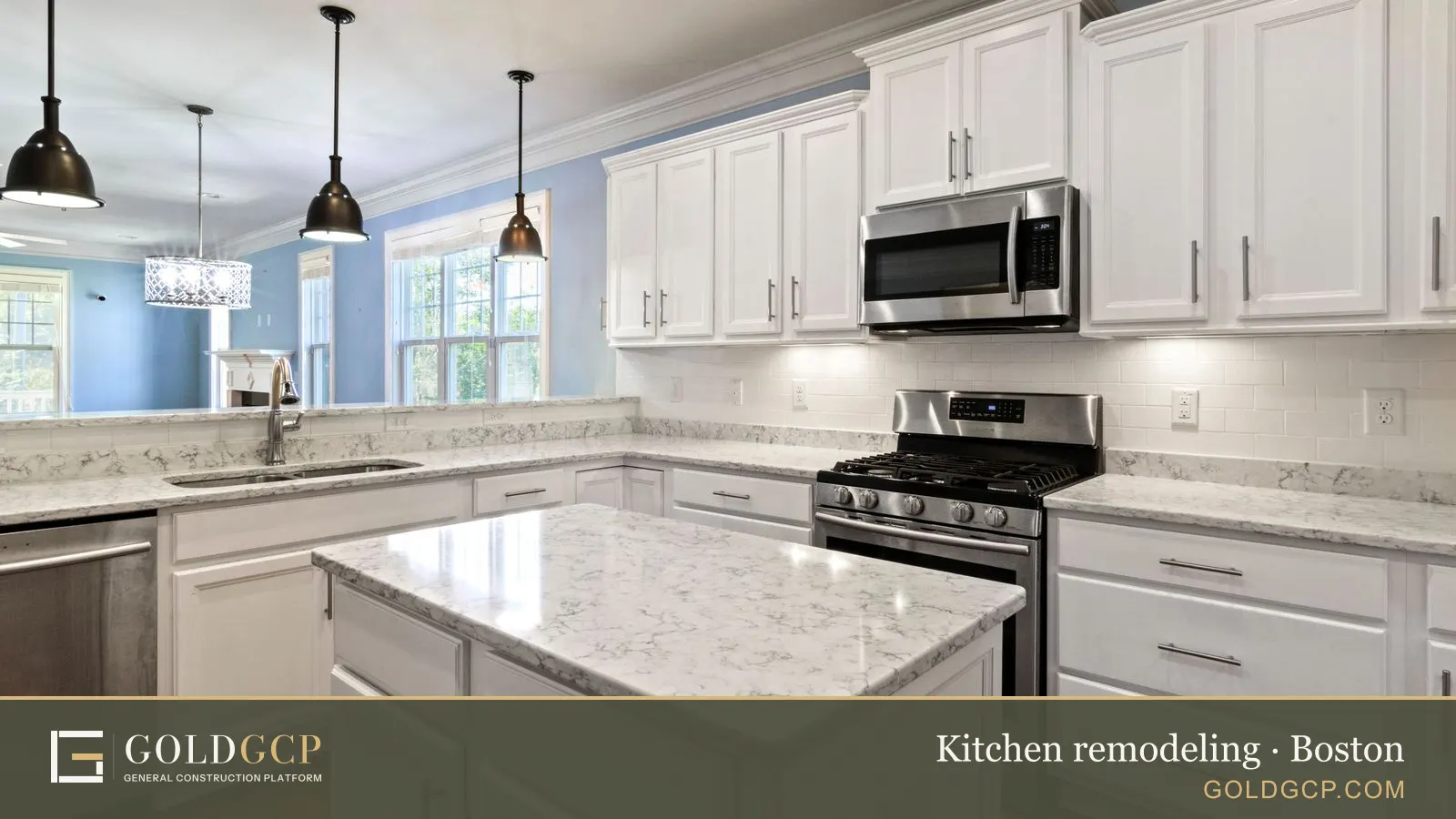
A mid-range remodel of a 150-square-foot kitchen in Boston runs about $27,700 to $46,150 by our cost-adjusted figures. The house itself is the biggest variable. In a 19th-century triple-decker or a prewar Cambridge two-family, opening a wall often turns up knob-and-tube wiring, old plumbing and no insulation, and the permit path depends on which city you live in.
What a kitchen remodel costs in Boston
The table starts from national remodeling cost data and applies the Boston construction cost factor of 1.23 from the U.S. Army Corps of Engineers. That puts Boston about 23% above the US average for the same work.
| Job | Boston (typical range) | US average |
|---|---|---|
| Cosmetic refresh, 150 sq ft kitchen | $13,850–$27,700 | $11,250–$22,500 |
| Mid-range remodel, 150 sq ft kitchen | $27,700–$46,150 | $22,500–$37,500 |
| High-end remodel, 150 sq ft kitchen | $46,150–$83,050 | $37,500–$67,500 |
| Small kitchen (10×10 ft), mid-range | $18,450–$30,750 | $15,000–$25,000 |
| Large kitchen (15×15 ft), mid-range | $41,500–$69,200 | $33,750–$56,250 |
| Stock cabinets, installed | $125–$490/lin ft | $100–$400/lin ft |
| Semi-custom cabinets, installed | $185–$860/lin ft | $150–$700/lin ft |
| Custom cabinets, installed | $615–$1,500/lin ft | $500–$1,200/lin ft |
| Appliance package | $3,100–$24,600 | $2,500–$20,000 |
| Moving plumbing or walls (add-on) | $6,150–$30,750 | $5,000–$25,000 |
| Permits | $615–$1,850 | $500–$1,500 |
Estimates for 2026, including labor and standard parts. Boston prices use the metro's construction cost factor of 1.23 (US average = 1.00) from the U.S. Army Corps of Engineers Area Cost Factors. Your quote depends on access, materials and the condition of the home.
To price your own kitchen by size, finish level and ZIP code, use the cost estimator. You can also open the full kitchen cost estimator.
Where the money goes in a Boston kitchen
Cabinets are the largest single purchase. Installed, stock boxes cost about $125 to $490 per linear foot here, semi-custom $185 to $860, and custom $615 to $1,500. A narrow galley in a Somerville two-family and a wide Newton kitchen are very different budgets at the same finish level, because the linear footage of cabinet run drives the cabinet line.
Three other cost lines often surprise Boston homeowners:
| Cost line | Why it shows up here | Typical effect |
|---|---|---|
| Moving plumbing, gas or walls | An open plan usually means taking out a bearing wall | About $6,150 to $30,750 on top of the remodel |
| Code upgrades | A kitchen permit pulls in electrical, gas and energy work elsewhere in the house | Depends on what the house already has |
| Hidden conditions | Much of the housing stock is old | Local remodelers hold a contingency in reserve on older houses |
Opening a kitchen wall in a century-old house can reveal knob-and-tube wiring, undersized drain lines, balloon framing or old water damage that no one could price beforehand. Ask your remodeler what contingency they recommend for your building's age, and get it written into the contract.
Under the EPA's Renovation, Repair and Painting program, a contractor who disturbs painted surfaces in an older home must be a certified firm and follow lead-safe work practices. Demolishing old cabinets, plaster and trim in a Boston triple-decker qualifies.
Layout changes and what triggers a permit
Boston and Cambridge handle kitchen permits differently, and the permit path decides your schedule.
In Boston, the Inspectional Services Department requires a building permit before beginning most construction, modification and repair work. A short form building permit covers a minor alteration. A long form permit covers a major alteration to a 1-3 family home. Paint, a backsplash, new counters and cabinets set in the same spots generally need no building permit, but new circuits, a moved sink, a gas line or a ducted hood do, through the electrical, plumbing, gas and sheet metal permits.
In Cambridge, the Inspectional Services Department enforces the Massachusetts State Building Code and requires a building permit before constructing or altering a structure. The permit must be posted at the job site. Cambridge also administers the state plumbing, gas, electrical and mechanical codes.
| What you are doing | Boston | Cambridge |
|---|---|---|
| Paint, counters, cabinets in the same spots | No building permit | No building permit |
| New circuits, moved sink, gas line, ducted hood | Trade permits through ISD | Trade permits through ISD |
| Removing or opening a wall, adding a beam | Long form building permit, plans required | Building permit, plans required |
Removing a wall or enlarging an opening means drawings and plan review in both cities. If you are thinking about an open plan, have a structural engineer or an architect look at the wall first. Our page on permit drawings covers what a building department expects to see, and structural coordination explains how the engineer and the architect work together.
What a kitchen permit costs
Boston's building permit fee is a $20 primary fee plus $10 per $1,000 of estimated cost of work for a short form, or a $50 primary fee plus $10 per $1,000 for a long form on a 1-3 family major alteration. Trade permits are added per item: plumbing is $20 plus $5 per fixture, gas is $20 plus $5 per appliance, electrical is a $20 application fee plus $1 per fixture, plug or outlet, and sheet metal is $20 plus $25 for the first 200 square feet and $25 for each additional 200. If work starts without a required permit, Boston charges a double fee.
Cambridge charges $20 per $1,000 of construction cost for building permits, with a $50 minimum, and a plan review fee of $100 included in the building permit fee. Plumbing is $50 for 5 fixtures and $5 for each additional fixture, and sheet metal is $50 plus $25 per 100 linear feet. Cambridge triples the fee if work starts before the permit is issued, and charges $50 for a re-inspection or for failing to call for a final inspection within 5 days of completion.
Across our price data, Boston kitchen permits come to roughly $615 to $1,850. You can check a Boston permit's status with the Permit Finder, or call the Inspectional Services Department at (617) 635-5300.
Electrical, gas and ventilation rules in Boston kitchens
Inspectors check kitchens against the Massachusetts codes the city adopts. The items below most often change a design.
Counter circuits and outlets
Massachusetts follows the 2026 edition of the National Electrical Code, effective April 24, 2026, with state amendments. At final inspection, countertops need the small-appliance circuits and GFCI protection the code requires. Many older Boston houses fed the whole kitchen from one shared circuit. Bringing that up to code often means new wire runs back to the panel, and sometimes a larger panel. Only a master or journeyman electrician licensed by the Board of State Examiners of Electricians can do the work.
Gas lines to the range
Extending or adding a gas line to a range or cooktop is gas fitting work under the permit. The Board of State Examiners of Plumbers and Gas Fitters regulates gas fitting in Massachusetts, and only a licensed master or journeyman gas fitter with a local permit can do the work. The inspector sees the new piping under an air pressure test before the walls close.
Range hoods and ductwork
A ducted range hood needs a sheet metal permit in Boston, and sheet metal work in Massachusetts is licensed through the Board of Examiners of Sheet Metal Workers. A restricted J-2 or M-2 license is limited to residential dwellings of 3 stories or less, which covers most Boston kitchens. Ask your remodeler who holds the sheet metal license and who pulls that permit.
Energy rules that a kitchen permit can trigger
Massachusetts is in climate zone 5A. The current building code is the 10th edition of the Massachusetts State Building Code, based on the 2021 International Codes. For energy, the 10th edition is a base energy code, and the Department of Energy Resources publishes which municipalities have adopted the Stretch Code or the Specialized Code.
Boston, Cambridge, Somerville, Newton, Brookline and Quincy have all adopted the Stretch Code. Brookline, Cambridge and Somerville adopted the Specialized Code effective July 1, 2023, and Boston and Newton adopted it effective January 1, 2024. The Specialized Code applies to new construction, so a kitchen remodel in an existing house is governed by the Stretch Code overlay. Under the Stretch Code, residential additions or alterations exceeding 1,000 square feet or 100% of the existing conditioned floor area must meet the applicable HERS score. A kitchen that stays under that threshold usually does not trigger a whole-house energy upgrade, but a kitchen plus a rear addition can.
Historic buildings may be exempt from Stretch Code compliance if compliance would compromise the building's historic nature or function, and that has to be demonstrated to the code official or the historic preservation authority. If your kitchen is in a historic district, ask before you design.
How long a Boston kitchen remodel takes
| Phase | Same layout | Wall removed or layout changed |
|---|---|---|
| Permit | Trade permits, usually days | Building permit with plans, longer |
| Inspections | Rough and final | Framing, rough and final |
| Total, start to finish | About 2 to 3 months | About 4 to 6 months |
Semi-custom and custom cabinets usually set the pace, so the order goes in as soon as measurements are final. In an old house, add time for surprises behind the walls. A kitchen in a triple-decker may need the gas line rerouted, the panel upgraded or the floor leveled before cabinets go in.
Will a kitchen remodel pay off in Boston?
Small kitchen jobs usually pay back better than full guts. A same-layout refresh that replaces cabinet fronts, counters, the sink, the faucet, appliances and flooring keeps the permit path short and the budget contained. A full gut with a new layout costs more and recovers a smaller share at resale. If you plan to sell within a few years, the same-layout refresh is the safer spend. If you plan to stay, weigh the open plan by how you cook and live. Our remodel return estimator runs the numbers for your own budget.
How to check a kitchen remodeler before you hire
A kitchen remodel touches several trades, so in Massachusetts you check the contractor's Home Improvement Contractor registration and the licenses of the trades.
- Look up the HIC registration. Contractors doing work on an existing, owner-occupied home of one to four units must be registered with the Home Improvement Contractor program. The registration number must appear on the first page of the contract.
- Check the trades. Electricians are licensed by the Board of State Examiners of Electricians, plumbers and gas fitters by the Board of State Examiners of Plumbers and Gas Fitters, and sheet metal workers by the Board of Examiners of Sheet Metal Workers. You can look up any of them on the state's eLIPSE platform.
- Read the contract. Under the Home Improvement Contractor law, all contracts over $1,000 must be in writing. Any deposit before work starts cannot exceed one-third of the total contract price, or the actual cost of special-order or custom materials that must be ordered in advance. Final payment cannot be demanded until the contract is completed to the satisfaction of all parties.
- Check the cancellation right. You have a 3-day right to cancel a contract signed at home or somewhere other than the contractor's office or business.
- Ask who pulls the permits. The contract must include a clause informing you of necessary permits and stating that the contractor must obtain them. Homeowners who secure their own building permits are excluded from the Guaranty Fund, which compensates eligible homeowners up to $25,000 for unpaid judgments against contractors.
An unregistered contractor is a bad sign, and it also costs you Guaranty Fund protection. More on safe payments is in our guide to paying a contractor.
Areas we cover
GOLDGCP kitchen remodelers work across Greater Boston, including:
- Boston, from the North End and the South End to Dorchester, Jamaica Plain and West Roxbury
- Cambridge and Somerville
- Newton, Brookline and Quincy
- The North Shore
- The South Shore
Cambridge, Somerville, Newton, Brookline and Quincy run their own building departments with their own fees and forms, but they enforce the same state electrical, plumbing and energy codes. To see prices for your exact ZIP code, use the search below.
How GOLDGCP works
- Tell us about your kitchen through the form, a call or WhatsApp: its size, what you want to change and your budget.
- We match you with up to 3 vetted, licensed remodelers who work in your area, and you see ZIP-based prices before anyone visits.
- If you are removing a wall, our in-house architects can prepare the drawings for plan review.
- Your remodeler pulls the permits and books the inspections.
- You pay in milestones, each one after you approve that stage, and track progress in the client portal.
If you are sourcing cabinets or stone from overseas, our GCP Source and Ship service handles sourcing, factory inspection, shipping, customs and delivery to the jobsite.
Frequently asked questions
How much does a kitchen remodel cost in Boston?
By our cost-adjusted figures, a 150-square-foot kitchen costs about $13,850 to $27,700 for a cosmetic refresh, $27,700 to $46,150 for a mid-range remodel and $46,150 to $83,050 for high-end work. A small 10 by 10 kitchen at mid-range runs $18,450 to $30,750, and a large 15 by 15 kitchen $41,500 to $69,200.
Do I need a permit to remodel a kitchen in Boston?
No permit is needed for paint, counters, flooring or cabinets set in the same spots. You do need one for new circuits, a moved sink, a gas line or a ducted hood, and Boston issues those as trade permits through the Inspectional Services Department. Removing a wall or enlarging an opening requires a building permit with plans.
Can I remove a kitchen wall in Boston without plans?
No. Any change to walls or openings needs a building permit and drawings. In Boston that means a long form permit for a major alteration to a 1-3 family home, and in Cambridge a building permit with plans. For a load-bearing wall you also need an engineered beam, so have a structural engineer look at it first.
What does a kitchen permit cost in Boston?
Boston charges a $20 primary fee plus $10 per $1,000 of estimated cost for a short form permit, and a $50 primary fee plus $10 per $1,000 for a long form on a 1-3 family major alteration. Trade permits are added per fixture, appliance or outlet. Across our price data, Boston kitchen permits come to roughly $615 to $1,850.
Does a range hood have to vent outside in Boston?
A ducted hood needs a sheet metal permit, and sheet metal work in Massachusetts is licensed through the Board of Examiners of Sheet Metal Workers. Ask your remodeler who holds the sheet metal license and who pulls that permit. A recirculating hood avoids the ductwork but does not vent moisture and cooking grease outside.
What energy code applies to a kitchen remodel in Boston?
Boston, Cambridge, Somerville, Newton, Brookline and Quincy have all adopted the Stretch Code. Under it, residential additions or alterations exceeding 1,000 square feet or 100% of the existing conditioned floor area must meet the applicable HERS score. A kitchen that stays under that threshold usually does not trigger a whole-house energy upgrade.
What license should a kitchen remodeler have in Massachusetts?
A Home Improvement Contractor registration from the state, and the trades hold their own licenses: electricians from the Board of State Examiners of Electricians, plumbers and gas fitters from the Board of State Examiners of Plumbers and Gas Fitters, and sheet metal workers from the Board of Examiners of Sheet Metal Workers. Check all of them on the eLIPSE platform.
How we calculate these prices
GOLDGCP starts from national price ranges for each job, taken from published 2026 cost guides and checked against local price guides where they exist. To get a local price, we multiply the national range by the construction cost factor for the metro from the U.S. Army Corps of Engineers Area Cost Factors (US average = 1.00). Where that table has no entry for a metro, we use the nearest listed location or the state value. For ZIP codes outside the 50 largest metros, the cost estimator uses the state's price level from the Bureau of Economic Analysis Regional Price Parities. Ranges include labor and standard materials but not unusual site conditions, so a written quote after an inspection is always the final price.
Sources
- U.S. EPA
- City of Boston Inspectional Services Department, Building Division
- permitfinder.boston.gov
- Office of Consumer Affairs and Business Regulation, Mass.gov · Office of Consumer Affairs and Business…
- Office of Consumer Affairs and Business Regulation, Mass.gov · Office of Consumer Affairs and Business…
- Office of Consumer Affairs and Business Regulation, Mass.gov · Office of Consumer Affairs and Business…
- Office of Consumer Affairs and Business Regulation, Mass.gov · Office of Consumer Affairs and Business…
- Massachusetts Department of Energy Resources
- Office of Consumer Affairs and Business Regulation, Mass.gov · Office of Consumer Affairs and Business…
- occupationallicensingandpermitting.mass.gov
- Office of Consumer Affairs and Business Regulation, Mass.gov · Home Improvement Contract Sample Language
- U.S. Army Corps of Engineers
- U.S. Bureau of Economic Analysis

About this guide
Written by the GOLDGCP editorial team. Prices come from national cost guides adjusted with official construction cost factors for Boston; rules and statistics come from the agencies and reports linked in the text. We update this page when prices or codes change.