How does customs clearance work for imported building materials?
Quick answer
Customs clearance is the legal release of your goods by US Customs and Border Protection (CBP). For a container of tile, quartz or cabinets, a licensed customs broker files the Importer Security Filing before loading, posts a bond, files the entry within 15 days of arrival, and pays duties and fees within 10 working days.
| Job | US average (typical range) | Typical |
|---|---|---|
| 20 ft container freight (estimate) | $3,000–$5,500 | $4,200 |
| 40 ft container freight (estimate) | $4,000–$7,500 | $5,500 |
| Shared container (LCL) freight | $900–$2,000 | $1,400 |
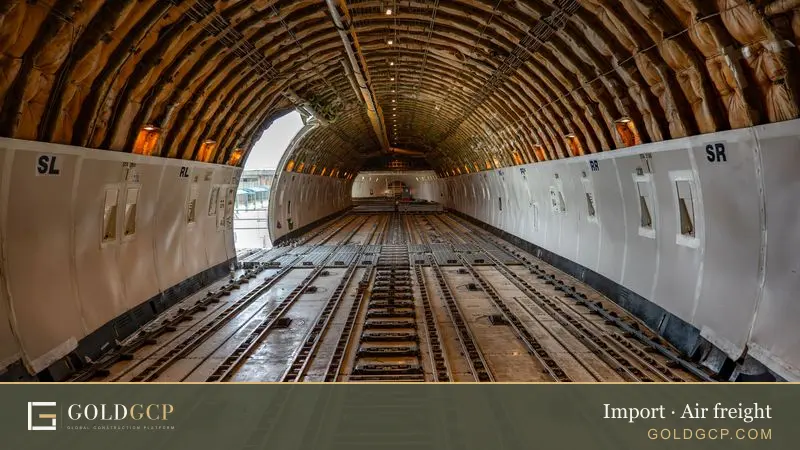
| Air freight | $3,000–$9,000 | $6,000 |
| Inland delivery to the jobsite | $350–$1,500 | $750 |
US national averages for 2026, labor and standard materials included, from published cost guides (sources at the end of this page). Local prices differ: see the city table below, or enter your ZIP code in the calculator.
The table above shows working estimates for freight, clearance and delivery. Duties are separate because they depend on what the product is and where it was made, which this page explains below.
The clearance timeline, step by step
Clearance starts long before the ship reaches a US port. Here is the order of events for a typical ocean shipment of building materials.
- Classify the goods. Before you place the order, each product gets a 10-digit number from the Harmonized Tariff Schedule of the United States (HTSUS). That number sets the duty rate and tells you whether any extra tariffs or trade cases apply.
- Sign a power of attorney. Since CBP's broker modernization rule, a broker must hold a power of attorney signed directly with the importer. One issued through a freight forwarder or another third party no longer counts.
- Arrange the bond. Goods cannot be released without a customs bond on file, either for one shipment or for a full year.
- File the ISF. At least 24 hours before the container is loaded on the vessel overseas, the Importer Security Filing goes to CBP.
- File the entry. Within 15 calendar days after the cargo lands, the broker files CBP Form 3461 with the commercial invoice and packing list so CBP can decide whether to release or examine the goods.
- File the entry summary and pay. Within 10 working days after the time of entry, the broker files CBP Form 7501 and deposits the estimated duties, the Merchandise Processing Fee and the Harbor Maintenance Fee.
- Release and pickup. Once CBP releases the cargo and the terminal and carrier charges are settled, a trucker can take the container out of the port.
- Liquidation. CBP later finalizes the duty owed. If the classification or value changes, you may get a bill or a refund.
What happens if a deadline is missed
If no entry is filed within 15 calendar days after landing, CBP can send the goods to "general order." That means they move to a bonded warehouse approved for unclaimed cargo, where storage charges build up. Goods left in general order for six months can be sold at public auction. A late entry summary brings a demand for liquidated damages against the importer's bond.
The Importer Security Filing (ISF 10+2)
The ISF applies to cargo arriving by vessel. It has been required since January 26, 2009. The "10" is the set of data elements the importer provides. The "2" refers to data the ocean carrier sends.
The ten importer elements, as listed in 19 CFR 149.3, are:
| Element | What it identifies |
|---|---|
| Seller | Last known party selling the goods |
| Buyer | Last known party buying the goods |
| Importer of record number | The party liable for duties |
| Consignee number | The party in the US the goods are shipped for |
| Manufacturer or supplier | The factory that made or assembled the goods |
| Ship-to party | The first place the goods go after release |
| Country of origin | Where the goods were made |
| HTSUS number | At least the first 6 digits of the tariff number |
| Container stuffing location | Where the container was loaded |
| Consolidator (stuffer) | Who loaded or arranged loading of the container |
The deadline is 24 hours before loading at the foreign port. The stuffing location and consolidator can be sent later, but no later than 24 hours before the vessel arrives in the US. CBP can assess liquidated damages of $5,000 per violation for a late, inaccurate or incomplete filing.
For a construction importer, the hard parts are usually the manufacturer and the stuffing location. If your quartz slabs come from one factory and your sinks from another, and both are loaded at a third warehouse, each detail has to match what actually happened at origin. That is one reason to settle the supplier list and loading plan early.
Customs bonds
A customs bond is a contract with a surety company that guarantees CBP gets paid if the importer fails to pay duties, fees or penalties. CBP will not release goods without one.
- A single-entry bond covers one shipment. It suits a one-time project order.
- A continuous bond covers all entries over one year. It suits contractors or developers who import several times a year.
For importers, CBP sets the minimum continuous bond at $50,000 or 10% of the duties, taxes and fees paid in the previous 12 months, whichever is greater. Bonds go up in $10,000 steps to $100,000 and then in $100,000 steps. If your project pulls in materials with antidumping or countervailing duties, the bond may need to be larger, because those duties raise the total CBP has to secure.
HTS classification: where the duty rate comes from
The Harmonized Tariff Schedule is maintained by the US International Trade Commission. Under General Rule of Interpretation 1, classification is decided by the wording of the headings and the section and chapter notes, not by what the product is called in a catalog. A quartz countertop, a porcelain tile and a vinyl plank floor each fall in different chapters, with different rates.
Some practical points:
- Material and construction matter. A wooden vanity, a metal vanity and a vanity sold with a stone top can each land in a different line.
- Sets and kits can be tricky. A door shipped with its frame and hardware may be classified as one item or several, depending on how it is packed and invoiced.
- The ISF can use 6 digits, but the entry needs the full 10-digit number.
If a classification is uncertain and the order is large, the importer can ask CBP for a binding ruling under 19 CFR Part 177. Past rulings are public in CBP's CROSS database, and brokers search them to see how CBP has treated similar products.
The importer of record is legally responsible for using "reasonable care" to classify and value goods correctly, even when a broker does the filing. A broker's advice helps show reasonable care, but the duty bill goes to the importer.
Customs fees in 2026
On top of duties, almost every formal entry pays two fees.
| Fee | Rate | Limits |
|---|---|---|
| Merchandise Processing Fee (MPF), Oct 1, 2025 to Sep 30, 2026 | 0.3464% of value | Minimum $33.58, maximum $651.50 |
| Merchandise Processing Fee (MPF), from Oct 1, 2026 (fiscal year 2027) | 0.3464% of value | Minimum $34.58, maximum $670.86 |
| Harbor Maintenance Fee (HMF), ocean cargo | 0.125% of value | No cap |
CBP adjusts the MPF minimum and maximum for inflation each fiscal year. The percentage rate stays at 0.3464%. Informal entries, which generally cover goods valued at $2,500 or less, pay a small flat MPF instead: $2.77 for an automated informal entry from October 1, 2026.
Here is how the math works on a container of tile with a customs value of $60,000. The MPF at 0.3464% is $207.84, which falls between the minimum and maximum. The HMF at 0.125% is $75. Neither fee is large next to the duty, but both must be paid with the entry summary.
Small shipments of samples no longer slip through duty free. Since August 29, 2025, CBP has suspended duty-free de minimis treatment for goods valued at $800 or less from all countries, so even a box of tile samples goes through formal or informal entry.
Calculate duties and fees on your order
Enter your product value, duty rate, origin and shipping method to see the fees and duties added to a full landed cost.
Extra duties that hit building materials
The base HTS rate is often low for finished building products. The bigger costs usually come from extra duty layers stacked on top.
Section 301 tariffs on goods from China
Since 2018, USTR has applied additional Section 301 duties on many products of China. List 3, the largest group, started at 10% in September 2018 and rose to 25% in May 2019. These duties are added to the normal HTS rate. Many building products, including some stone, tile, wood and metal items, fall on the lists, so check each HTS number before ordering from China.
Section 232 duties on lumber and cabinets
From October 14, 2025, a Section 232 proclamation added a 10% duty on softwood timber and lumber and a 25% duty on kitchen cabinets, vanities and their parts, with different treatment for some trade partners such as the UK, the EU and Japan. A scheduled increase for cabinets and vanities to 50% on January 1, 2026 was pushed back to January 1, 2027.
Antidumping and countervailing duties
Antidumping (AD) duties offset prices below fair value. Countervailing (CVD) duties offset foreign subsidies. The Department of Commerce sets the rates and the ITC decides whether US producers were injured. Rates are specific to each exporter and can change with annual reviews, sometimes after you have already imported. Orders that matter for construction include:
| Product | Countries | Status |
|---|---|---|
| Quartz surface products | China | AD and CVD orders since July 2019, continued after a 2025 sunset review |
| Wooden cabinets and vanities and components | China | AD and CVD orders since 2020, continued after sunset review |
| Hardwood and decorative plywood | China, Indonesia, Vietnam | Commerce final margins July 2026 (combined 275% for China, 28% to 213% for Indonesia, 138% to 255% for Vietnam); ITC affirmative vote August 2026 |
AD and CVD cash deposits are paid at entry, along with regular duties. CBP also pursues evasion. In 2023 it opened an investigation into quartz from China that was allegedly shipped through Vietnam to avoid the orders. Buying from a third country only helps if the product is truly made there.
Tariffs that changed in 2026
On February 20, 2026, the Supreme Court held in Learning Resources, Inc. v. Trump that the International Emergency Economic Powers Act does not authorize tariffs. That ended the 2025 IEEPA tariffs and started a refund process through CBP and the Court of International Trade. Other tariff measures followed and were challenged in court. Because these layers have moved so often, ask your broker for the full stack of duties on each HTS number in the month you plan to ship.
Who does the filing
Most importers of building materials use a licensed customs broker. Brokers are licensed by CBP to transact customs business on behalf of importers. The broker classifies the goods, files the ISF, entry and entry summary, calculates and pays duties and fees, and answers CBP questions.
The importer still holds the legal duty of reasonable care. Give your broker clear invoices that list each product's material, size, unit count and value, plus the name and address of the actual factory. Vague invoices are a common cause of exams and delays.
How GOLDGCP handles clearance
Clearance is one part of the GCP Source & Ship import service, which also covers sourcing, factory inspection, shipping and delivery to the jobsite. GOLDGCP is not a customs broker. Entries, ISF filings, bonds and duty payments are handled through licensed customs brokers.
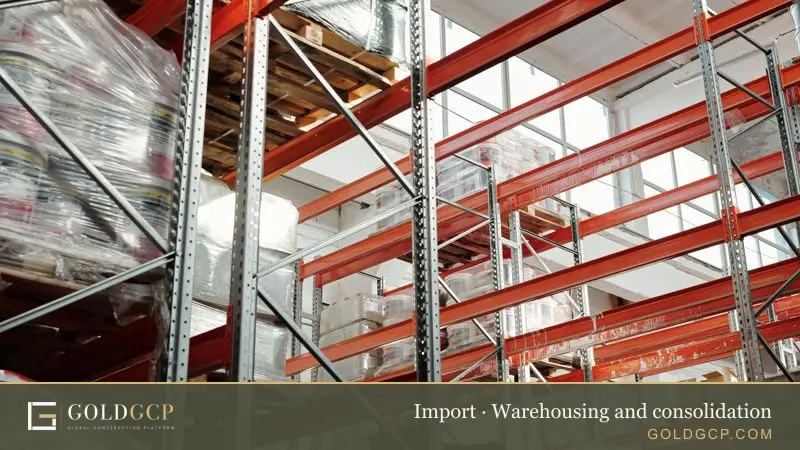
Each stage feeds the next. Product specs from overseas sourcing feed the classification. Data from the factory inspection confirms what was loaded and where. Booking details from ocean freight set the ISF timing, while air freight shipments do not need an ISF. After release, goods can go to warehousing and consolidation or straight to jobsite delivery. The import hub covers the full landed cost, and the landed cost calculator runs the numbers. Payment for the service is in milestones, each one after you approve that stage.
Frequently asked questions
How long does customs clearance take?
When the ISF, bond and entry are filed on time and CBP does not order an exam, clearance usually adds little to the schedule. An exam, a missing document or a classification question can add days or weeks. The legal deadline to file the entry is 15 calendar days after the cargo lands.
Do I need a customs broker to import building materials?
Not by law, since an importer can file its own entries. In practice, most construction importers use a licensed customs broker because the filings, bonds, classifications and duty layers are detailed and mistakes carry penalties. The broker must hold a power of attorney signed directly with you.
What is the MPF on imports in 2026?
The Merchandise Processing Fee is 0.3464% of the entered value. For fiscal year 2026 the minimum was $33.58 and the maximum $651.50. From October 1, 2026, the minimum is $34.58 and the maximum is $670.86. Ocean cargo also pays the 0.125% Harbor Maintenance Fee.
What is the penalty for a late ISF?
CBP can assess liquidated damages of $5,000 per violation for an ISF that is late, inaccurate or incomplete. The filing is due at least 24 hours before the cargo is loaded at the foreign port, so the clock starts before the ship leaves.
Are there antidumping duties on quartz countertops and cabinets?
Yes, for products from China. Quartz surface products have had antidumping and countervailing duty orders since 2019, and wooden cabinets and vanities since 2020. Rates depend on the exporter, so ask your broker for the current deposit rate before you order.
What size customs bond do I need?
For one shipment, a single-entry bond. For regular imports, a continuous bond, which CBP sets at the greater of $50,000 or 10% of the duties, taxes and fees you paid over the past 12 months, in fixed steps.
Can I get a binding answer on my product's classification?
Yes. You can request a binding ruling from CBP under 19 CFR Part 177 before you import. Rulings are published in CBP's CROSS database, which brokers also use to check how similar products were classified.
How we calculate these prices
GOLDGCP starts from national price ranges for each job, taken from published 2026 cost guides and checked against local price guides where they exist. To get a local price, we multiply the national range by the construction cost factor for the metro from the U.S. Army Corps of Engineers Area Cost Factors (US average = 1.00). For ZIP codes outside the 50 largest metros, the calculator uses the state's price level from the Bureau of Economic Analysis Regional Price Parities. Ranges include labor and standard materials but not unusual site conditions, so a written quote after an inspection is always the final price.
Sources
- What Every Member of the Trade Community Should Know About: Entry · U.S. Customs and Border Protection
- Customs User Fees To Be Adjusted for Inflation in Fiscal Year 2027 · Federal Register (CBP)
- User Fee Table · U.S. Customs and Border Protection
- 19 CFR 149.3, Importer Security Filing data elements · eCFR
- Bonds · U.S. Customs and Border Protection
- $200 Billion Trade Action (List 3) · Office of the U.S. Trade Representative
- Hardwood and Decorative Plywood From China, Indonesia, and Vietnam; Determinations · U.S. International Trade Commission
- Certain Quartz Surface Products From China: Continuation of AD and CVD Orders · Federal Register (Commerce)

About this guide
Written by the GOLDGCP editorial team. Prices come from national cost guides; rules and statistics come from the agencies and reports linked in the text. We update this page when prices or codes change.