How does ocean freight work for building materials?
Quick answer
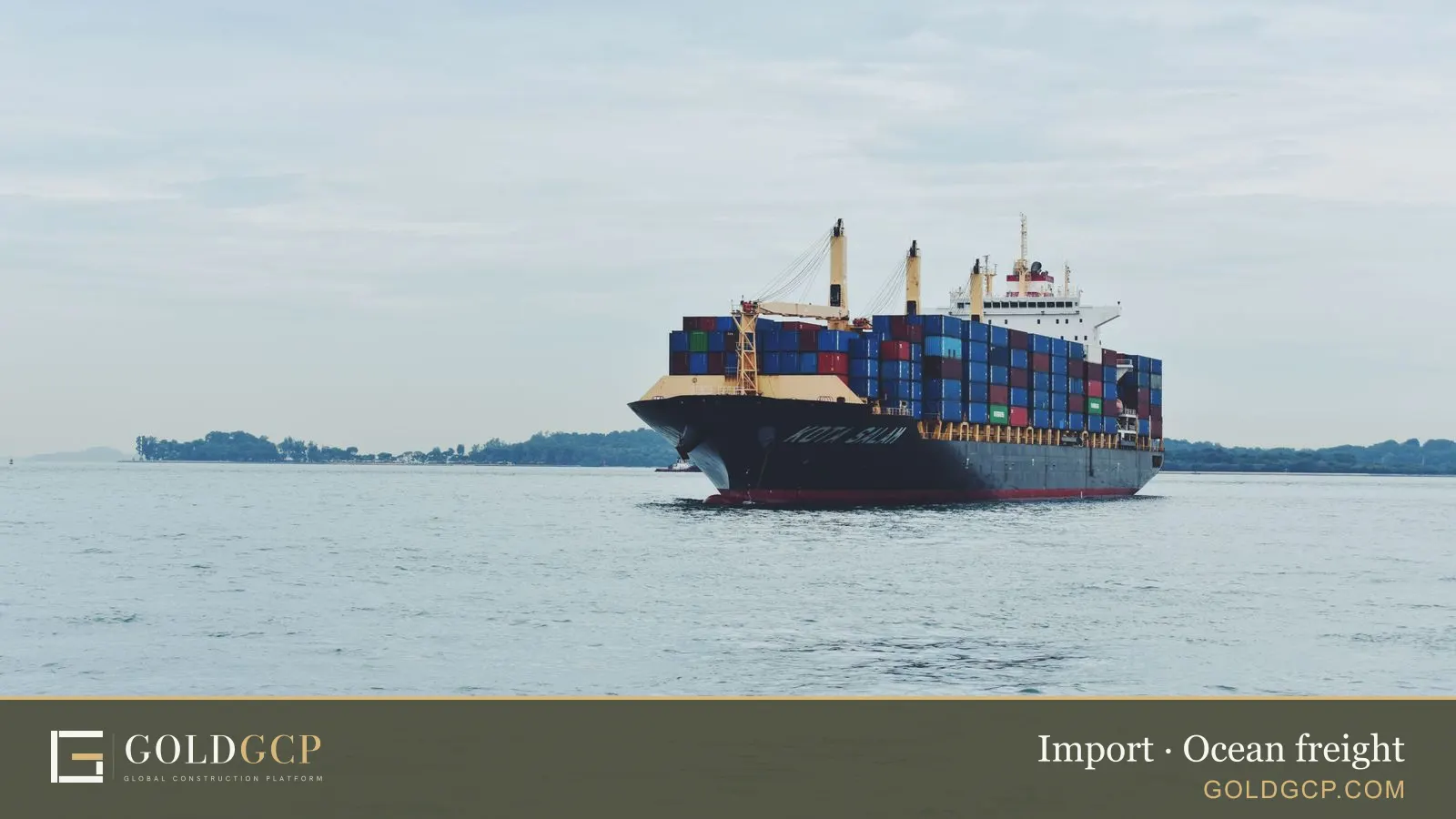
Most imported building materials cross the ocean in steel containers. You either book a whole container (FCL), priced per box, or share one with other shippers (LCL), priced by cubic meter or metric ton, whichever is larger. From Shanghai, published estimates put port-to-port transit at 27 to 36 days to Los Angeles and 43 to 56 days to New York.
| Job | US average (typical range) | Typical |
|---|---|---|
| 20 ft container freight (estimate) | $3,000–$5,500 | $4,200 |
| 40 ft container freight (estimate) | $4,000–$7,500 | $5,500 |
| Shared container (LCL) freight | $900–$2,000 | $1,400 |
| Air freight | $3,000–$9,000 | $6,000 |
| Inland delivery to the jobsite | $350–$1,500 | $750 |
US national averages for 2026, labor and standard materials included, from published cost guides (sources at the end of this page). Local prices differ: see the city table below, or enter your ZIP code in the calculator.
Those ranges are budgeting estimates. Ocean rates move week to week, so any quote you act on should carry a date and an expiry.
FCL vs LCL at a glance
| Full container load (FCL) | Less than container load (LCL) | |
|---|---|---|
| How it's priced | A flat rate per container, plus charges layered on top | Per chargeable unit: the larger of cubic meters (CBM) or metric tons |
| Who else is in the box | Nobody; the container is yours | Cargo from other shippers |
| Handling | Loaded at origin, sealed, opened at destination | Packed at a consolidation warehouse, unpacked at a destination warehouse |
| Transit, Shanghai to Los Angeles (Freightos estimate) | 27 to 36 days | 29 to 41 days |
| Transit, Shanghai to New York (Freightos estimate) | 43 to 56 days | 45 to 61 days |
| Damage risk | Lower, fewer touches | Higher, more handling at both ends |
| Fits | Large orders, heavy or fragile goods | Small orders, samples, mixed small shipments |
How LCL is billed
LCL uses a rule called weight or measure (W/M). The carrier compares the shipment's volume in cubic meters with its weight in metric tons and charges on whichever number is larger. One cubic meter counts the same as 1,000 kg.
- Two pallets of boxed light fixtures at 4 CBM and 600 kg are billed as 4 units, because volume wins.
- Two crates of stone tile at 1.5 CBM and 2,400 kg are billed as 2.4 units, because weight wins.
Freightos marketplace estimates, read on October 1, 2026, show how LCL scales from Shanghai:
| LCL volume | To Los Angeles | To New York |
|---|---|---|
| 1 CBM | $826 to $1,101 | $930 to $1,240 |
| 5 CBM | $1,704 to $2,272 | $2,043 to $2,724 |
| 10 CBM | $2,688 to $3,584 | $3,320 to $4,427 |
The price per cubic meter drops as volume grows, and at some point a dedicated container becomes the cheaper option per unit. Where that point falls depends on the week's FCL rate, so get both quotes once your shipment passes several cubic meters.
Container sizes and what they hold
Three dry container types carry nearly all building materials. Figures below come from Maersk's published equipment specifications:
| 20 ft standard | 40 ft standard | 40 ft high cube | |
|---|---|---|---|
| Internal length | 5,896 mm (19 ft 4 in) | 12,032 mm (39 ft 5 in) | 12,032 mm (39 ft 5 in) |
| Internal width | 2,350 mm (7 ft 8 in) | 2,350 mm (7 ft 8 in) | 2,350 mm (7 ft 8 in) |
| Internal height | 2,393 mm (7 ft 10 in) | 2,393 mm (7 ft 10 in) | 2,697 mm (8 ft 10 in) |
| Door opening height | 2,274 mm | 2,274 mm | 2,577 mm |
| Volume | 33 m3 (1,165 cu ft) | 67 m3 (2,366 cu ft) | 76 m3 (2,684 cu ft) |
| Maximum payload | 28,200 kg (62,170 lb) | 28,800 kg (63,493 lb) | 28,620 kg (63,100 lb) |
| Empty (tare) weight | 2,280 kg | 3,700 kg | 3,880 kg |
Carriers list slightly different payload figures on different documents, and Maersk notes that limits can vary by country. Confirm the limit on your booking.
Weight or space: which runs out first
Look at the payload row. A 40 ft container holds about twice the volume of a 20 ft, but almost the same weight. That decides which box you need:
- Dense materials such as porcelain tile, stone slabs and quartz reach the weight limit long before the container is full. They usually ship in 20 ft containers with empty space above the load.
- Bulky, lighter goods such as assembled cabinets, vanities, windows and doors fill the space first. A 40 ft high cube gives about 13% more volume than a standard 40 ft for the same footprint, and its taller door helps with tall crates.
US road limits matter too
The container's sea payload is not the end of the story. The truck that takes it from the port has to stay legal. Federal limits on the Interstate system are 80,000 lb gross vehicle weight, 20,000 lb on a single axle and 34,000 lb on a tandem axle group, and states set rules for other roads. Truck, chassis and container all count toward that total, so a container loaded to its full sea payload may be too heavy to drive away without a permit or special equipment. Plan the load weight with the trucking leg in mind. The jobsite delivery page covers the last leg.
Transit times on the main lanes
Freightos route pages give these port-to-port estimates from Shanghai, read on October 1, 2026:
| Route | FCL | LCL |
|---|---|---|
| Shanghai to Los Angeles | 27 to 36 days | 29 to 41 days |
| Shanghai to New York | 43 to 56 days | 45 to 61 days |
Three things to add to those numbers:
- Production time at the factory, which is often longer than the voyage.
- Time to get the container to the origin port and loaded, and to clear it and truck it out at the US end.
- Holidays and schedule changes. Carriers cancel sailings, called blank sailings, when demand drops. Drewry noted 15 blank sailings scheduled in the run-up to China's Golden Week holiday in early October 2026.
West Coast ports are closer to Asia. East Coast ports are closer to many US jobsites. The cheaper ocean leg is not always the cheaper total once inland trucking is counted, so compare landed cost to the jobsite, not port-to-port price.
What drives the price of a container
The base rate
Spot rates swing widely. Drewry's World Container Index for September 24, 2026 put Shanghai to Los Angeles at $7,838 per 40 ft container, up 2% on the week, and Shanghai to New York at $10,373. The global composite was $4,468 per 40 ft. Drewry pointed to tension in the Red Sea and constraints at the Panama Canal among the pressures on rates. These are spot benchmarks for one week, so treat them as a snapshot and check the current index before you budget.
Surcharges and local charges
The base rate is only part of the invoice. Common additions include:
- A fuel surcharge, often called BAF
- General rate increases (GRI) announced by carriers
- Terminal handling charges (THC) at origin and destination
- Documentation fees
- For LCL, warehouse handling to pack and unpack the shared container
Demurrage and detention
Ports and carriers give a set number of free days. After that, demurrage is charged while a full container sits at the terminal, and detention is charged while you keep the carrier's container outside the terminal. These charges can add up fast on a delayed customs release or a jobsite that isn't ready. Since May 28, 2024, a Federal Maritime Commission rule requires ocean carriers and terminal operators to send these invoices within 30 calendar days of when the charges were last incurred, and gives the billed party at least 30 days to ask for a reduction, refund or waiver. Invoices can only go to the party that contracted for the service or to the consignee.
US fees tied to ocean cargo
Two items apply to ocean shipments specifically. The Harbor Maintenance Fee is 0.125% of the cargo value and is charged only on ocean cargo. The Importer Security Filing must reach CBP at least 24 hours before the container is loaded at the foreign port, and violations can cost $5,000 each. The import hub lists the other fees, and the customs clearance page explains the entry.
Who can book ocean freight in the US
In the US, the Federal Maritime Commission regulates ocean transportation intermediaries. These are ocean freight forwarders, who arrange shipments and prepare documents for shippers, and non-vessel-operating common carriers (NVOCCs), who issue their own bills of lading without running ships. US-based companies acting as either must hold an FMC license and show financial responsibility, and NVOCCs must publish their tariffs. Before you hand cargo to a company, you can check its status in the FMC's published lists.
Reducing ocean freight cost per unit
- Fill the container. Coordinate order sizes with your supplier so the load is close to the weight or volume limit, whichever comes first.
- Combine suppliers. Several small orders can be consolidated into one container at origin. The warehousing and consolidation page explains how.
- Pack tight. Standard carton sizes and pallet patterns reduce wasted space, which matters most for cabinets and windows.
- Book early and avoid peak weeks around major holidays at origin.
- Plan the US end. Have the customs filing ready and the delivery booked, so the container doesn't sit through its free days.
Estimate your landed cost
Freight is one of several lines in the total. Enter the shipping method and values to see the full picture.
The standalone landed cost calculator gives the same estimate on its own page.
How GOLDGCP works for ocean shipments
Shipping is one stage of the GCP Source & Ship import service, which runs from sourcing and factory inspection through shipping, customs clearance and delivery to the jobsite.
- After the goods pass factory inspection, GOLDGCP helps choose between a full container, a shared container or air freight based on weight, volume and schedule.
- The ocean booking, ISF timing and customs entry are lined up before the cargo sails.
- On arrival, the goods clear customs and are trucked to your site or held for consolidation.
The overseas sourcing guide covers the steps before production. For the install, GOLDGCP matches you with 3 vetted, licensed pros, and prices are shown by ZIP code before anyone visits.
Frequently asked questions
When should I choose FCL instead of LCL?
When the shipment is large enough that a full container costs less per unit, or when the goods are heavy or fragile. FCL stays sealed from origin to destination, which avoids the extra handling of a shared container. Compare both quotes once you pass several cubic meters.
How much does a 20 ft container hold?
Maersk lists 33 cubic meters of volume and a maximum payload of 28,200 kg for a 20 ft standard container. Heavy materials such as tile and stone usually reach the weight limit before the box is full.
How long does ocean freight take from China to the US?
Freightos estimates 27 to 36 days port to port from Shanghai to Los Angeles by FCL, and 43 to 56 days to New York. Add factory production, port handling, customs and trucking for the full schedule.
What is the difference between demurrage and detention?
Demurrage is charged when a full container stays at the terminal past its free time. Detention is charged when you keep the carrier's container outside the terminal too long. Both start after the free days set by the carrier or terminal.
Why did my ocean freight quote change?
Spot rates move with demand, fuel costs, blank sailings and route disruptions. Drewry's index showed Shanghai to Los Angeles rising 2% in one week in September 2026. Quotes are usually valid only for a short window.
Does a full container weigh too much to truck?
It can. Federal Interstate limits are 80,000 lb gross vehicle weight, and the truck, chassis and container count toward it. Dense loads like stone may need to be planned below the sea payload limit.
How we calculate these prices
GOLDGCP starts from national price ranges for each job, taken from published 2026 cost guides and checked against local price guides where they exist. To get a local price, we multiply the national range by the construction cost factor for the metro from the U.S. Army Corps of Engineers Area Cost Factors (US average = 1.00). For ZIP codes outside the 50 largest metros, the calculator uses the state's price level from the Bureau of Economic Analysis Regional Price Parities. Ranges include labor and standard materials but not unusual site conditions, so a written quote after an inspection is always the final price.
Sources
- Our fleet: dry container equipment specifications · Maersk
- How to calculate ocean freight charges (FCL and LCL) · iContainers
- Shipping from Shanghai to Los Angeles · Freightos
- World Container Index, 24 September 2026 · Drewry, via DCN
- Ocean Transportation Intermediaries · Federal Maritime Commission
- FMC publishes final rule on detention and demurrage billing practices · Federal Maritime Commission
- Commercial Vehicle Size and Weight Program · Federal Highway Administration
- MPF and HMF fees explained · Peacock Tariff Consulting

About this guide
Written by the GOLDGCP editorial team. Prices come from national cost guides; rules and statistics come from the agencies and reports linked in the text. We update this page when prices or codes change.