What is a pre-shipment inspection for building materials?
Quick answer
A pre-shipment inspection is a check at the factory, once at least 80% of an order is finished, where an inspector pulls a random sample and compares it with your specification and approved sample. The sample size and pass limits usually follow ISO 2859-1 AQL tables. It is your last cheap chance to catch defects before the goods ship.
| Job | US average (typical range) | Typical |
|---|---|---|
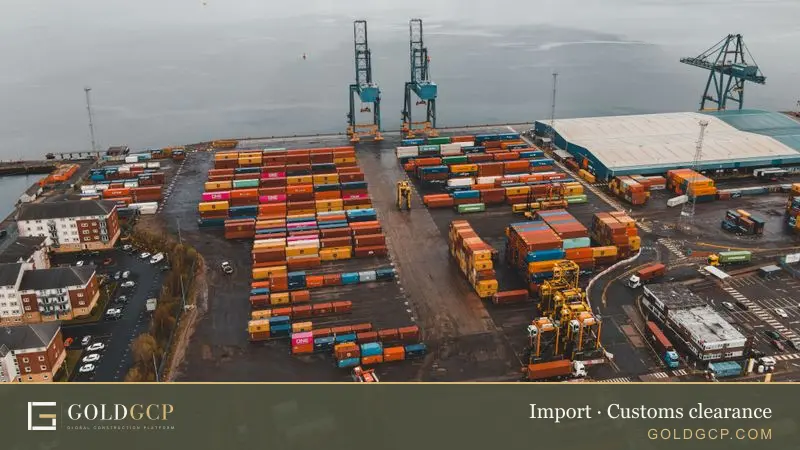
| 20 ft container freight (estimate) | $3,000–$5,500 | $4,200 |
| 40 ft container freight (estimate) | $4,000–$7,500 | $5,500 |
| Shared container (LCL) freight | $900–$2,000 | $1,400 |
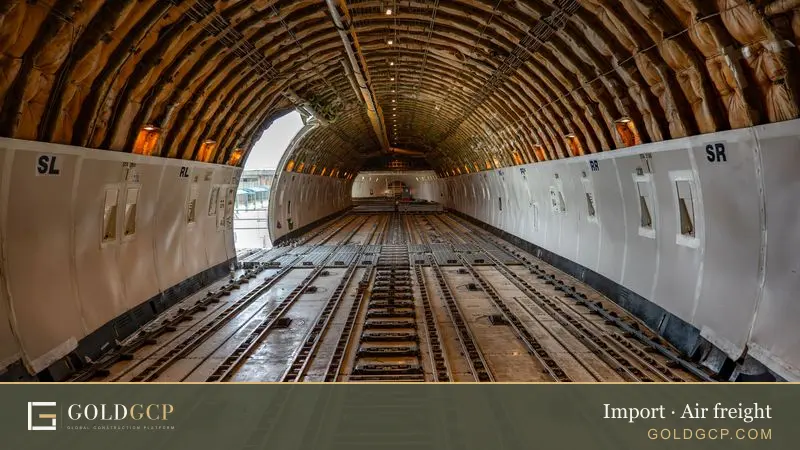
| Air freight | $3,000–$9,000 | $6,000 |
| Inland delivery to the jobsite | $350–$1,500 | $750 |
US national averages for 2026, labor and standard materials included, from published cost guides (sources at the end of this page). Local prices differ: see the city table below, or enter your ZIP code in the calculator.
Inspection is a small line in that table compared with freight and duties. Its value is in what it prevents: a container of off-shade tile or cabinets with the wrong hinges costs far more to fix once it reaches a US port.
The inspection types and when each one fits
Quality control on an import order is a series of checks, each at a different point in production. You don't need all of them on every order.
| Check | When it happens | What it tells you |
|---|---|---|
| Factory audit | Before you place the order | Whether the supplier is a real manufacturer with the equipment, staff and quality system to make your product |
| Initial production check (IPC) | As production starts | Whether raw materials and the first units match the approved sample |
| During production inspection (DUPRO) | Partway through the run | Whether defects are appearing while there is still time to correct the line |
| Pre-shipment inspection (PSI) | When at least 80% of the order is complete | Whether the finished, packed goods meet the specification |
| Container loading check (CLC) | While the container is loaded | Whether the right quantity and items go in, packed and stacked properly |
For a first order with a new factory, a factory audit plus a pre-shipment inspection is the usual minimum. Add a during-production check on long or custom runs, such as a full kitchen package or a large window order, where finding a problem at the end would mean weeks of rework. A loading check makes sense for fragile loads like stone slabs and glass, where poor bracing causes most of the damage.
Factory audits in more detail
Audits look at the supplier, not at a single batch of product. Published inspection firms describe a few common types:
- A factory verification audit confirms the company exists, holds the right license, operates at the stated address and has production capacity. It is typically one man-day.
- A factory technical audit reviews equipment, processes and the quality management system in more depth. It is typically two man-days.
- A social compliance audit, such as a SMETA audit, looks at labor conditions and usually takes two to four days on site plus reporting time.
Social and supply chain checks have become more relevant for US importers. Under the Uyghur Forced Labor Prevention Act, CBP presumes that goods made wholly or partly in Xinjiang, or by listed entities, are barred from entry unless the importer proves otherwise with clear and convincing evidence. An audit alone doesn't meet that bar, but it helps you start the tracing file.
How AQL sampling works
Checking every tile in a container is slow and expensive, and an inspector's attention fades after hours of repetitive work. Instead, inspections use statistical sampling. More than 95% of random sampling inspections follow ISO 2859-1, or its American counterpart ANSI/ASQ Z1.4, according to QualityInspection.org. Both replaced the older military standard MIL-STD-105E.
The method has two separate settings you choose as the buyer:
- The inspection level, which sets how many units are pulled from the lot.
- The acceptance quality limit (AQL) for each defect class, which sets how many defective units are allowed in that sample before the lot fails.
Inspection levels
ISO 2859-1 has three general levels and four special levels.
- Level II is the default for most visual inspections.
- Level I checks fewer units. It can suit a supplier with a clean track record, but it finds fewer problems.
- Level III checks more units. It fits a supplier with recent quality problems or high-value goods.
- Special levels S-1 to S-4 use very small samples. They are meant for tests that are slow or destroy the sample, and for quick checks during container loading.
Sample size grows with lot size and with the level. Two worked examples published by QualityInspection.org:
| Order size | Level I | Level II | Level III | S-1 | S-2 | S-3 | S-4 |
|---|---|---|---|---|---|---|---|
| 5,000 pieces | 80 | 200 | 315 | 5 | 8 | 20 | 32 |
| 40,000 pieces | 200 | 500 | 800 | 8 | 13 | 32 | 80 |
At level II the standard assigns a code letter by lot size. A lot of 1,201 to 3,200 units is code K with 125 samples, 3,201 to 10,000 units is code L with 200 samples, and 10,001 to 35,000 units is code M with 315 samples.
Defect classes and AQL limits
Inspectors sort each defect found into one of three classes:
- Critical: a safety, legal or regulatory problem, such as a missing required label or a hazard to the installer or user.
- Major: a defect likely to make the product fail or not fit for use, such as a cabinet door that won't close or a tile outside its size tolerance.
- Minor: a cosmetic flaw that doesn't affect use, such as a small surface mark.
Common limits are 0 for critical defects, 0.65% to 2.5% for major defects and 2.5% to 4.0% for minor defects. A frequently used combination is AQL 2.5 for major and 4.0 for minor.
A worked example
QCADVISOR publishes this example for a lot of 1,500 units at level II:
- Code letter K, so the inspector checks 125 units.
- Major defects at AQL 2.5: the lot passes with 7 or fewer major defects and fails at 8.
- Minor defects at AQL 4.0: the lot passes with 10 or fewer and fails at 11.
- Critical defects: any single critical defect fails the lot.
Note what this means in practice. A pass at AQL 2.5 does not mean the lot has zero defects. It means the sample was within the limit you agreed to. If you need tighter quality, pick a lower AQL or a higher level, and accept that the inspection will take longer.
What to inspect for each material
Generic checklists miss the problems that matter most for building products. Give the inspector a checklist written for your item, with the approved sample as the reference.
Tile
- Shade and caliber (size) consistency, both within a box and across production batches
- Flatness and warpage, edge chips and surface pinholes
- Box labels showing size, shade and batch, so installers don't mix lots
Natural stone and quartz
- Slab and tile thickness at several points
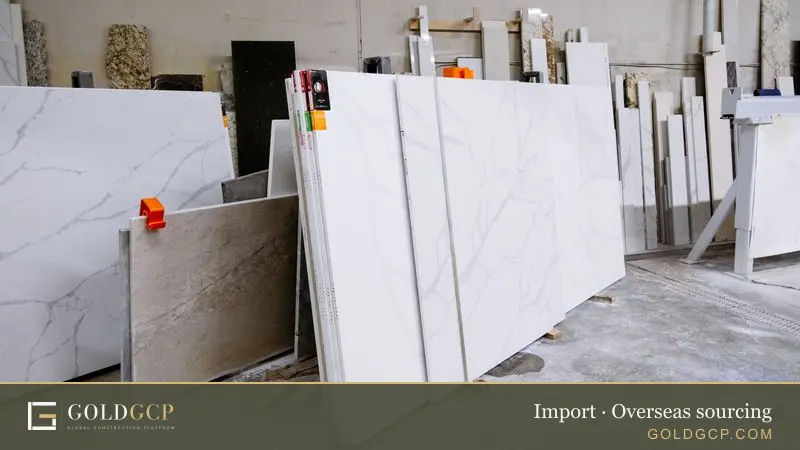
- Cracks, fills and resin repairs, polish level, edge profiles
- Crating and bracing strong enough for the weight
Cabinets and vanities
- Box dimensions and squareness, door and drawer alignment
- Hinge, slide and hardware function through repeated cycles
- The TSCA Title VI label: EPA requires hardwood plywood, MDF, particleboard and finished goods containing them to be certified and labeled by an EPA-recognized third-party certifier
Windows and doors
- Overall and rough-opening dimensions, glass build, seals and weatherstripping
- Operation of sashes, locks and hinges
- Labels and documents matching the ratings your project needs (the windows guide explains those ratings)
Plumbing and lighting fixtures
- Finish quality, threads and connections, included parts
- Function checks such as running water or switching on a lamp
- Certification marks and packaging strength
What inspections cost
Inspection and audit firms price by the man-day: one inspector working one full day on site. Published figures give a sense of scale:
| Item | Published figure |
|---|---|
| Factory audit, most of Asia (QCADVISOR) | from USD 280 per man-day |
| Factory audit, Taiwan and South Korea (QCADVISOR) | USD 380 per man-day |
| Other published audit rates (cited by QCADVISOR) | about $188, about $238 and $398 per man-day |
| Premium audit models (cited by QCADVISOR) | $900 or more per man-day |
What pushes the cost up:
- Sample size. A higher level or a larger lot means more units to check and more days. In the 40,000-piece example above, the inspection might take one day at a reduced level, two days at level II and three at level III.
- Location. Some firms include travel to major manufacturing areas and charge extra for remote sites.
- Test scope. Function tests, measurements on every sample and lab tests add time.
- Reporting. Some firms bill desk review and report writing separately from the site day.
Ask any inspection firm what its man-day includes before comparing quotes.
What to do when a lot fails
A failed inspection can still be fixed cheaply as long as the goods haven't left the factory. Typical next steps:
- Read the report with photos and decide whether the defects are real failures against your spec or a disagreement about the standard.
- Ask the factory to sort and rework the lot, replacing defective units.
- Order a re-inspection. Agree in the contract that the supplier pays for re-inspection after a failure.
- Hold the balance payment until the lot passes. This is your main leverage, so write it into the purchase order.
The overseas sourcing guide covers how to build these terms into the contract before production starts.
Estimate the full cost of your order
Inspection fees, freight, duties and fees all add to the factory price. Put your numbers into the calculator to see the landed total.
The same tool is available as a standalone landed cost calculator.
How GOLDGCP works for inspections
Factory inspection is one stage of the GCP Source & Ship import service, which also covers sourcing, shipping, customs clearance and delivery to the jobsite. In practice:
- You approve the specification and the reference samples.
- GOLDGCP agrees the inspection level, AQL limits and material checklist with you before production.
- Goods are inspected at the factory before they ship, and you see the findings before the order moves.
- Goods that pass go on to ocean freight or air freight, then customs clearance and delivery.
When the materials arrive, GOLDGCP can match you with 3 vetted, licensed pros for the installation. Payment for that work is made in milestones, each paid after you approve the stage. See the import hub for the full service.
Frequently asked questions
When should a pre-shipment inspection happen?
When at least 80% of the order is finished and packed. That way the inspector can sample finished goods and check packing and labels, while the factory still has time to fix problems before the ship date.
What AQL should I use for building materials?
A common setup is level II sampling with AQL 2.5 for major defects, 4.0 for minor defects and zero tolerance for critical defects. Use a lower AQL or level III for a supplier with recent problems or for high-value products.
How many units will the inspector check?
It depends on the lot size and level. At level II, a lot of 3,201 to 10,000 units needs 200 samples, and a lot of 10,001 to 35,000 units needs 315. Special levels use far smaller samples for slow tests.
How much does a factory inspection cost?
Inspection and audit firms charge per man-day. One firm publishes factory audits from USD 280 per man-day across most of Asia, and published rates elsewhere range from under $200 to over $900. Ask what travel and reporting are included.
Is a factory audit the same as an inspection?
No. An audit evaluates the supplier, its license, equipment, processes and labor conditions, usually before you order. An inspection checks a specific batch of product against your specification, usually just before shipment.
Does passing inspection mean there are no defects?
No. Passing means the sample stayed within the AQL limits you agreed to. A small number of defective units can still be in the lot. Tighter limits or a higher inspection level reduce that risk at a higher cost.
How we calculate these prices
GOLDGCP starts from national price ranges for each job, taken from published 2026 cost guides and checked against local price guides where they exist. To get a local price, we multiply the national range by the construction cost factor for the metro from the U.S. Army Corps of Engineers Area Cost Factors (US average = 1.00). For ZIP codes outside the 50 largest metros, the calculator uses the state's price level from the Bureau of Economic Analysis Regional Price Parities. Ranges include labor and standard materials but not unusual site conditions, so a written quote after an inspection is always the final price.
Sources
- Pre-Shipment Inspection · QIMA
- How the AQL inspection levels in ISO 2859-1 affect sampling size · QualityInspection.org
- Acceptable Quality Limit: definition, charts and examples · QCADVISOR
- AQL chart and table: sample size codes · Tetra Inspection
- How much does a factory audit cost? · QCADVISOR
- Formaldehyde Emission Standards for Composite Wood Products · U.S. Environmental Protection Agency
- Uyghur Forced Labor Prevention Act · U.S. Customs and Border Protection

About this guide
Written by the GOLDGCP editorial team. Prices come from national cost guides; rules and statistics come from the agencies and reports linked in the text. We update this page when prices or codes change.