How do you find and vet an overseas factory for building materials?
Quick answer
Start with a written product specification, then shortlist factories that actually make that product, verify their license and certificates, audit the site, and approve physical samples before you pay a deposit. Agree on an Incoterms 2020 rule so everyone knows where cost and risk change hands. As the US importer, you remain responsible for classification, marking and compliance.

| Job | US average (typical range) | Typical |
|---|---|---|
| 20 ft container freight (estimate) | $3,000–$5,500 | $4,200 |
| 40 ft container freight (estimate) | $4,000–$7,500 | $5,500 |
| Shared container (LCL) freight | $900–$2,000 | $1,400 |
| Air freight | $3,000–$9,000 | $6,000 |
| Inland delivery to the jobsite | $350–$1,500 | $750 |
US national averages for 2026, labor and standard materials included, from published cost guides (sources at the end of this page). Local prices differ: see the city table below, or enter your ZIP code in the calculator.
The table above shows working ranges for the import service as a whole. Sourcing itself is mostly time and attention. The money is lost later, when a weak supplier ships the wrong shade of tile or cabinets that fail a US rule.
Write the specification before you contact anyone
Factories quote what you ask for. A loose request such as "white shaker cabinets" gets a loose price and a product you can't hold the supplier to. A usable spec for building materials lists:
- Exact dimensions and tolerances, with drawings for anything custom
- Materials and grades (for example the panel type inside a cabinet box, the glass build of a window, the finish of a faucet)
- Color, shade or veining standard, ideally tied to a physical reference
- US compliance needs: formaldehyde certification for composite wood, energy and impact ratings for windows, certifications for plumbing fixtures
- Packing method, carton marks and labels
- Quantity, target delivery date and the destination in the US
This document becomes the yardstick for samples, inspections and any dispute. Keep it versioned and send the final copy with the purchase order.
Where buyers find overseas suppliers
Most importers build a long list from several channels and then cut it hard:
- B2B sourcing platforms, which list thousands of sellers but mix real manufacturers with resellers.
- Trade fairs, where you can handle products and meet the sales team in person.
- Referrals from other contractors, distributors or architects who already buy abroad.
- Sourcing agents based in the producing country, who know the local factory clusters.
Whatever the channel, treat a listing as a lead, never as proof. Badges and ratings on a platform tell you little about the factory floor.
Factory or trading company?
A trading company buys from factories and resells. That can be useful for small mixed orders, because one trader can combine tile, lighting and hardware from different plants. The trade-off is less control: you may not know which factory made your goods, and quality can change when the trader switches suppliers. A manufacturer gives you direct access to production but usually asks for larger orders. Ask directly, then confirm with the business license and a site visit. A company whose license does not cover manufacturing, or whose "factory" photos don't match the address, is reselling.
A supplier vetting checklist
Run these checks in order. Each one is cheaper than the next, so drop weak suppliers early.
- Business license and scope. Ask for a copy and check that the registered scope covers making the product you are buying.
- Management system certificates. If a supplier claims ISO 9001 or similar, look the certificate up in IAF CertSearch, the International Accreditation Forum's database. It shows whether the certificate is valid, what scope it covers, which sites are included and which body issued it.
- Product certificates. For cabinets, vanities and other products made with hardwood plywood, MDF or particleboard, EPA's TSCA Title VI rule requires certification and labeling by an EPA-recognized third-party certifier. Ask for the certifier's name and the label format before you order. For windows, doors and plumbing fixtures, ask for the test reports that match the US ratings your project needs.
- Forced labor exposure. Under the Uyghur Forced Labor Prevention Act, CBP presumes that goods made wholly or partly in Xinjiang, or by an entity on the UFLPA Entity List, are barred from entry. Overcoming that presumption takes clear and convincing evidence, so ask suppliers early where their raw materials come from and whether they can document the chain.
- Factory audit. A third-party auditor visits the site. A basic factory verification audit is typically one man-day, and a technical audit that looks at equipment and quality systems is typically two. One published inspection firm lists factory audits from USD 280 per man-day across most of Asia.
- References. Ask for buyers in North America you can call, and ask those buyers about lead times, defects and how complaints were handled.
- Samples. Covered in detail below.
Minimum order quantity (MOQ)
The MOQ is the smallest order a factory will accept for a given item. It usually reflects how the plant runs: a tile line has to be set up for one glaze and size, a cabinet shop cuts panels in batches, and a window plant orders profiles and glass by the lot. Below that volume, setup cost per unit gets too high for the factory.
What MOQ means for you:
- A low MOQ often signals a trader or stock goods, which is fine for standard items but limits customization.
- A custom color, size or finish almost always carries a higher MOQ than a catalog item.
- The MOQ can apply per item, per color or per order. Ask which, because "500 units" across ten colors is a very different commitment from 500 per color.
- Some factories accept a smaller first order at a higher unit price. Get both prices in writing.
Match the MOQ to what fits your shipping plan. An order that barely fills part of a container may cost more per unit to ship than a slightly larger one. The ocean freight guide explains how full and shared containers are priced, and the warehousing and consolidation page covers combining orders from several suppliers.
Running the sample stage
Samples are where most sourcing problems show up, and they are cheap to fix at this point. Expect to pay for samples and their courier shipping. Three kinds matter:
- Stock samples come off the shelf and show general quality.
- Custom samples are made to your specification and show whether the factory can actually meet it.
- Approved (reference) samples are the ones you sign off. Keep one set yourself and leave one sealed set at the factory, so the inspector compares production against the same item.
What to check by material
| Material | What to look at in the sample |
|---|---|
| Porcelain and ceramic tile | Shade and size consistency across several pieces, flatness, edge chipping, surface finish, box labeling |
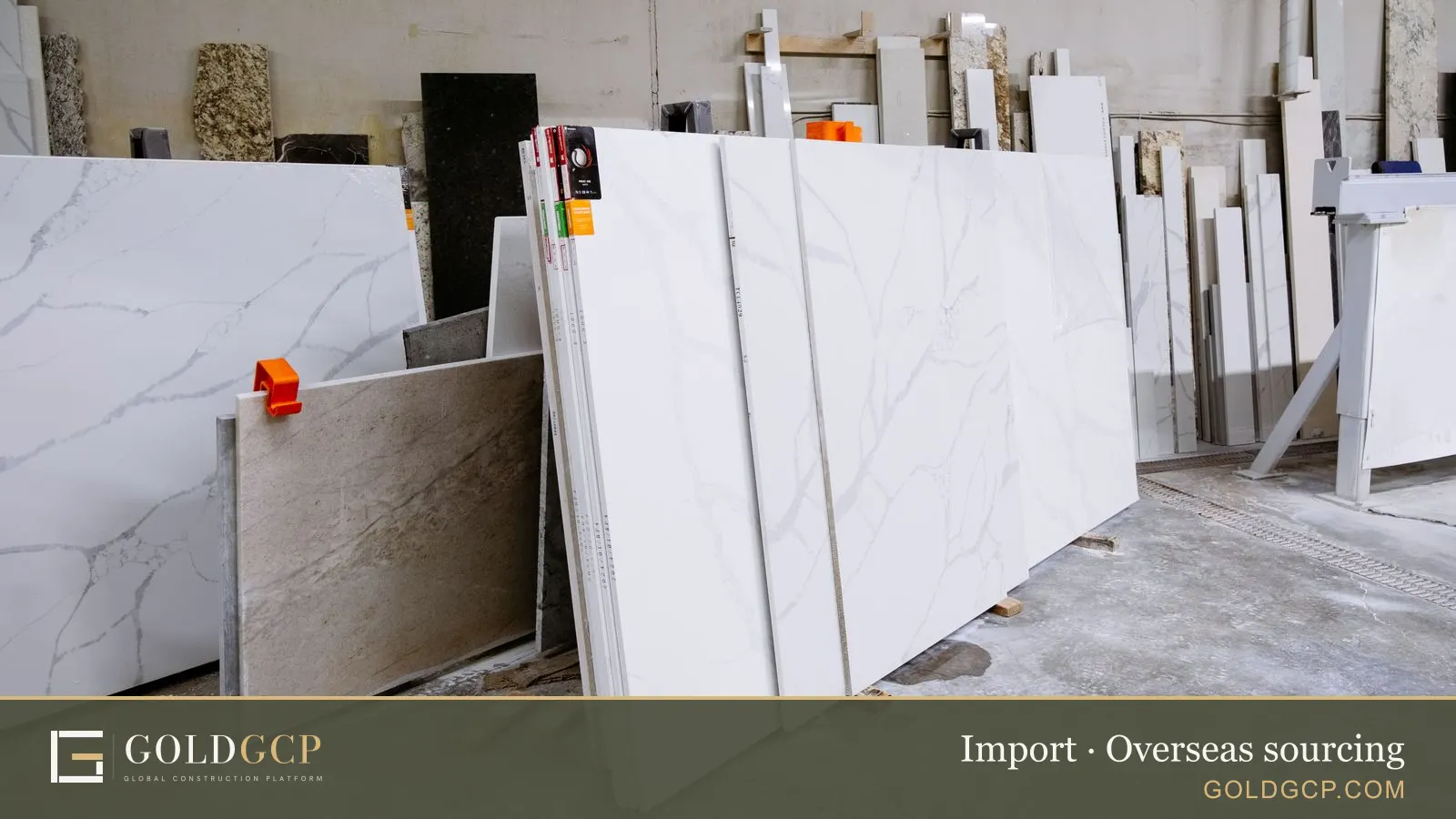
| Natural stone and quartz | Thickness, edge profile, polish, cracks or fills, how veining compares to your reference |
| Cabinets and vanities | Box construction, panel type and certification label, door finish, hinge and slide quality, assembly hardware |
| Windows and doors | Frame profile, glass build, hardware operation, labels needed for your project's ratings |
| Plumbing and lighting fixtures | Finish, threads and connections, included parts, certification marks, packaging strength |
Test the sample the way it will be used: install a few tiles, run water through a faucet, open and close a window. Write down every change you request and get a revised sample before production if anything structural changes.
Incoterms 2020: who pays and who carries the risk
Incoterms 2020, published by the International Chamber of Commerce, is a set of 11 three-letter trade terms. Each one says where the seller hands over the goods, who pays which costs and when the risk of loss moves to the buyer.
| Group | Rule | In short |
|---|---|---|
| Any mode of transport | EXW (Ex Works) | Goods made available at the seller's premises; buyer handles and risks everything after that |
| Any mode | FCA (Free Carrier) | Seller delivers to the buyer's carrier at a named place |
| Any mode | CPT (Carriage Paid To) | Seller pays carriage to the destination; risk passes at handover to the first carrier |
| Any mode | CIP (Carriage and Insurance Paid To) | As CPT, plus seller insures the goods |
| Any mode | DAP (Delivered at Place) | Seller delivers to the named place, ready for unloading |
| Any mode | DPU (Delivered at Place Unloaded) | Seller delivers and unloads at the named place |
| Any mode | DDP (Delivered Duty Paid) | Seller delivers cleared for import, with all costs and risks |
| Sea and inland waterway | FAS (Free Alongside Ship) | Seller places goods alongside the vessel |
| Sea and inland waterway | FOB (Free on Board) | Seller loads goods on board; risk passes once on board |
| Sea and inland waterway | CFR (Cost and Freight) | Seller pays sea freight; risk passes when loaded |
| Sea and inland waterway | CIF (Cost, Insurance and Freight) | As CFR, plus seller insures the goods |
FOB or FCA for containers?
Many building-material quotes come as FOB. The ICC itself points out a gap: with containerized goods, the seller usually hands the container over at the terminal, often before it is loaded on the ship, so FCA fits better. Under FCA the risk moves when the carrier receives the goods. The 2020 revision also lets the parties agree that the buyer will have the carrier issue an on-board bill of lading to the seller, which helps when a bank is involved in payment.
Insurance under CIF and CIP
If the seller buys the insurance, check the cover level. CIF only requires the minimum cover of Institute Cargo Clauses (C), while CIP now requires the broader Institute Cargo Clauses (A). For breakable goods such as glass and stone, the difference matters.
What Incoterms leave out
The rules don't set the price, describe the goods or fix payment method and timing. Your purchase contract still needs those terms, plus the specification, the approved sample, the inspection standard and what happens if goods fail inspection.
What the US importer is responsible for
Whoever acts as importer of record carries legal duties that a foreign supplier can't take off your hands, even under DDP.
- Reasonable care. CBP expects the importer of record to use reasonable care to enter, classify and value merchandise. Mistakes can delay release and lead to penalties.
- Classification. The duty rate depends on how the product is classified. CBP issues advance rulings that say how it will treat a planned import, which is useful before a large custom order.
- Country of origin marking. Imported articles, or their containers, must be marked with the English name of the country of origin, legibly and permanently. Unmarked goods can face an additional 10% duty. Put the marking requirement in your purchase order.
- Product rules. Certifications such as TSCA Title VI for composite wood apply no matter where the product was made.
The customs clearance page covers the entry process itself, and the import hub lists the fees that apply to every shipment.
Estimate your landed cost before you commit
A low factory price can disappear once freight, duties and fees are added. Use the calculator with the supplier's quote and your shipping plan.
You can also open the full landed cost calculator on its own page.
How GOLDGCP works for sourcing
The GCP Source & Ship import service covers sourcing, factory inspection, shipping, customs clearance and delivery to the jobsite, so the specification you approve at the start is the one checked at the end. For sourcing, that means:
- You share drawings, quantities and the project's US requirements.
- GOLDGCP shortlists factories for the product, whether that is tile, stone, cabinets, windows or fixtures, and runs the vetting checks above.
- Samples come to you for approval before production.
- Goods are inspected at the factory before they ship, as described on the quality inspection page.
- Shipping, customs clearance and delivery to your jobsite follow.
If you are planning a project around imported products, the windows guide and the kitchen guide explain what installation and local code review will involve. GOLDGCP serves all 50 states, and for the installation itself it matches you with 3 vetted, licensed pros who pass a six-step vetting process.
Frequently asked questions
How do I know if a supplier is a real factory?
Check that the business license scope covers manufacturing the product, confirm the address, and have a third-party auditor visit. A factory verification audit is usually one man-day. If the supplier can't show production lines making your item, you are likely dealing with a trading company.
What is a reasonable MOQ for building materials?
It depends on the product and how the factory runs its lines. Catalog items often have lower minimums than custom colors or sizes. Ask whether the MOQ applies per item, per color or per order, and get prices for both a trial order and a full run.
Should I pay for samples?
Usually yes, and it is worth it. Custom samples show whether the factory can meet your specification, and an approved sample becomes the reference for production and inspection. Keep one set and leave a sealed set at the factory.
Which Incoterm should I use for a container of tile?
Many suppliers quote FOB, but the ICC notes that FCA fits containerized goods better, because the seller usually hands containers over at the terminal before loading. Agree on the term in writing and name the exact place of delivery.
Can the supplier handle US customs for me under DDP?
Under DDP the seller takes on delivery costs, duties and risk. You still need to be sure the products meet US rules, are marked with their country of origin and are classified correctly, because noncompliant goods can be held at the border.
Do imported cabinets need a formaldehyde label?
Yes, if they contain hardwood plywood, MDF or particleboard. EPA's TSCA Title VI rule requires those products, and finished goods containing them, to be certified and labeled by an EPA-recognized third-party certifier.
How we calculate these prices
GOLDGCP starts from national price ranges for each job, taken from published 2026 cost guides and checked against local price guides where they exist. To get a local price, we multiply the national range by the construction cost factor for the metro from the U.S. Army Corps of Engineers Area Cost Factors (US average = 1.00). For ZIP codes outside the 50 largest metros, the calculator uses the state's price level from the Bureau of Economic Analysis Regional Price Parities. Ranges include labor and standard materials but not unusual site conditions, so a written quote after an inspection is always the final price.
Sources
- Know Your Incoterms · U.S. International Trade Administration
- Incoterms 2020 · International Chamber of Commerce
- Incoterms 2020: FAS or FOB? · ICC Academy
- How much does a factory audit cost? · QCADVISOR
- Uyghur Forced Labor Prevention Act · U.S. Customs and Border Protection
- Formaldehyde Emission Standards for Composite Wood Products · U.S. Environmental Protection Agency
- Reasonable Care: An Informed Compliance Publication · U.S. Customs and Border Protection
- 19 CFR Part 134: Country of Origin Marking · eCFR, National Archives

About this guide
Written by the GOLDGCP editorial team. Prices come from national cost guides; rules and statistics come from the agencies and reports linked in the text. We update this page when prices or codes change.